
Learn equine biosecurity basics for the farm, horse show, and breeding shed to protect your horses from infectious diseases.
— Read on thehorse.com/features/practical-biosecurity-tips-to-protect-your-horse/
Tag Archives: Equine worming

Microscopic Parasites in Equine
https://microscope-microscope.org

Diagnose and Track Your Horse’s Health with Your Phone
Carrying a smartphone or tablet is like having a spare brain in your pocket, one that helps you keep track of all the details in your busy life. At the barn, that device can also help you keep your horse healthy.
Health Data in Your Hand
The latest tool for this task is Horse Health Tracker, a smartphone app released by Equine Guelph, the horse-focused education and research center at the University of Guelph in Ontario, Canada. It’s designed to help you monitor vital health information for your horse.
The heart of the app is the Horse Health Check feature. It guides you through a 16-point health checklist that covers the horse from ears to hooves. Videos show you how to monitor heart rate and other vital signs. You can record results as often as you like, even several times a day, which makes this feature important for monitoring a sick horse.
Other features in the app help you determine and record the horse’s body condition score or estimate his body weight. A video library gives you quick access to all the instructional videos presented in the app. The app retains data from each health tool for 13 months and it will generate graphs so you can compare the results over time. Built-in email capability allows you to send the data directly to your veterinarian or others. You can also enter reminders for vet and farrier visits and other appointments. If you want, the app will sync the reminders with your smartphone’s calendar.
Horse Health Tracker is available for download at the App Store and Google Play. The basic version, which is free, allows you to track information for one or two horses. Upgrades ($4.59 to $11.99) can handle as many as 50 horses. Each horse is tracked separately, and you can add pictures taken with your device to the records. A user guide is online at equineguelph.ca.
Five-Minute Parasite Egg Counts
Does your horse need deworming right now or can he wait until fall? Soon a smartphone may help answer that question, thanks to an innovative new fecal-testing system developed in collaboration with scientists at the University of Kentucky.
Current veterinary guidelines call for individualized deworming programs, using fecal testing to determine the best intervals between treatments and to gauge whether the drugs you’re using are effective. The tests look for the eggs of strongyles, ascarids and some other parasites in manure samples. You collect a sample and send it to a lab (directly or through your veterinarian), where a technician prepares a slide, views it with a microscope and manually counts each visible egg with a clicker. This work requires skill and training, and the results take some time. Generally you’ll wait a week to 10 days for the them to come back.

The new Parasight imaging unit attaches to a smartphone. Veterinarians can use it in the field to get immediate information about a horse’s parasite load. | Courtesy, MEP Equine Solutions, LLC
The new system, called Parasight, shortens that time to less than five minutes. This means that vets can use it in the field to get real-time information about parasite loads. The system includes a smartphone app, an imaging unit (a simple device that attaches to a smartphone) and a kit for prepping manure samples. Samples are first treated with chemicals that cause parasite eggs to glow under blue light. Then they are placed in the imaging unit and photographed with a smartphone.
The smartphone app counts the glowing eggs and emails the results to the veterinarian, along with recommendations for treatment. It can distinguish between different types of parasite eggs and is as accurate as traditional lab tests, the developers say. A companion follow-up kit, which gives less detailed information, is intended for horse owners to use in monitoring the effectiveness of treatment.
MEP Equine Solutions, LLC, the Lexington, Kentucky, company that developed the Parasight System, expects to have a commercial version on the market within a year. Last spring, the company was awarded a $100,000 Small Business Innovation Research grant from the U.S. Department of Agriculture to help move the process along. The people behind the company include Chief Scientific Officer and Co-founder Paul Slusarewicz, PhD, an adjunct professor at the University of Kentucky’s Gluck Equine Research Center who focuses on the commercial development of new animal-health technologies. MEP’s other co-founders are company President Eric Hauk, a businessman, and Technical Adviser Martin Nielsen, DVM, PhD, an international expert in parasitology research who is an assistant professor at the Gluck Center.—Elaine Pascoe
This article originally appeared in the July 2015 issue of Practical Horseman.

Cleanliness is Next to Godliness
WHY IS IT IMPORTANT TO KEEP YOUR FEED ROOM CLEAN?
- Making sure that the feed is not expired!
- To ensure that nothing is rotting or moldy: Mold spores cause colic. Colic, well, is not only expensive but deadly.
- To keep wildlife out: Many little critters carry diseases that can seriously impair your horse’s health. Diseases such as EPM is passed through opossum urinating on feed, hay, grass, etc and your horse ingesting it.
- Checking the feed bins: Ensuring that all feed bins are sealed and have no holes or ways for wildlife to crawl inside. This is also important to ensure that the containers are air tight so that mold and other bacteria doesn’t get in or grow.
- Supplements and Medications: Checking the dates on medications and supplements to ensure that they are still safe to administer to your horse.
- Cleaning the feed buckets: This is important to make sure that there is no mold, fungus, bacteria etc growing on the inside of your buckets. It is also important if you have used any of your buckets to give medication or supplements to ensure another horse’s feed isn’t being contaminated.


RESOURCES
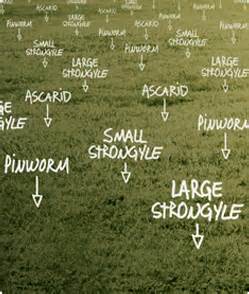
“I Guess I’ll Eat Some Worms…”
It was time for me to deworm my guys and I misplaced my “schedule”, so I decided to go online and print one. Bad idea! There are so many deworming schedules out there…it is easy to get overwhelmed.
I found a deworming quiz that was incredibly helpful when deciding what schedule and dewormers are right for my horse. The quiz & the below information was written by Karen Hayes (an Idaho-based equine practitioner) and was published in the June 1999 issue of Horse & Rider magazine. –
See more at: http://www.equisearch.com/artic/eqdeworm321#sthash.7cTzzRGc.dpuf
QUIZ: Now see how you score on the following eight questions to determine which program is right for your horse.
1. Does your horse graze on pasture all year, increasing his chances of exposure to parasite larvae? (Yes=2. No=0.)
2. Do other horses, on different or unknown deworming programs, graze on the same pasture, increasing your horse’s chances of ingesting parasite larvae? (Yes=3. No=0.) – See more at: http://www.equisearch.com/article/eqdeworm321#sthash.7cTzzRGc.dpuf
3. Does your horse nibble grass at other stables or public horse facilities-such as show grounds, fairgrounds, campgrounds, and/or highway rest stops-increasing his chances of ingesting parasite larvae? (Yes=5. No=0.)
4. Has your horse ever shown signs of heavy worm infestation? (Symptoms include a poor haircoat, weight loss, recurrent colic, or sloppy manure; or a fecal egg count of more than 100 eggs per gram.) (Yes=4. No=0.)
5. Is the collected manure at your horse’s facility spread on the pasture as fertilizer, increasing the chance of parasite larvae in his grazing pastures? (Yes=3. No=0.)
6. Is “dropped” manure in your horse’s grazing areas spread out with a harrow at least once a year? (Yes=3. No=0.)
7. Do you have a hard time keeping track of which dewormers can be used in a rotation program-possibly disrupting a purge program?(Yes=2. No=0.)
8. Do you delay scheduling your horse’s regular-care appointments, such as farriery, dentistry, vaccinations, and deworming? (Yes=3. No=0.)
Here’s what your total score means:
0-8: Your horse’s management and general condition are good enough that a well-timed purge program probably is adequate. It’ll minimize parasite eggs in his manure, and his risk of internal damage from worm larvae picked up in the environment is probably minimal. (Exception: If you answered “yes” to questions 3, 4, and/or 5, risk of damage increases; consider a daily dewormer.)
8-15: You’re in a gray area. Although a well-timed purge program will minimize worm eggs in your horse’s manure, other factors- such as a high concentration of parasite larvae in his environment- may expose him to internal damage.
15-25: Your horse is exposed to high levels of parasite eggs and larvae in his environment. Use a daily dewormer to protect him from internal damage caused by larvae migration. – See more at: http://www.equisearch.com/article/eqdeworm321#sthash.7cTzzRGc.dpuf
Target Troublemakers
Whether you choose purge or daily deworming, you won’t kill some dangerous parasites unless you take additional steps. These troublemakers are bots, tapeworms, and encysted cyathostomes (one of the most destructive immature forms of small strongyles).
Here’s a general program to fight these parasites, but check with your vet to develop a program right for your horse and your particular area.
Bots. Ivermectin and moxidectin are the only available products effective against bots. In a purge deworming program, you can kill two birds with one stone by using one of these products on your regular late-fall and spring treatment dates. Time of year is critical, because fall’s’ first frost kills bot flies, giving you a leg up on reducing their population-especially if you follow up in the spring. Here’s what to do: After first frost, remove/kill any remaining bot eggs or larvae on your horse’s legs with a bot block or knife. Then use a purge dewormer to get rid of adult bots in his system. In spring, remove/kill any external eggs or larvae you may’ve missed in the fall, and deworm him again to zap any adult bots in his stomach before they lay eggs. Then you’ll start bot season (spring through early fall) with a clean slate.
If your horse is on a daily program, give him a dose of ivermectin or moxidectin in early spring and again in late fall, in addition to the daily dewormer.
Tapeworms. Some investigators believe daily deworming effectively controls tapeworms, but the evidence is conflicting. As an extra measure, you have three options:
1) give pyrantel pamoate (Strongid P or T), at twice the usual dose, 2 days in a row;
2) give pyrantel tartrate (daily dewormer), at 10 times the usual daily dose, 2 days in a row; or
3) use of the canine tapeworm medication prazi-quantel (Droncit), which your vet can prescribe for oral use in your horse (about $45 a dose).
You can use options one or two to replace your horse’s regular deworming treatments in spring and fall. Give Droncit in addition to the regular deworming treatment, but on a different day, to avoid possible drug interactions.
Encysted cyathostomes. Prevent encysted cyathostomes by putting your horse on a daily deworming program, or kill them by:
1) using moxidectin as a spring and/or fall treatment in your purge deworming program; or
2) replacing a regular spring and/or fall purge treatment with fenbendazole at twice the usual dose, for five days in a row.
Daily verses Purge Programs
For daily programs, it’s critical that your horse gets his daily dose daily, as missed doses will decrease the levels of dewormer in his system, rendering it less effective- See more at: http://www.equisearch.com/article/eqdeworm321#sthash.7cTzzRGc.dp
For purge programs, timing is key. If you treat too early, targeted worms will be too immature to be affected by the dewormer. If you treat too late, adult worms will have the opportunity to produce eggs, infesting your horse’s environment and raising his (and other horses’) risk of exposure.
I hope the information was as helpful for you as it has been for me. For more information on worming and a comparison of the products available click the link below.
 The Chances We Take