Tag Archives: protazil

The Perfect storm

So, I wish I did not have to start this process again…but unfortunately, I do. Once again I have a senior horse with a variety of acute and chronic conditions that all hit at the same time. Right now I am trying to make her comfortable while also trying to figure out what is what and how to best respond.

Three months ago Tilly was tested for EPM due to muscle wasting and weight loss.The first time she was in the lower end of an active infection. We started a compounded medicine for 1 month and her numbers decreased. We decided to do another round as she responded well to the first round. However, the numbers remained the same. We also tested her for Lyme which showed a chronic and an active infection but the numbers were in the high normal range and the vet felt that it was not treatment worthy at the time.

Last month Tilly began “crab walking” out of the blue. Called the vet. They came out. Her ataxia was bilateral- both her left and right hind- whereas EPM tends to be unilateral. Further, her presentation was not suggestive of Lyme.

We started steroids (dexamethasone oral power) for 5 days with Banamine, tapering as we went, and she seemed to recover. The consensus was it was an acute attack that may have occurred given she is a senior with a history of being an Amish workhorse and perhaps, she pulled something in her neck.

Treatment was complete and another week went by and again, she showed some ataxia. This time less severe. The vet felt that since she responded well to the first round of steroids that it was not EPM-related as you would not see improvement. Further, if it were Lyme related the presentation would be more consistent. Again, a round of Dex and improved quickly. The next week we had her neck x-rayed and there were some arthritic changes. However, she was running around and moving well so the vet felt injections in her neck would not be necessary at that time.

Seventy two hours later, she had some trouble getting up but eventually succeeded. The next morning my sweet girl was spinning, crab walking, and falling over. It was absolutely terrible to see. I immediately gave her 10cc IV Banamine and she calmed down and stopped spinning. The vet came out and administered Dex IV and thought that due to her inflammatory bowel disease we should try Dex IM to ensure absorption. We also decided to pull blood to test for Cushings as she seemed to lose weight overnight and was not shedding out well. The next day she was lame on her right front. Panicked I called the vet fearing that if she did have Cushings, she was trying to founder due to the steroid use. Thankfully, the vet came out, did a nerve block on her right front (this helps to see if the horse has laminitis as they will improve once blocked) and checked for pulses (if a horse has laminitis typically they will have pulses in their hooves) and Tilly did not have any. So, the vet did not feel we were dealing with founder. However, the lameness presented a major challenge due to her still being ataxic on the hind end. The vet did cortisone injections into her neck hoping to help with inflammation due to arthritis. Tilly did great and suddenly, began freaking out. Spinning, knocking into the doors, etc. The vet explained that the injections likely added more pressure on her spinal cord causing her to react. Again, once the vet was able to safely administer Banamine and some Dorm, she calmed and laid down for the first time in over a week for a good 45 minutes. We decided to make sure she was able to get back up. Although she had some trouble, after a couple tries, she was able to do so. Her breathing was heavy, wheezy, almost like she was having a panic attack and hyperventilating. A few minutes later, her breathing returned to normal.

Tilly’s Cushing’s text level was about 100 pg/mL (it should be about 30 pg/mL during mid-November to mid-July) meaning, she does have Cushings. The vet decided to wean her off of the steroid as to not increase the risk of Laminitis even more but also to give neck injections time to work (5-7 days). We also immediately began Prescend (2 tabs) a day to treat her Cushings.

We are on day 5 since the 3rd ataxic episode and day 3 post neck injection and she is still lame on her right front along with ataxic on her hind end. However, she is still eating, engaging, and is bright and alert. She does not seemed distressed or in pain thankfully. Due to Tilly not showing much improvement (even though it can take 5-7 days to see improvements from the neck injections) I decided to start her on a non-compounded EPM medication, Protazil. According to the vet, Protazil should not cause any harm whether her symptoms are EMP related or not. I also began 10cc of Vitamin E oil. Tilly was previously on pelleted Vitamin E but due to her inflammatory bowel disorder, she may struggle to absorb the pelleted form of the supplement. Further, there are a number of studies showing the benefits of Vitamin E and the connection between Vitamin E and ataxia.

On a positive note, since starting Prescend for her Cushings, I have noticed that she is drinking less water. Increased water intake is a symptom of unmanaged Cushings. I am hopeful that means the medication has started to work at regulating her hormones. We are now at a wait and see point. I continue to try to make her comfortable. Tons of bedding in her huge foaling stall, hay everywhere, fans on, doors open. She has been a trooper. My hope is that she recovers from this and enjoy whatever time she has left and fights this as she has so many other things- the reason she was given the name, Ottilie.


RESOURCES

https://www.horseillustrated.com/horse-health-equine-cushings-disease-24321

https://www.horseillustrated.com/horse-experts-horse-vet-advice-cushings-disease-diet

https://cvm.msu.edu/vdl/laboratory-sections/endocrinology/equine-endocrine-testing

https://www.horseillustrated.com/horse-experts-horse-vet-advice-cushings-horse-treats

https://resources.integricare.ca/blog/cushings-disease-in-horses

https://equine-vets.com/health/l/laminitis-is-one-of-the-most-common-causes-of-lameness-in-horses-and-ponies/

EPM Tilter. What Do The Numbers Mean?

During my horse’s recent Lymphingitis flare-up, the vet advised that we run labs to test for Lyme and EPM due to his presenting symptoms (hind weakness, twisting his back leg at the walk/walking sideways I refer to it as- “Chance’s swagger”).  As I noted previously, Chance’s Lyme test revealed that he was at the beginning stages of an acute infection…yay for the labs at Cornell University for their amazing ability to give you more than a positive or negative!

A little history before getting to the EPM Tilter results.

About 2ish years ago, Chance was diagnosed with EPM (and one of the reasons opossums and I are not friends since they host the disease as do a few other culprits).  Chance immediately began EPM treatment- he received Protazil in his feed for one month. After hours of research I chose Protazil, although extremely expensive (if you order from http://www.drfosterandsmith.com they sometimes have promotions where you receive store credit for every $100.00 you spend…they did when I ordered and I got a “free” dog bed that my dogs adore), due to the decreased likelihood of Chance experiencing a “Treatment Crisis” (worsening of symptoms) and the ease of administration (other brands require the drug being administered 1 hour before eating or an hour after and so on).  Typically, EPM treatment is done for 30 days and, depending on the residual symptoms, some may require subsequent treatments.  While Chance’s symptoms improved, I wanted to ensure that we annihilated the disease and did another round of treatment but this time with Marquis.  At the end of two months, Chance’s ataxia was gone!

Fast forward to September 2016…Chance, just having a Lymphingitis flare-up, has been tested for Lyme and EPM. Lyme came back positive.  And….so did the EPM test..well, kind of.  Wonderful.  (See why I loathe opossums?)

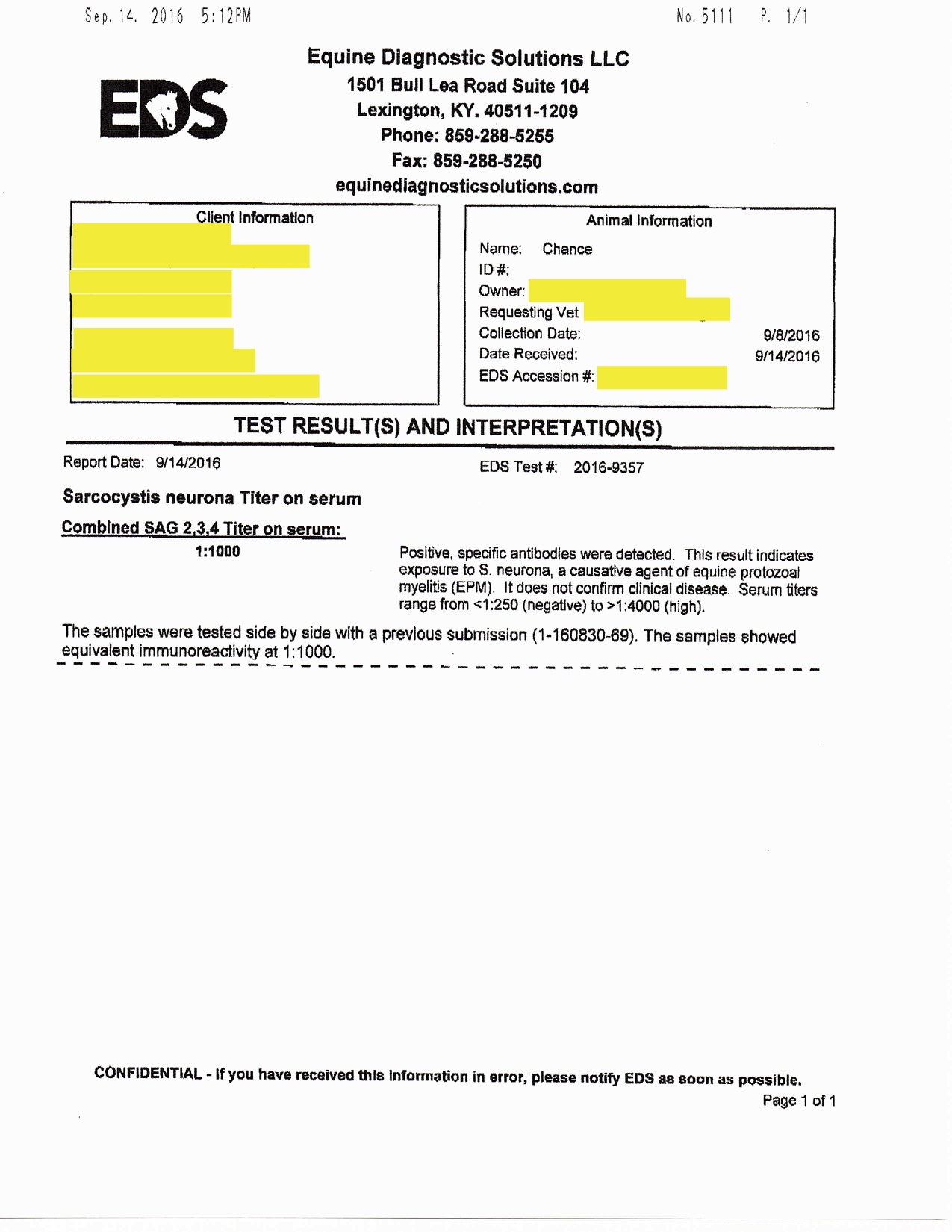
Chance’s EPM test #2 on 8/30/16 (the 1st one was 2ish years ago) showed the following:

“Combined SAG 2,3,4 Tilter on serum= 1:2000”

So, what does this mean?

The test revealed that Chance had “positive, specific antibodies” detected in the blood work.  This means that he had EXPOSURE to S. Neurona, a causative agent of EPM.   Serum tilters range from <1:250 (negative) to >1:4000 (high positive).  S. Neurona (SarcoFluor) is one of two protozoa found in EPM infected horses, the other protazoa is N. Hughesil (NeoFluor). S. Neurona is most frequently seen, whereas N. Hughesil is not as common.

The vet ran another EPM test to confirm the findings in the 8/30/16 test.  The results showed that Chance had “Combined SAG 2,3,4 Tilter on serum= 1:1000.  Again, Chance showed EPM protozoa in the positive-ish range.

I initially had not seen the results but was told by the vet that he was EPM negative.  So when I asked for the test results to be emailed to me and saw the numbers I sort of freaked out…I emailed the vet to ask for clarification.  She explained,

“The EPM test shows that he was exposed to the organism in the first test we did which is why we did a follow-up test. Since his exposure level dropped from 1:2000 to 1:1000 this shows that he does not have the disease. There is no good one time test for EPM once they are exposed which is why we had to do the repeat to compare the two.”

While this explanation offered me comfort, I was confused…why does he have any protozoa in his blood if he doesn’t have EPM?

I spoke to another vet and she explained it in a bit more detail…I am hoping I am summarizing what she said correctly..

When a horse tests positive for EPM they either have an active disease or they may not.  However, when the test does from 1:2000 down to 1:1000 this typically means that the horse’s immune system is working correctly to fight the disease off- active or not.  EPM testing typically provides you with a % of the chance your horse has an active EPM infection, or at least if you send it to Cornell University.  For instance, lets say a horse gets the results back and it shows that they are “positive” or have been exposed to S. Neurona (one of the two EPM protozoa)…their results are  1:647.  This means that, after doing a bunch of adding and multiplying that this vet kindly did for me, the horse has a 60-70% chance of having ACTIVE EPM.  Meaning, he most likely would be symptomatic (ie: behavioral changes, ataxia, weight loss, difficulty eating, changes in soundness, and a bunch of other neurological symptoms).

My hunch is that Chance’s immune system was boosted because I started him on Transfer Factor (amazing stuff… more information can be found in some of my older posts) again as soon as his results came back positive for Lyme.

Here are the 3 EPM tilters that were run on Chance (oldest to most recent) along with his Lyme test results:

epm-2014

epm-test-results-8-31-16

EPM results 9-8-16 copy.jpg

lyme-titer-8-30-16

Another Try

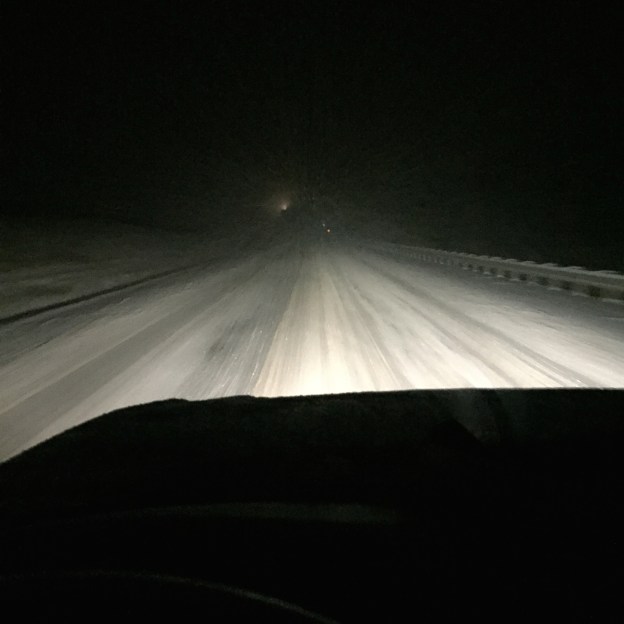
Yesterday, while at the farm, Chance’s medications arrived at my house instead of the farm.  I drove home, grabbed the meds, and began my drive back to the farm.  A winter storm was just beginning.  4 hours later, I dropped off the medication and turned back around to head home.

Thankfully, Chance began his second round of EPM treatment this morning.

I decided to try a different type of treatment this time around- round one: Protazil and round two: Marquis.  Marquis has been around longer and has similar potential side effects and outcomes as Protazil.

Rebalance recently was linked to the death of 4 horses in 2014.

Or

Oraquin-10 which is a 10 day treatment that is more cost effective.  However, it is a newer medication and the vets that I have spoken to were not as comfortable with the outcomes in the horses with EPM.

IMG_1843

A Month Later

Luckily, after about one week of stall rest and hand walking, along with a stronger anti-inflammatory, Chance has begun to show improvements over the last couple weeks of treatment.

Chance has almost completed his first 30 days of EPM treatment and has about a day or so left of the Protazil. He is going to continue his other medications and supplements:

1. SmartPak: senior flex and immune boost
2. Vitamin E
3. MicroLactin (amazing) to help with regrowth of his cells, inflammation, and pain.

As I’m doing research, and trying to come up with a plan of action, once again I am inundated with opinions…medication, exercise, holistic, massage, acupuncture, chiropractic, organic, shoeing, etc.

I know I need to continue therapy, or start a new therapy. But which one do I choose?

Do I go the holistic approach and work with an acupuncturist, chiropractor, massage therapist, and vitamins such as Vita Royals? Do I go organic? Or do I try Marquis? Another month of Protazil? Oraquin-10? Rebalance has been linked to a number of recent deaths in the past handful of months. If I go the organic or holistic approach do I run the risk of the disease progressing? If I go with the medication do I run the risk of yet another “treatment crisis”?

I contacted Vet4 and he suggested doing another round of the Protazil or Marquis.  I decided on trying Marquis and waited for it to arrive.

Chance after a month on Protazil 

Our Regiment


IMG_1792


Chance receives the following:


AM:

1. Protazil 50mls

2. Vitamin E 4 scoops (Watch for loose stools.  This would indicate that his VitE should be cut down)

PM:

1. SmartPak: Immune Boost

2. SmartPak: Senior Flex

3. Equinyl 2 scoops first two weeks, 1 scoop after

OTHER:

If Chance’s symptoms are worse, he can receive Equinox and UlcerGuard.

How to we get there?

As I said previously, the idea of Chance collapsing and no one being there terrifies me. Vet4 is shipping me the Protazil and I am trying to find another vet to come and administer the DMSO before beginning treatment.  DMSO typically helps the Protazil adhere better, thus making the treatment more effective.

EPM: Is DMSO the Cure for Treatment Issues?

By Stacey Oke, DVM, MSc Aug 3, 2009

New research on treating horses with equine protozoal myeloencephalitis (EPM) has found dissolving toltrazuril sulfone, commercially known as ponazuril, in dimethylsulfoxide (DMSO) instead of water prior to oral administration in horses increases the bioavailability by three times and achieves therapeutic levels in both the blood and cerebrospinal fluid.
Ponazuril and related triazine-based antiprotozoal agents used to treat horses with EPM are highly lipid (fat) soluble. As a result, these agents dissolve poorly in the gastrointestinal systemand are therefore poorly absorbed.
Poor drug absorption results in variable drug concentrations in the bloodstream, which translates into a variable therapeutic effect in the treated horse, explained Levent Dirikolu, DVM, PhD, from the Department of Veterinary Biosciences at the University of Illinois, and co-researchers from the University of Kentucky Gluck Equine Research Center and the United States Department of Agriculture (USDA) Animal and Natural resources Institute.

I finally found a vet who was able to come to the farm to meet Chance and administer other medications.

Vet6 felt that DMSO wasn’t necessary and that Chance would be fine. I called Vet4, explained the situation, and he advised beginning Chance on 1/2 a dose of Protazil for the first couple days in conjunction with a mild anti-inflammatory.

So, that is what we did. I had also read that Vit E (only in its all natural form) was helpful during treatment, along with Ulcer Guard to keep his stomach safe from the medications.

I called 5 different vets and no one has what I was looking for in stock. I finally found it in Chantilly!