Tag Archives: Research

An All Natural Option?

While doing research on EPM, and ways to prevent a treatment crisis, I came across something called MicroLactin. Below are two of the many studies I found regarding the use of MicroLactin and its use for EPM.

STUDY 1: Journal of Equine Veterinary Science (Impact Factor: 0.89). 09/2005; 25(9):380-382. DOI: 10.1016/j.jevs.2005.08.004
ABSTRACT Fifty-eight horses with inflammation from lameness/foot trauma, muscle and skin trauma, and respiratory, gastrointestinal, and soft tissue toxins were fed MicroLactin (Duralactin Equine, Veterinary Products Laboratories, Phoenix, AZ) as an aid to therapy to inhibit neutrophil participation in the inflammatory response. Based on clinical signs of observed improvement and owner's observations, there was 86% positive effect, 14% no effect. Owner's satisfaction of results was seen by continued use of MicroLactin instead of nonsteroidal anti-inflammatory drugs and steroids in respiratory inflammation and in chronic lameness, myositis, and skin inflammation.
STUDY 2:  Sandhill Equine Center, Southern Pines, NC Journal of Equine Veterinary Science (Impact Factor: 0.89). 06/2009; 29(6):547-550. DOI: 10.1016/j.jevs.2009.05.004
ABSTRACT MicroLactin is a patented milk protein concentrate whose mode of action is proposed to inhibit neutrophil activation in inflammation and to bolster the immune response in musculoskeletal diseases. MicroLactin was empirically used in the treatment of a series of equine clinical cases. MicroLactin was given in two trials to 166 horses in which neutrophils were associated with an inflammatory response. The primary clinical groups having the greatest positive responders to the use of MicroLactin were: respiratory (92%), joint lameness/foot trauma (90%), muscle injury/myositis (92%), equine protozoal myeloencephalitis (EPM) (81%), skin trauma/hypersensitivity (89%), and toxic enteritis (89%). Positive clinical results were seen within 10 to 14 days when MicroLactin was used as a daily treatment either alone or in combination with other anti-inflammatory agents or as an adjunct to the primary treatment.

Every study I read claimed MicroLactin to be a “miracle anti-inflammatory” that aided in cell regrowth. People were raving about this substance that is derived from cow’s milk. The studies dated back to the 80’s and not only suggested that MicroLactin truly was a natural cure all, but that it also had zero side effects or interactions.

I figured that I should give it a try. Again, I looked everywhere and nobody carried it. I looked online and saw that there was a brand called DuraLactin but that I would not be able to actually receive it for about a week. I began looking for supplements that contained the same ingredients as DuraLactin. Sure enough, I was able to find it!

The brand is called Vita-Flex Equinyl.

Vita Flex® Equinyl™ Combo is designed to help ease pain and inflammation associated with training and competition without causing gastrointestinal side effects. This supplement provides joint health support and increases flexibility. It shortens recovery time by reducing the emigration of neutrophils to the site of the inflammation. Contains glucosamine, which helps maintain synovial fluid that lubricates the joints for all day pain associated with daily exercise and activity. 5,000 mg glucosamine, 875 mg chondroitin. 7500 mg MSM. 3.75 lb (60-day supply).

Other EPM Therapies

The below research was found athttp://www.epmhorse.org/Treatment/Other_Therapy.htm

Veterinarians should discuss other drug therapies, in addition to the protozoa killing drugs, to address symptomatic problems that may occur during treatment.  Limiting inflammation of the cerebrospinal column, stimulating the immune system, and anti-oxidants are three things that the owner should be prepared to handle during treatment.  If the veterinarian does not discuss these, ask about them.

Inflammation

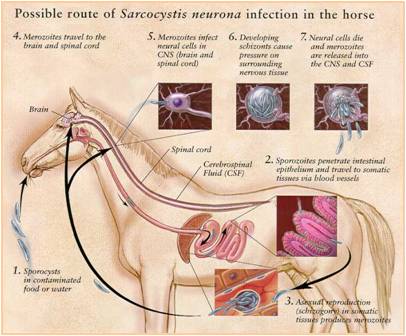
An active S. neurona infection in the central nervous system (CNS) will produce both temporary inflammation and permanent nerve damage. The inflammation can get worse when the protozoa start to die during treatment.  This can happen as the treatment drug level builds in the CNS, and is known as a ‘treatment crisis’.  Watch for symptoms to get worse 7 to 14 days after the start of treatment drugs.

Inflammation by itself can cause permanent nerve damage, so treating it is important.  Veterinarians report that horses with higher neurologic deficiencies, and possibly higher levels of protozoa, tend to get treatment crises more often that horses with a Mayhew score of 1.  Some veterinarians will place a horse on anti-inflammatory drugs immediately, to prevent additional damage to the CNS.

Banamine   Many owners already have the non-steroidal anti-inflammatory drug (NSAID) Banamine at the barn.  Even if your horse is a 1 on the Mayhew scale, you may wish to have Banamine on-hand to deal with any worsening of the symptoms. Banamine can cause gastro-intestinal side effects such as ulcers when given in high doses, or longer than five days.  A January 2009 cost was $35 for 5 doses.

MicroLactin   This supplement is gaining recognition as an overall, mild anti-inflammatory.  This non-prescription supplement is a derivative of cows milk, and is known as Duralactin, or the ingredient ComfortX in Equinyl.  MicroLactin does not have side effects, so it can be used over the entire course of treatment.  It is possible to supplement with Banamine during a treatment crisis.  March 2009 price was $50 per month.

Dexamethazone   (Dex) This steroid suppresses the immune system, so it should not be used as an anti-inflammatory for EPM horses except in an extreme neurological case.  Used longer than 5 days, it can cause Laminitis.

DMSO   Dimethyl sulfoxide given intravenously, can be useful when the horse has extreme neurological symptoms.  The veterinarian should administer this drug, it should only be used for short time periods, and it can interact with other drugs.

Immune System

In many regions of the U.S. more than 50% of the horses have been exposed to EPM. Researchers do not know why less than 2% of them get an active infection in the CNS.  Studies on blood of EPM horses indicate a change in the immune system response and cells.  Relapse rates for EPM are high, often with the same symptoms. Some researchers believe that the relapses are latent infections which were never completely killed, and the immune system does not recognize.  Immune system stimulants have been suggested to help the horse fight the infection.

Levasimole   This drug has been used as part of a wormer, and anti-inflammatory.  It is known to increase immune response.  It has not been clinically tested specifically for use with EPM, but is being used for it.

Transfer Factor    This supplement has been around since the 1940’s for human use. The older studies on humans suggest it increases the cell-mediated immune response.  It has not been clinically tested in horses.  The supplement is suggested to increase the cell-mediated immune response (see research below).  It WILL NOT kill the protozoa; it is only an immune booster.  It is made from cow colostrum, eggs, and mushrooms.  At least two companies produce this for equine use, and while the main ingredients are the same, there are differences.  4 Life Research and Nutrition Horizons USA offer this at March 2009 prices of $150 to $200 per month.

Vitamin E

Vitamin E has been shown to relieve inflammation, promote regeneration of nerve cells, and is an anti-oxidant protecting the CNS.  This vitamin is suggested by many veterinarians for supplementation during and after drug treatment for EPM.  It crosses the blood-brain barrier to work in the CNS.  A deficiency in Vitamin E is thought to impair the blood-brain barrier.  It is suggested at therapeutic rates from 5,000 to 10,000 total IU per day.  Add the total Vitamin E content of all supplements and feed to reach the target rate.  Research has shown that natural source vitamin E (D-alpha tocopherol) is absorbed by the body better than manufactured E (DL-alpha-tocopherol).

Recent Research

A 2006 study published in Veterinary Parasitology indicated: “Our results demonstrated that naturally infected horses had significantly (P < 0.05) higher percentages of CD4 T-lymphocytes and neutrophils (PMN) in separated peripheral blood leukocytes than clinically normal horses.  The product MicroLactin has been shown to limit neutrophil activity thereby reducing the inflammation process in the CNS.  The study goes on to say, “Leukocytes from naturally infected EPM horses had significantly lower proliferation responses, as measured by thymidine incorporation, to a non-antigen specific mitogen than did clinically normal horses (P < 0.05).  Cell-mediated immunity is lowered in EPM positive horses.

An ongoing study by Dr. Bello, Journal of Equine Veterinary Science, vol. 28, issue 8 (2008), uses Marquis, MicroLactin, and transfer factor in a protocol.  The initial study involved 28 horses, and 8 more have been studied.  This study was presented at the AVMA conference in 2007, and was published in 2008. The full text article is available below with permission from Dr. Bello.

Continuing research by others indicates controlling inflammation is a large part of the treatment process, and immune system stimulation is critical to avoiding relapses.

January 2012

References:

Veterinary Parasitology 138 (2006) 200–210

J Appl Res Vet Med 2003;1:272-8.

J Eq Vet Sc, vol. 28, issue 8 (2008) 479-482
An Intensive Approach in the Treatment of Clinical Equine Protozoal Myeloencephalitis 

Am J Vet Research, June 2008  Vitamin E

J Eq Vet Sc, vol. 25, issue 9 (2005) 380-382

TheHorse.com articles # 12025, 4829

Yet Another Obstacle

Chance has been doing great since his Stem Cell treatment.  He has not had a single flare up of Lymphangitis since he arrived in Sperryville.  He no longer stocks up when he stays inside due to weather. He is gaining weight.  AND he has not been on daily pain medication! He is finally happy, healthy, and pain free!

Until one day I noticed that he began twisting his back right leg inward at the walk.  I figured that it was due to the long term injury to the DDFT and lack of muscle on that side.  I asked Vet4 and he agreed.  I called the farrier, who had previously worked on Chance when we arrived in Lynchburg many years prior, and he did a more supportive back shoe.  The shoes seemed to help a bit- Chance’s twist was less extreme.

A few weeks later, I realized that I needed to find a local vet due to Vet4 being 2 hours away.  I called and Vet5 came out.  She watched Chance walk down a small hill and immediately said, “He is a wobbler!  We need to test him for EPM.”  I tried to justify Chance’s ataxia by suggesting that he was walking down a hill, after a long standing injury, and it was a bit muddy.  And, to be perfectly honest, I was a bit peeved!  My horse did NOT have EPM!  Not after all he had already been through!  He was healthy!  He just needed some rehab to rebuild the muscle.  I was thinking to myself, that EPM was the first condition that I had addressed with Vet1.  The very same diagnosis he had shot down.  There was no way….

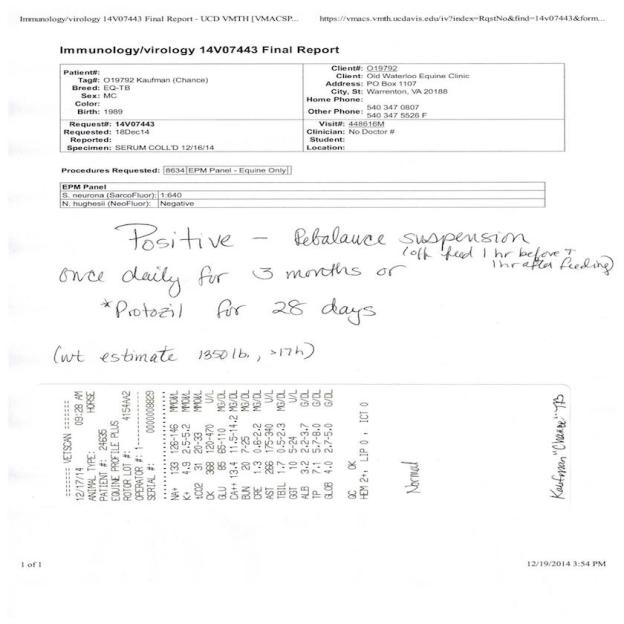
Well, we tested him anyway.  I convinced myself that the test would come back negative.

I began to do what I do best- hours of research. The journals and articles I read said, that while 50% of horses have come in contact with contaminated feed, only 1% actually develop symptoms!  1 PERCENT!  The Protazia attack the CNS, eventually moving from the spinal cord to the brain.  Symptoms can, and will, differ from horse to horse, but usually a horse with the parasite on the spinal cord shows lameness and ataxia on one side of the body (usually hind end).  Where as horses whose brain has become infected, show anything from paralysis of the face, to personality changes, choking, difficulty chewing, etc.

A week or so later, I received a call that Chance did have EPM!  I was heartbroken! And, honestly, I was angry!  Angry at Vet1 for dismissing my initial thoughts about Chance having EPM!  I was reassured that he was not in any pain, but in order to ensure his safety, we needed to get him on medication ASAP!

Again, hours of research…looking at the different medications (Protazil, Marquis, etc) and the outcomes and side effects.

I called the vet I trusted with my horse’s life, Vet4, and he walked me through what should be done.

Spoke to Vet4 ie EPM results:
He state there were two choices- Marque and Protazil & typically he sees an improvement with 85% of horses.

Plan:
Day 1: DMSO and Banamine
Day 2: Same
Day 3: Same
Day 4: Begin Protazil with DMSO and Banamine

After reading about my opinions, I was inundated with talk about what is referred to as, “the treatment crisis”.  Some horses will begin the medication and, due to the kill off of the parasite, their body reacts with severe inflammation.  Some horses will collapse and not be able to get back up, and others will have an increase in their initial EPM related symptoms.  This scared me.  I did not want Chance to fall and be laying there all alone for hours; I wanted him to be under 24/7 watch.

Vet4 said that If I wanted to trailer him to the hospital, I was looking at around $1500.00 for one month.
~$800.00 (1 month)
~$700 (1 month) board

Typically, the outcome of the medication, when EPM is caught early, is a decrease in 2 grades of Ataxia.  Chance was deemed a 3 on the Ataxia Scale.

HandleFileHandleFile (2)

Dr. Fortier’s “Lameness Originating from Tendon Sheaths”

Lameness originating from tendon sheathes.
Lisa A. Fortier, DVM, PhD, Diplomate ACVS Cornell University, Ithaca, New York, USA
Laf4@cornell.edu

(Below is cut and pasted from Dr. Fortier’s “Lameness Originating from Tendon Sheaths”)

The most commonly affected tendon sheathes associated with lameness is horses are the digital, carpal, and tarsal sheaths. In general, the diagnoses of lameness originating from tendon sheathes is increasing with awareness and with the more common use of MRI. Clinical signs associated with tendon sheath lameness are variable with respect to degree of lameness and extent of synovial distension. In general, the lameness will worsen with flexion and with work, but the degree of lameness is not directly associated with prognosis for return to athletic performance.

Lameness associated with the digital sheath

Lameness can be localized to the digital sheath with a low 4-point block or intrathecal anesthesia. If sepsis is suspected, a clean (non blood-contaminated) synovial fluid sample can be obtained at the base of the sesamoid bones and axial to the palmar digital neurovascular bundle.

Simple annular ligament constriction, without involvement of the superficial (SDFT) or deep digital flexor tendons (DDFT) is a common cause of lameness associated with the digital sheath. When viewed from the side, the palmar/plantar profile of the digital sheath will have a “notched” or “cut-in” appearance at the fetlock joint. The integrity of the annular ligament (thickness and structure) should be evaluated using ultrasonography to be sure there are no other structures involved such as the SDFT or DDFT. Horses can be treated with intrathecal hyaluronic acid with variable success prior to surgical intervention. If the annular ligament is the sole structure involved and there are no adhesions within the tendon sheath, then a closed or semi-open annular ligament transection could be performed rather than a tenoscopic transection. If ultrasound examination reveals adhesions or synovial masses within the sheath, then tenoscopic exploration and removal of the masses/adhesions is warranted.
Performing surgical maneuvers or exploratory surgery under tenoscopic guidance has distinct advantages as compared to open approaches. Tenoscopy allows for more complete examination of the entire tendon and tendon sheath, resulting in a more accurate diagnosis than can be provided by ultrasonography and the surgeon has an opportunity for removal of pathologic tissues such as synovial proliferative masses, hyperplasic synovial tissue, and adhesions. Additionally, the use of tenoscopic portals instead of an open approach reduces potential iatrogenic damage to neighboring structures and decreases the incidence of postoperative synovial fistulation. The biggest take-home message of these notes should be that the presence or extent of synovial masses/adhesions is not directly correlated with prognosis and many horses return to full athletic performance after tenoscopic surgery and removal of adhesions/masses and annular ligament transection.

Longitudinal tears in deep flexor tendon are increasing commonly diagnosed. Like adhesions and masses, tears are frequently worse on tenoscopic exam than on ultrasound. In these cases, the tendon tear appears to be the primary cause of the tenosynovitis and the annular ligament constriction is likely secondary. Currently, debriding the tendon edges is the only treatment, but some tendon repair technique seems warranted. Ian Wright described a combined approach to repair these tears, but has subsequently discontinued this practice and simple debridement of the granulation tissue between tendon edges is recommended.

Research, Research, Research

Tendon Injury Handbook

After I left the barn, I drove home and went straight to my computer.

What was happening?  What are the masses? Scar tissue?  Nothing was able to be extracted out of them…How can I get rid of them in order to see behind them?

Again, I stayed up until the sun came out the next morning.  I already had two binders full of research and now I had a third.

Research made me believe that C has an infection in the Synovial Tendon Sheath that was being masked by the masses on the outer lining of the SS. The masses could be scar tissue from his MANY past Lymphangitis flare-ups. Perhaps, his immune system was not able to fight last attack and the infection settled in the SS and was walled off.  Thus his CBC & WBC were normal and no fluid was extracted from SS masses due to the large size of the scar tissue.
C has a major hx with his RH and “flare-ups” and lameness. I never realized this until I took the time to study his past records from the first 5 years I owned him.

Symptoms are similar to an infection- what if we proceeded as if it were?
Lack of a positive culture does NOT mean that there is not an infection in the sheath!

Current Symptoms:
1. Swelling decreases after being active
2. Fails to extend fetlock
3. Lame- exasperated by flexion
4. Positioning for fetlock flexion

Septic Synovitis: Cartilage degradation ischemia, Fibrin deposition lead to lameness to pannus form and adhesive form

Entrobacteriacaea
Strep
Staph
Most common is Staph

Treatment: 

Systematic Procaine Penicillin 22000 iU/kg or Sodium Benzyl Penicillin & Gentamicin 6.6 mg/kg for 2-9 days

Then change to oral potentiated sulfonamides 5mg.kg Trimethoprim and 25 mg/kg of Sulphadiazine

Other potassium penicillin w/ Amikacin Cectiofur or Enrofloxacin

IV antibiotics for 7-10 days switch to oral for 2 weeks

Regional limb profusion or placement of impregnated Polymethyylmethacralate or PMMA

I immediately called Vet4 and told him my theory.  He said that it was possible and that we should begin treatment asap.  He was still out of town so I called Vet3 to order Baytril. Vet3 felt my theory was legit and immediately ordered the antibiotic!