
Category Archives: Mindfulness
The Donkey Days of Summer

The cuddliest donkey, water and a good book makes for a perfect Sunday.
It’s Raining…Lets Play!
Your Horse is Not a Therapist
Your Horse Is Not a Therapist
(But They Are Good Medicine)
This and other notes on horses and depression

When I teach horse riding to friends and family, I use like and as like trailer hitches: they pull my students into different concepts while they are in the saddle.
“Hold the reins like a baby bird.”
“Imagine the horse as a river, and your legs as the banks guiding the river along.”
“I want you to push down through your heels like you could break the stirrups.”
Unlike riding, the metaphors I use for depression never describe it with much accuracy. Depression is at once an absence of things and a too much of things, a void, a slowing down, a speeding up, it’s too much and too little.
Instead, my depressive episodes are blotted, memories. They are moments half-vacant. The first time I remember having symptoms, all I could pull up from the database of my memory was the hum of my parents’ air conditioner at eleven in the morning. It was gurgling. Droning thuds right outside the door where I slept. It was the summer of 2008, the gas prices rose, the economy crumbled, and the coda of my existence was staying in bed because there was no point in getting out of it.
It went away when I went back to school the following autumn. Or, at least, I thought it did. I can still hear the echoes of school friends, telling me that maybe there was more to my melancholy than just sadness and being a chronic overachiever.
I ignored them.
After college, I lived on a horse farm in rural Colorado. It had a million-dollar view of slotted canyons and farm fields stretching for miles. Most days I rolled out of bed by 7:00am, fed 20 horses, cleaned out their runs for the day, did chores, and then wrote website copy for a marketing agency in a little office that faced east.
I remember the raccoons squabbling over the dumpster at night, the echo of coyotes after a kill, and the thrill of a shooting star streaking the sky with luminous urgency. I loved riding just before sunset, watching the red dust cast clouds behind the horses hooves. I can also remember waves of nauseating numb and a strange sense of dread that never really lifted. Some days didn’t pass, they army-crawled.
The rhythm of farm life masked my symptoms. I have what doctors call “high functioning” clinical depression: it never mattered how crappy I felt or how existential I got or how much of a mess my relationships became, horses still needed to be fed, water troughs cleaned, and manure cleared away. Cowgirls don’t cry.
I DIDN’T UNDERSTAND THAT I WAS SICK.
Now almost five years since I first lived on that farm, I know that I can do most basic things when I am depressed. I can go to the grocery store, pay bills and answer the phone. I am one of the lucky ones.
What I can’t do is notice details. I can’t write, stay organized, or meet deadlines. I stop being able to pick up after myself or see anything as worthwhile. I eat too much or too little; sleep becomes a curse and a blessing. Before I knew I had depression, I would just blame my lack of self-discipline. I thought it was my dyslexia, a character flaw, or maybe I just wasn’t getting enough sleep. I told myself I needed to get up earlier, eat better, or drink more coffee. I didn’t understand that I was sick.
It is very unlikely I could have known I had depression. I had no idea what depression was.
My understanding of mental illness came from one high school production of David and Lisa and two 100 level psychology courses that still presented mental illness as uncommon. I thought anxiety was a normal state of being and depression was just bouncing, egg-shaped heads that smiled and talked about sexual side effects in Zoloft commercials.
Besides, I got to spend a lot of time with horses; my beliefs told me that if I had everything I wanted there was just no way I could be depressed. But that was exactly what was happening.
Depression or major depressive disorder as defined by the American Psychiatric Association is “a common and serious medical illness that negatively affects how you feel, the way you think and how you act.” Common symptoms include lack of energy, becoming withdrawn and numb to your environment, a sense of dread, despair, guilt, or worthlessness. It is also common for depressives to isolate themselves and stop doing the things they care about. It can impact sleeping and eating patterns and can show a drastic shift in behavior and personality. While these are the most common symptoms, each case varies from person to person, episode to episode.
For us farm folk of the world, this may seem flowery and self-involved. Me, a few years ago would have said, “Oh how sad for you, now get up and get stuff done.”
No matter my shame and judgment, the dollar signs in front of depression are staggering and very, very real. A 2015 study showed depression cost the United States $210 billion every year, this accounts for everything from lost wages, to treatment and other direct and indirect costs and losses. If it was a fake disease like I once believed it was, shouldn’t it be cheaper?
If the cost in dollars and cents weren’t enough to leave us blushing over the manure pile, the number of people with the disease should do the trick. The National Alliance on Mental Illness reports that more that 43.8 million Americans suffered from some form of mental illness in 2015. This is just under one in five Americans.
Depression, which is the most common mood disorder, is also recognized by the Center for Disease Control as “a serious medical illness and an important public health issue.” Thus while we would all love to say, that depression and other mental illness never enters into the barn, the facts are stacked against us.
There is a t-shirt in many horse catalogs that says “My horse is my therapist.” I once would have purchased it in a couple of different colors. Now, as the resident Captain Killjoy of the barn, I want to say, “Cool, maybe they’ll make ‘My horse is my Chemotherapy,’ or how about this potential best-seller ‘My horse is my fast-acting inhaler.’”
If you just found the second two offensive, then yes, the first one is too. The reason it is problematic is not because our time with horses isn’t therapeutic. But rather because it diminishes mental illness as a lesser, illegitimate disease.
I, too, fell for the ethos of the horse as a cure-all for mental illness. I once thought therapy and psychiatric medication was for bored, wealthy people and the occasional hypochondriac. I also thought it was only effective for those with really low functioning diagnoses and meth addicts.
I WAS A FARM GIRL, STRANGERS TOLD ME I SEEMED TOUGH. WHO WAS I IF I LOST THAT?
On the other hand, I was also terrified. My imagination told me that if I went to a therapist, I’d be institutionalized like I had seen in the movies or I’d be the one thing I had convinced myself I was not: weak.
I was a horse person; I was a farm girl, strangers told me I seemed tough. Who was I if I lost that?
I would never think I was weak if I went to the emergency room because I got chucked off a horse and landed badly. I also wouldn’t think I was weak if I went to a doctor because I caught pneumonia after breaking the ice out of water buckets. The same logic should have applied to seeking treatment for depression.
Yet, when I talked myself into making an appointment with the mental health department I spent the entire phone call to the doctor in a cold sweat. I also considered running out of the waiting room in a panic before my first consultation had even started. Old stigmas against mental illness are a hard thing to silence, even if that mental illness is slowly trying to kill you.
Treatment turned out to be nothing like I imagined. There was minimal mood lighting, pedantic banter or forced breathing exercises. Therapy and treatment turned out to be very much like taking riding lessons. I paid a therapist for the same reason I paid a riding instructor: to notice things. They used their training and expertise and made me better. Just like a riding instructor had shown me that I had a nasty habit of letting the horse fall in at the corner, a therapist showed me how my emotional patterns were making me sicker. After noting the problem, they then gave me strategies to improve.
IT IS STILL A PART OF MY LIFE, BUT IT NO LONGER CONTROLS MY LIFE.
I know that if I had treated my depression sooner, I would have enjoyed my days on the farm more, I would have ridden more, worked harder, and laughed more. I would have been a better advocate for the horses I rode. If I had started therapy sooner, I would have ridden better, too. I would have spent the time noting reality, instead of simply trying to stay afloat in a soup of depression induced self-deprecation.
I am still not free of depression but because I understand it, I am better at taking care of myself when it appears. It is still a part of my life, it probably always will be, but it no longer controls my life.
You may, at this point, think I have sworn off horses as medicine altogether. If I had struggled that hard with depression when I was around horses every day, you might be surprised to hear that I do believe that horses are a valid way to help treat depression and other mental illnesses.
“Help treat” is the key statement here. My feelings on equine therapy for mental illness simply hold more specific parameters than they once did. I believe that if equine therapy is a primary treatment then it should be done in the company of a trained professional. In fact, this kind of therapy on horseback or in the company of horses is done all over the world and has been used to treat everyone from teens with severe anxiety, to veterans with PTSD, to those incarcerated. While research on the effectiveness of equine-based therapy for mental illness is still in its early stages, early studies show promise.
Time with horses have proven to be one of my best forms of secondary treatment to supplement therapy and medication. One of the beautiful things about depression, notes psychology writer Andrew Solomon, is that it is a disease that impacts the way we feel. If someone has diabetes, lunges a horse, and feels better, they will still leave the round pen with diabetes. If someone goes into a round pen with depression and lunges a horse makes them feel better, then for that moment it is an effective treatment for depression.
Exercise is also often a key component in treating depression and, for many, being around horses is a good excuse for doing just that. It also can provide a low-stress way to cut down on isolation as our interactions with horses can have lower social stakes than those with other people.
I now understand that cowgirls do cry and we should. Our time with horses should be a safe time to struggle and change and talk and perhaps find some relief from what ails us. If it is not, then it’s important to find out the reason why and do what we can to address it.
Asking for help isn’t a sign of weakness, it is a sign of agency and self-awareness and these are two things that I, as a horse person, have learned to admire.
Even if I can’t use metaphors to describe depression, I can use one to describe what it is like when it lifts. When the depression first lifts, it feels like the first time I correctly rode a flying lead change. There is a moment of flight, of release, of understanding and clarity that is so delicious I wish I could bottle it and keep it on a windowsill. It’s as if the mysterious thing that I had been prevented from understanding is now understood.
When depression is gone, I can see the steam curl from a sweaty horse in the morning light with a renewed sense of wonder. I can laugh at horse galloping at play in a pasture.
When my depression lifts, it is as though I can pull myself out of the dingy trailer of my despair and a long trail ride awaits, and my horse is already saddled.
About the Author
Gretchen Lida is an essayist and equestrian. Her work has appeared in Brevity, Earth Island Journal, Washington Independent Review of Books, and many others. She has an MFA in Creative Nonfiction from Columbia College Chicago and currently lives in Wisconsin. Follow her on Twitter at @GC_Lida.

Fat Little Donkey
I have been desperately trying to get my miniature donkey, Lucky, to drop some lbs. The thing with Lucky- he literally gained weight overnight. One day he was a skinny mini and the next he had a potbelly. I was really concerned that the weight suddenly appeared and had the vet run a heptic panel to ensure he wasn’t experiencing some sort of liver dysfunction. Sort of like how humans can develop Ascites when they have liver related disease. Anyways, his blood work came back and all was okay….he was just fat!
Unlike horses, donkeys develop “fat deposits” around their neck, abdomen, and butt and even once the weight has been lost the deposits stay for life!
The Dangers of Obesity in Donkeys
According to the Scarsdale Vets;
“Obesity increases the risk of developing hyperlipaemia and laminitis, both of which can be fatal. Prevention of obesity is better than cure, because rapid loss of condition in overweight donkeys can trigger hyperlipaemia.
Hyperlipaemia is a condition in which triglycerides (fats) are released into the circulation which can result in organ failure and death unless treated rapidly. The early signs of dullness and reduced appetite can be difficult to detect. Hyperlipaemia can be triggered by anything that causes a reduction in food intake e.g. stress, transport, dental disease.
Laminitis is a condition in which there is inflammation in the laminae of the foot that connect the pedal bone to the hoof wall. This can progress to rotation or sinking of the pedal bone within the foot. The cause is not fully understood and many factors are involved but obese animals are more prone to develop the disease.”
Equine Metabolic Syndrome: “Overweight donkeys often develop a fat, crest neck and fat pads around their tail base. When this occurs the donkey can develop a metabolic disease known as ‘Equine Metabolic Syndrome’. This causes insulin resistance and increased levels of blood glucose (blood sugar) in the blood stream. In equids this can lead to recurrent episodes of laminitis or founder. This disease involves inflammation of the white lining or laminar junctions of the feet, extreme foot pain and difficulty walking. In severe cases this can also cause changes in the bone of the foot and hoof wall” (Yarra Ranges Animal Clinic)
How To Help Your Donkey Lose Weight Safely
- Use a muzzle
- Limit grazing
- Ask your vet to do blood work to ensure your donkey is healthy
- Have the dentist come out and examine the donkey’s teeth
- Engage in an exercise routine
Donkey Related Resources and Information
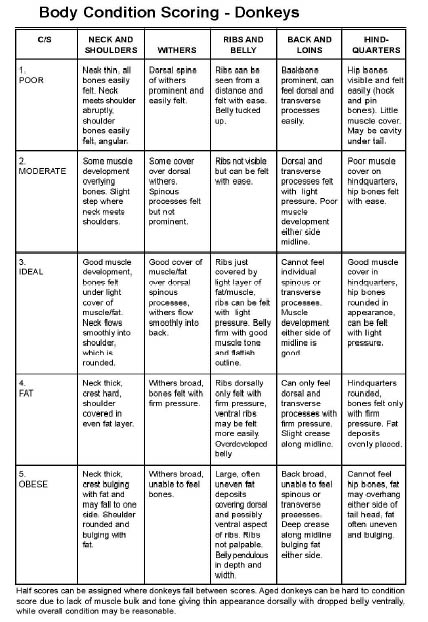
DonkeyBCS3posterDonkey Body Scoring by Dr_ Judy Marteniuk
The Welcoming Committee

Donkey See- Donkey Do
Lucky sees his new donkey neighbors for the first time! ❤️


The Leader of the Pack
When meeting new friends it is important to show that you maybe 32 years old but you’ve still got it…even if that means being sore the next day!


Lazy Sunday
Sundays are the perfect day for sitting on the ground, reading, while your horse falls asleep next to you in the sunshine and your donkey sunbaths. (Please excuse the length of Chance’s front feet. He’s due for his monthly pedicure!)

Home is Whereever You Are
Recently, I had to move to a new farm. And, if you are anything like me you loathe not only moving but moving your horse. The what-ifs running though my head- what if he won’t load? What if he hits his head? What if he freaks out? (Or to be completely transparent, what if I do?). What if he falls? Etc. Personally, when I am faced with a anxiety provoking situation, I need to have a sense of control however small it is. So, I did what I do best and planned and organized. Everything.
Chance had a bad prior experience with being trailered. Plus, with his age (31) and past health issues my anxiety was at an all time high. It was recommended that I plan to meet him at the new farm instead of being there for loading. Made sense. I scheduled the vet to be there in case medications were needed. And they scheduled a therapeutic trailering service with a large trailer that had an forward unloading ramp. The horse communicator was also scheduled as she knew of Chance’s past experience and did energy work.
The day arrived. I went to the farm early and wrapped Chance’s legs, brought he and Lucky inside, packed up all my stuff, and met with the horse communicator. She did some grounding exercises with Chance and myself. I left when everyone arrived and went to the new farm and unloaded our stuff. About 1 hour later the phone rang and of course, I thought the worse. Chance refused to load even after 2 rounds of medications. Lucky was on the trailer. They requested I come and try. I drove the 30 minutes back to the farm- praying to everyone and anything- that Chance would load. I read some tips on Google (yes, I’m ashamed to admit, while driving). One article suggested doing groundwork to get the horse to pay attention. For example, stop him, make him stand, back up, etc. Once he was listening that is when you try to load. The article went on to say that anger and frustration would not work. Because a horse is in sync with our emotions. And that physically, a horse has stamina that we as humans do not share. However, mentally the horse will give up quicker. Patience. Kindness. Persistence.
I arrived. I followed the advice of the article. I walked him and gave commands. I was cool, collected, firm, and kind. We tried once. He walked part way up the ramp, stopped, and backed up. Again, I did the commands. Tried once more. Same thing. The third time the lady who was there to Trailer him lightly smacked his butt with a crop and suddenly, he was on the trailer! I couldn’t believe it. We quickly shut the doors and off we went.
The trip was about 45 minutes. And, thankfully, uneventful. The trailering company was amazing and patient. I’m beyond grateful for everyone’s help!
Below is information for trailering issues, how-tos, and professionals that can make the transition 10000% easier and, almost, stress free.
Resources:
1. True North Equine in Marshall, Virginia
2. Trailering service: Always There Horsecare: 703-915-6255 or http://www.alwaystherehorsecare.com
3. Article: Think like a horse
4. Article: The hard to load horse
5. Article: Lets Get Loaded


Science: When Horses Are in Trouble They Ask Humans for Help, Finds New Study
Research Fellow Monamie Ringhofer and Associate Professor Shinya Yamamoto (Kobe University Graduate School of Intercultural Studies) have proved that when horses face unsolvable problems they use visual and tactile signals to get human attention and ask for help.
The study also suggests that horses alter their communicative behavior based on humans’ knowledge of the situation. These findings were published in the online version of Animal Cognition on November 24.
Communicating with other individuals in order to get information about foraging sites and predators is a valuable survival skill. Chimpanzees, who are evolutionarily close to humans, are especially skilled at understanding others. Studies suggest that chimpanzees distinguish the attentional states of other individuals (seeing or not seeing), and they are also able to understand others’ knowledge states (knowing or not knowing).
Some domestic animals are also very good at communicating with humans—recent studies of dogs have revealed that they are excellent at understanding various human gestures and expressions. It is thought that these abilities were influenced by the domestication process.
Since they were domesticated 6000 years ago, horses have contributed to human society in various shapes and forms, from transport to companionship. Horse-riding has recently drawn attention for its positive effects on our physical and mental health. The high social cognitive skills of horses towards humans might partially explain why humans and horses have a collaborative relationship today. However, the scientific evidence for this ability is still scarce.
In this study, scientists investigated horses’ social cognitive skills with humans in a problem-solving situation where food was hidden in a place accessible only to humans. The experiment was carried out in a paddock belonging to the equestrian club at Kobe University, where eight horses from the club participated with the cooperation of their student caretakers.
For the first experiment, an assistant experimenter hid food (carrots) in a bucket that the horse could not reach. The researchers observed whether and how the horse sent signals to the caretaker when the caretaker (unaware of the situation) arrived. The horse stayed near the caretaker and looked at, touched, and pushed the caretaker. These behaviors occurred over a significantly longer period compared to cases when they carried out the experiment without hiding the food.
The results showed that when horses cannot solve problems by themselves they send signals to humans both visually (looking) and physically (touching and pushing).
Building on these results, for the second experiment they tested whether the horses’ behavior changed based on the caretakers’ knowledge of the hidden food. If the caretaker hadn’t watched the food being hidden, the horses gave more signals, demonstrating that horses can change their behavior in response to the knowledge levels of humans.
These two experiments revealed some behaviors used by horses to communicate demands to humans. They also suggest that horses possess high cognitive skills that enable them to flexibly alter their behavior towards humans according to humans’ knowledge state. This high social cognitive ability may have been acquired during the domestication process.
In order to identify the characteristic that enables horses to form close bonds with humans, in future research the team aims to compare communication between horses, as well as looking more closely at the social cognitive ability of horses in their communication with humans.
By deepening our understanding of the cognitive abilities held by species who have close relationships with humans, and making comparisons with the cognitive abilities of species such as primates who are evolutionarily close to humans, we can investigate the development of unique communication traits in domesticated animals.
This is connected to the influence of domestication on the cognitive ability of animals, and can potentially provide valuable information for realizing stronger bonds between humans and animals.
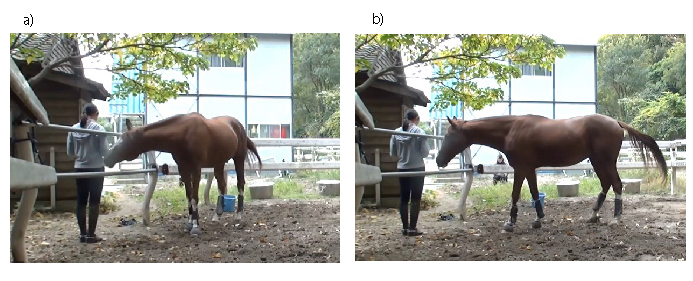
Figure 1. Horse making demands: The horse a) lightly pushes and b) looks at the caretaker standing outside the paddock. Food is hidden inside one of the two silver buckets behind them. When horses cannot obtain this food by themselves, they give humans visual and tactile signals.

Photo provided by Monamie Ringhofer.
Figure 2. Horse with caretaker at the equestrian club
When You Lose Your Partner

Stories from the Heart
When You Lose Your Partner

We all know the too-familiar story used in crime shows on television. A dynamic duo, perfectly paired in every way. They’re best friends who bicker like an old married couple and complete each other’s lives. That partnership is something most people long for. And it’s something a few equestrians are lucky enough to find with their four-legged half.
I was one of those few. His name was Beau. He was an off-the-track thoroughbred with a heart of gold and the chest of a draft horse. Tall, dark, handsome, loyal, always in tune with my thoughts—he was the best partner a girl could ask for.
We spent hours, days, weeks, months, training together. Athletically, we were on point. Emotionally, we were more in tune than most married couples. In every way, he was my other half. My confidence stemmed from him, and vice versa. There was nothing we couldn’t do when we were together. We literally climbed mountains.

Then, too soon, Beau passed away.

It was sudden. Unexpected. One day he was there, the next I had to make the decision to have him euthanized at the age of seven. That day I lost not only my partner, but a part of myself.
Saying goodbye to a partner is hard. For a while, there’s a hole. It never really gets filled. You keep riding, keep hopping up in that worn-out leather saddle that still smells like him. But it’s never the same. That same passion, love and commitment you shared for one another will never be replaced.
That’s a hard thing to get over. But it’s something every single equestrian will one day have to face. I hope none of you need to face it so soon. I hope your partners grow to be old and gray and pass in the most dignified and peaceful sense. I hope you have time to sit on the ground with them, no matter how hard it may be, hold their head in your lap for the last time and say goodbye.
I hope you get the chance to tell them thank you for the heart they gave you. For the confidence, experience, and love they shared with you every time you stepped into their world. But most of all, I hope you appreciate every single ride.
Go out to your barn and hug your horse.
Let them have that extra snack. Next time they decide they aren’t going to listen, or kick up their heels because they feel fresh, laugh it off. Someday you’ll miss it. You’ll miss the green stains on your white shirt from their grassy kisses. You’re going to miss braiding that mane until your arms ache. You’ll miss hitting the dirt because you couldn’t quite sit their power over that jump. Enjoy every moment of your partnership.

For those who have experienced this and said goodbye, I feel your pain. Don’t be afraid of feeling it, too. Sometimes it’s good to sit down and look at all those old photos and have a good cry over the life you had with your best friend. It’s okay for it to hurt a little bit every time you walk in the barn and they aren’t there waiting for you.
Just remember, they gave the best years of their life to you. They loved you with every ounce of their being. And you returned the favor.
About the Author
Megan Stephens is small-town equestrian from the hills of New York. She first hit the saddle at the age of four and the obsession has grown ever since. She is mom to a Hackney gelding and competes in hunter/jumper divisions for a local farm. She enjoys freelance writing about her favorite topic in her spare time.
Interviews & Profiles
Q&A: Artist Whitney Anderson Is Bringing Horses to High Fashion
Whitney Anderson was born in Alaska into a third-generation commercial fishing family and grew up in Breckenridge, Colorado, and Seattle, Washington. In 2009, she received a B.A. of…
6 days ago

Opinion
And the Sun Does Rise
It is over. Mostly. Well, except for the part about the ‘winning side’ gloating for the next year about how they were so right, and…
6 days ago

Racing
California Chrome Headed to Stud in 2017
California Chrome is heading to stud in 2017 and will stand for a fee of $40,000, Taylor Made Farm’s Duncan Taylor announced on Tuesday. The…
6 days ago

Life
The Beauty of Pony Club’s Biggest Flaw
The first six months of my riding career were spent with two trainers; one for two months, and the second for about four. Then I…
6 days ago

Uncategorized
8 Signs Your Trainer Has Adopted You
Every horse person knows the trainer/rider relationship is a little different than most coach/player relationships… About the Author Kim Ablon Whitney is a USEF ‘R’…
6 days ago
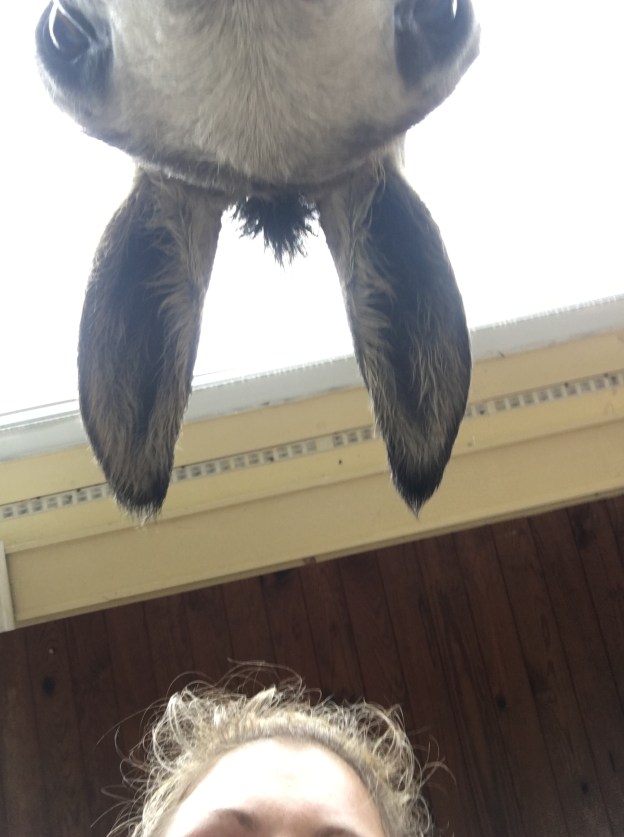
How I Dissertate
There is absolutely no other way to do research for your dissertation….outside, at the farm, with all my furry friends to distract me!

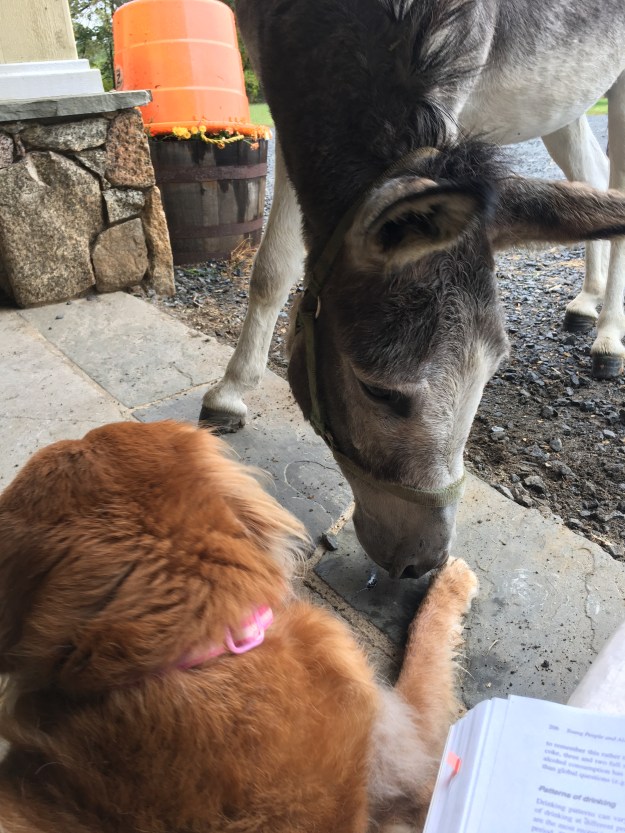
Summer Days
Such a perfect day to lay on the grass and read!


Eyes Wide Shut
I had the opportunity to work with a “horse communicator” today. She was recommended to me by an equine vet who, after reading my blog, felt that I would be open to the idea, and introduced me to her via email. According to the vet, she often works with this particular equine communicator due to her ability to point out exactly where the horse’s issues are, allowing the vet to adjust/manipulate/treat the main issue.
I chatted with her at length a few days ago as she explained the process and we scheduled an appointment.
Today I gave her a call, as she explained, connecting remotely allows for the horse to be in his natural setting without the influence of an unknown person. That way the horse could be relaxed and the owner can observe, ask questions, and engage. So, that is what I did. She went onto explain that sometimes the horse needs energy work in order to open up to the process and that the horse must trust the process, her, and obviously, the owner.
I was asked to have questions ready to ask my horse, along with something I would like to tell him at the end of the session. (If you have been following this blog then you will know I had some difficulty narrowing down a couple of questions- I have a lot! 😉 ) She began connecting with Chance.
I will not be able to convey all the details of what was said, Chance’s reactions, or even mine…It is almost a blur… I wish I could.
I was asked to feel around Chance’s right forehead/eye area for a lump or bump. I did as I was asked and didn’t feel anything abnormal…but remembered he had a gash that was healing right above his right eye. She informed me that he had a “headache”. She continued to move over him and explained that his “energy” was “blocked” on his right side. This makes sense…Chance has a “swagger” at the walk- he pokes his butt to the side and has a twist on the back right leg (Chance’s swagger has gone up and down- it was worse when he had the tendon issues, resolved after stem cell injections, came back when he got EPM, went away ish, and came back with his Lyme). While she was working on his energy, I massaged Chance’s back, neck, hip, and shoulders. She went on to explain that Chance had some right shoulder pain. Thankfully, Chance allowed her to work on his jaw (he pretty much has TMJ), his head, his back, etc. The energy was “pouring out” even on the hind end which, if I recall correctly, is commonly seen on horses with head injuries.
This is where my one question came in…I wanted to know what happened to Chance when he came to my college. I didn’t give many details…I didn’t know many details but I always wondered what may have happened on Chance’s trip down to my college.
I had gone off to college in January and decided to have someone trailer Chance down (about 3 and a 1/2 hours) once I got settled and found a barn, etc. Two months later Chance was arrived at her new barn. Despite the cool March weather, he was covered in sweat and was visibly scared. I didn’t inquire too much since he was in one piece and I chalked up the sweating and fear to exactly that- fear and anxiety. However, as the months progressed, Chance began bucking and rearing while under saddle….this was really strange..When he had left home we were doing dressage and jumping and he was sound and calm. Once again, I chalked it up to being in a new place- a barn that hosted Friday night Bullbucking no less. I decided to switch to a different farm, one preferably without bulls, even though the show was awesome to go and see, and work with a trainer. Still the behaviors persisted and the episodes of lameness increased. The vet finally diagnosed Chance with arthritic changes in his back and suggested I no longer jump him. I decided that summer instead of bringing Chance home and have him endure another long trailer ride, to board him at my new vet’s farm. Chance had the summer to recuperate while under the care of an equine vet.
Anyways, after that summer, I decided to retire Chance for good. I would occasionally get home him to walk around, I still can and do today. But, that was the beginning of a chronic condition that was never given a diagnosis. Instead, Chance’s symptoms were treated as they came.
Back to my session with my very own horse whisperer..
Chance “showed” her what happened on his trip to college- a trailer wheel falling off the side of the road. His head hitting one side of the trailer and slamming the other side. The pain. The concussion. His neck and back becoming misaligned. His jaw coming out of position. His body compensating. He showed the decline of his once functioning body- starting with the hit on his head, to his jaw, and his neck. Down his neck and through his back towards his hips and down his legs. The wear and tear of his body. Chance stated that he is still angry with the person driving the trailer; he wasn’t ready to forgive. I have forgiven them. I have no doubt it was a mistake and that there was no ill intent. But, I am not the one feeling the pain that he is. I am not the one who went from a racehorse to a jumper to practicing dressage to retirement long before I should have. And like the “horse whisperer” said, she will “hold the forgiveness for him until he is ready.” I will do the same.
She spoke of his time on the racetrack. Chance was happy to hear that he was being remembered for who he once was, and will always be to me- a strong, beautiful and crazy talented 17.1 hand red-headed thoroughbred and not a “weak old man” as he put it. When asked what his name was during his time on the track, he said, “Hot Stuff”, which could be a nickname and not his actual race name.
At one point during Chance’s session he fell asleep; standing in an odd way- hind legs spread out. Suddenly, his body gave out and he caught himself from falling. This entire time his eyes were still closed! They remained closed for another minute after this. His body reacting to something, perhaps a shift in his energies, and all the while he was a a state of peace; trusting that nothing bad would happen to him.
The session lasted an hour and a half. Honestly, we could have continued because of all the “blockages” but decided to stop for the day and pick up again another day. I was told that the effects of the energy work or Reiki, would continued throughout the week and that he would be emotionally vulnerable. As the session wrapped up Chance apparently said that he was the lucky one because I found him all those years ago.
Energy Work and Reiki Resources
Reiki for Horses: Workshops, Training, Courses, and Resources
Reiki Related Research and Resources for Two and Four Legged Friends
Amorosa Equestrian Center in Ohio
Reiki Forum on Horse and Hound
Reiki Handout: Full history, explanation, and how to pictures
Equine Communication
Horse Forum: Horse Communicators
Head Trauma and Headaches in Horses
Symptoms of Equine Concussions
Trauma, Concussions or Other Brain injuries in Horses
How to Handle Horse Head Injuries
Helping Horses with Traumatic Brain Injuries
 The Chances We Take