
Tag Archives: equine
Tornado Preparedness with Horses
Equine Vaccination Cheat Sheet – The Horse
Equine Vaccination Cheat Sheet – The Horse
— Read on thehorse.com/137994/equine-vaccination-cheat-sheet/

You’re Always with Me
Tonight I lost my best friend, Chance. The one who whinnied the moment my car pulled up, would run away and wait for me to catch him only to turn around and run away again. He made me laugh, knew all my secrets and nuzzled me when I was sad. He taught me about unconditional love and having a positive attitude despite circumstances. He nodded when I asked if he loved me and gave kisses to get treats. He’s the 17.1 hand horse who would stand behind me and fall asleep as I did my school work and would get upset if any horse got near me but would never hurt a fly. He let children hug him and dogs run into his stall and let me dress him up with flowers. He loved rolling in the snow, laying in the sunshine, and would light up the moment he saw me. I’ll miss playing in the barn on cold nights and curling up reading in his stall when he wasn’t feeling well. I’m thankful that he waited for me to get there tonight to say goodbye so I could hold his head in my lap and talk to him while he passed. There will never be a sweeter horse with a more gentle and pure soul. Thank you, Bubba, for being with me through it all- high school, college, the break ups, the losses, the good and bad days. You gave one hell of a fight for 30+ years. Lucky and I will miss you- there will never be another you❤️ #myfavoriteredhead #chancewetake #20yearstogether #thebesthorseintheworld #myheart
Silly Donkey

Wobbler Syndrome: Proof At Last!
The Donkey Days of Summer

The cuddliest donkey, water and a good book makes for a perfect Sunday.
It’s Raining…Lets Play!
The Welcoming Committee

Donkey See- Donkey Do
Lucky sees his new donkey neighbors for the first time! ❤️


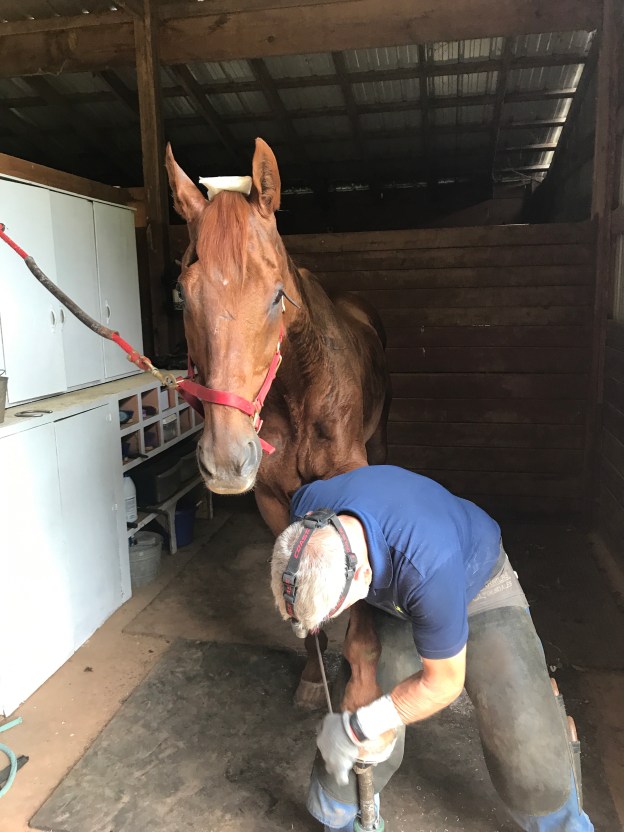
Ice Packs & Horseshoes
When it’s hot outside and you are getting your feet done, it’s imperative to have an ice pack on your head.


Gut Check: A New View from the Inside
By Sushil Dulai Wenholz

Researchers are testing an endoscopic camera, contained in a small capsule and placed directly into the horse’s stomach, to gather imagery of the equine intestinal tract. The capsule sends images to an external recorder, held in place by a harness.
Courtesy, Western College of Veterinary Medicine
Traditionally, veterinarians’ and researchers’ view of the equine intestinal tract has been limited. Endoscopy (inserting through the horse’s mouth a small camera attached to a flexible cable to view his insides) allows them to see only as far as the stomach. While ultrasound can sometimes provide a bigger picture, the technology can’t see through gas—and the horse’s hindgut (colon) is a highly gassy environment.
These limitations make it hard to diagnose certain internal issues and also present research challenges. But the view is now expanding, thanks to a “camera pill” being tested by a team at the University of Saskatchewan, led by Julia Montgomery, DVM, PhD, DACVIM. Dr. Montgomery worked with a multi-disciplinary group, including equine surgeon Joe Bracamonte, DVM, DVSc, DACVS, DECVS, electrical and computer engineer Khan Wahid, PhD, PEng, SMIEEE, a specialist in health informatics and imaging; veterinary undergraduate student Louisa Belgrave and engineering graduate student Shahed Khan Mohammed.
In human medicine, so-called camera pills are an accepted technology for gathering imagery of the intestinal tract. The device is basically an endoscopic camera inside a small capsule (about the size and shape of a vitamin pill). The capsule, which is clear on one end, also contains a light source and an antenna to send images to an external recording device.
The team thought: Why not try it for veterinary medicine?
They conducted a one-horse trial using off-the-shelf capsule endoscopy technology. They applied sensors to shaved patches on the horse’s abdomen, and used a harness to hold the recorder. They employed a stomach tube to send the capsule directly to the horse’s stomach, where it began a roughly eight-hour journey through the small intestine.
The results are promising. The camera was able to capture nearly continuous footage of the intestinal tract with just a few gaps where the sensors apparently lost contact with the camera. For veterinarians, this could become a powerful diagnostic aid for troubles such as inflammatory bowel disease and cancer. It could provide insight on how well internal surgical sites are healing. It may also help researchers understand normal small-intestine function and let them see the effect of drugs on the equine bowel.
The team did identify some challenges in using a technology designed for humans. They realized that a revamp of the sensor array could help accommodate the horse’s larger size and help pinpoint the exact location of the camera at any given time. That larger size also could allow for a larger capsule, which in turn could carry more equipment—such as a double camera to ensure forward-facing footage even if the capsule flips.
With this successful trial run, the team plans additional testing on different horses. Ultimately, they hope to use the information they gather to seek funding for development of an equine-specific camera pill.
“From the engineering side, we can now look at good data,” Dr. Wahid explained. “Once we know more about the requirements, we can make it really customizable, a pill specific to the horse.”
This article was originally published in Practical Horseman’s October 2016 issue.
The Leader of the Pack
When meeting new friends it is important to show that you maybe 32 years old but you’ve still got it…even if that means being sore the next day!


Lazy Sunday
Sundays are the perfect day for sitting on the ground, reading, while your horse falls asleep next to you in the sunshine and your donkey sunbaths. (Please excuse the length of Chance’s front feet. He’s due for his monthly pedicure!)

Home is Whereever You Are
Recently, I had to move to a new farm. And, if you are anything like me you loathe not only moving but moving your horse. The what-ifs running though my head- what if he won’t load? What if he hits his head? What if he freaks out? (Or to be completely transparent, what if I do?). What if he falls? Etc. Personally, when I am faced with a anxiety provoking situation, I need to have a sense of control however small it is. So, I did what I do best and planned and organized. Everything.
Chance had a bad prior experience with being trailered. Plus, with his age (31) and past health issues my anxiety was at an all time high. It was recommended that I plan to meet him at the new farm instead of being there for loading. Made sense. I scheduled the vet to be there in case medications were needed. And they scheduled a therapeutic trailering service with a large trailer that had an forward unloading ramp. The horse communicator was also scheduled as she knew of Chance’s past experience and did energy work.
The day arrived. I went to the farm early and wrapped Chance’s legs, brought he and Lucky inside, packed up all my stuff, and met with the horse communicator. She did some grounding exercises with Chance and myself. I left when everyone arrived and went to the new farm and unloaded our stuff. About 1 hour later the phone rang and of course, I thought the worse. Chance refused to load even after 2 rounds of medications. Lucky was on the trailer. They requested I come and try. I drove the 30 minutes back to the farm- praying to everyone and anything- that Chance would load. I read some tips on Google (yes, I’m ashamed to admit, while driving). One article suggested doing groundwork to get the horse to pay attention. For example, stop him, make him stand, back up, etc. Once he was listening that is when you try to load. The article went on to say that anger and frustration would not work. Because a horse is in sync with our emotions. And that physically, a horse has stamina that we as humans do not share. However, mentally the horse will give up quicker. Patience. Kindness. Persistence.
I arrived. I followed the advice of the article. I walked him and gave commands. I was cool, collected, firm, and kind. We tried once. He walked part way up the ramp, stopped, and backed up. Again, I did the commands. Tried once more. Same thing. The third time the lady who was there to Trailer him lightly smacked his butt with a crop and suddenly, he was on the trailer! I couldn’t believe it. We quickly shut the doors and off we went.
The trip was about 45 minutes. And, thankfully, uneventful. The trailering company was amazing and patient. I’m beyond grateful for everyone’s help!
Below is information for trailering issues, how-tos, and professionals that can make the transition 10000% easier and, almost, stress free.
Resources:
1. True North Equine in Marshall, Virginia
2. Trailering service: Always There Horsecare: 703-915-6255 or http://www.alwaystherehorsecare.com
3. Article: Think like a horse
4. Article: The hard to load horse
5. Article: Lets Get Loaded


 The Chances We Take