
Chance has been doing great since his Stem Cell treatment. He has not had a single flare up of Lymphangitis since he arrived in Sperryville. He no longer stocks up when he stays inside due to weather. He is gaining weight. AND he has not been on daily pain medication! He is finally happy, healthy, and pain free!
Until one day I noticed that he began twisting his back right leg inward at the walk. I figured that it was due to the long term injury to the DDFT and lack of muscle on that side. I asked Vet4 and he agreed. I called the farrier, who had previously worked on Chance when we arrived in Lynchburg many years prior, and he did a more supportive back shoe. The shoes seemed to help a bit- Chance’s twist was less extreme.
A few weeks later, I realized that I needed to find a local vet due to Vet4 being 2 hours away. I called and Vet5 came out. She watched Chance walk down a small hill and immediately said, “He is a wobbler! We need to test him for EPM.” I tried to justify Chance’s ataxia by suggesting that he was walking down a hill, after a long standing injury, and it was a bit muddy. And, to be perfectly honest, I was a bit peeved! My horse did NOT have EPM! Not after all he had already been through! He was healthy! He just needed some rehab to rebuild the muscle. I was thinking to myself, that EPM was the first condition that I had addressed with Vet1. The very same diagnosis he had shot down. There was no way….
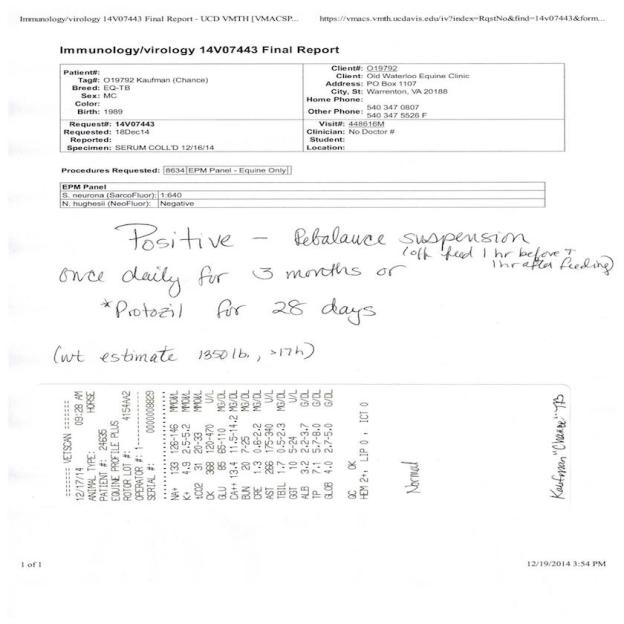
Well, we tested him anyway. I convinced myself that the test would come back negative.
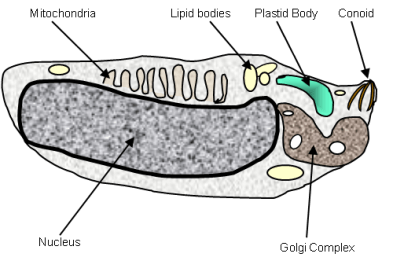
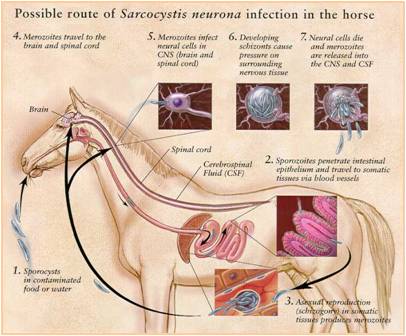
I began to do what I do best- hours of research. The journals and articles I read said, that while 50% of horses have come in contact with contaminated feed, only 1% actually develop symptoms! 1 PERCENT! The Protazia attack the CNS, eventually moving from the spinal cord to the brain. Symptoms can, and will, differ from horse to horse, but usually a horse with the parasite on the spinal cord shows lameness and ataxia on one side of the body (usually hind end). Where as horses whose brain has become infected, show anything from paralysis of the face, to personality changes, choking, difficulty chewing, etc.
A week or so later, I received a call that Chance did have EPM! I was heartbroken! And, honestly, I was angry! Angry at Vet1 for dismissing my initial thoughts about Chance having EPM! I was reassured that he was not in any pain, but in order to ensure his safety, we needed to get him on medication ASAP!
Again, hours of research…looking at the different medications (Protazil, Marquis, etc) and the outcomes and side effects.
I called the vet I trusted with my horse’s life, Vet4, and he walked me through what should be done.
Spoke to Vet4 ie EPM results:
He state there were two choices- Marque and Protazil & typically he sees an improvement with 85% of horses.
Plan:
Day 1: DMSO and Banamine
Day 2: Same
Day 3: Same
Day 4: Begin Protazil with DMSO and Banamine
After reading about my opinions, I was inundated with talk about what is referred to as, “the treatment crisis”. Some horses will begin the medication and, due to the kill off of the parasite, their body reacts with severe inflammation. Some horses will collapse and not be able to get back up, and others will have an increase in their initial EPM related symptoms. This scared me. I did not want Chance to fall and be laying there all alone for hours; I wanted him to be under 24/7 watch.
Vet4 said that If I wanted to trailer him to the hospital, I was looking at around $1500.00 for one month.
~$800.00 (1 month)
~$700 (1 month) board
Typically, the outcome of the medication, when EPM is caught early, is a decrease in 2 grades of Ataxia. Chance was deemed a 3 on the Ataxia Scale.


 The Chances We Take