Tag Archives: Virginia

Recommended Equine Professionals and Services

 True North Equine Vets  www.truenorthequinevets.com   540-364-9111

Genesis Farriers: Dave Giza www.genesisfarriers.com   571-921-5822

Ken Pankow  www.horsedentistvirginia.com  540-675-3815

Full Circle Equine www.fullcircleequine.com  540-937-1754

Farriers Depot:  (Farrier related supplies) www.farriersdepot.com 352-840-0106

StemVet (Stem cell acquisition and storage) www.vet-stem.com

SmartPak Equine Supplements  www.smartpakequine.com


The Weather Outside is Frightful…

I walked outside to sit on my porch and enjoy the evening, when I realized that the time is fast approaching where I can not longer do so without bundling up first.  I decided it was time to get ready for the winter months ahead especially for my equine friends.

I have included articles, lists, resources, etc to help you make sure you and your horse are ready for the dropping temperatures! 


Preparing Your Horse for Winter

Cushings Horse

By: Dr. Lydia Gray

Hot chocolate, mittens and roaring fires keep us warm on cold winter nights. But what about horses? What can you do to help them through the bitter cold, driving wind and icy snow? Below are tips to help you and your horse not only survive but thrive during yet another frosty season.

Nutrition

Your number one responsibility to your horse during winter is to make sure he receives enough quality feedstuffs to maintain his weight and enough drinkable water to maintain his hydration. Forage, or hay, should make up the largest portion of his diet, 1 – 2 % of his body weight per day. Because horses burn calories to stay warm, fortified grain can be added to the diet to keep him at a body condition score of 5 on a scale of 1 (emaciated) to 9 (obese). If your horse is an easy keeper, will not be worked hard, or should not have grain for medical reasons, then a ration balancer or complete multi-vitamin/mineral supplement is a better choice than grain. Increasing the amount of hay fed is the best way to keep weight on horses during the winter, as the fermentation process generates internal heat.

Research performed at the University of Pennsylvania School of Veterinary Medicine showed that if during cold weather horses have only warm water available, they will drink a greater volume per day than if they have only icy cold water available. But if they have a choice between warm and icy water simultaneously, they drink almost exclusively from the icy and drink less volume than if they have only warm water available. The take home message is this: you can increase your horse’s water consumption by only providing warm water. This can be accomplished either by using any number of bucket or tank heaters or by adding hot water twice daily with feeding. Another method to encourage your horse to drink more in winter (or any time of the year) is to topdress his feed with electrolytes.

Exercise

It may be tempting to give your horse some “down-time” during winter, but studies have found that muscular strength, cardiovascular fitness and overall flexibility significantly decrease even if daily turnout is provided. And as horses grow older, it takes longer and becomes more difficult each spring to return them to their previous level of work. Unfortunately, exercising your horse when it’s cold and slippery or frozen can be challenging.

First, work with your farrier to determine if your horse has the best traction with no shoes, regular shoes, shoes with borium added, shoes with “snowball” pads, or some other arrangement. Do your best to lunge, ride or drive in outside areas that are not slippery. Indoor arenas can become quite dusty in winter so ask if a binding agent can be added to hold water and try to water (and drag) as frequently as the temperature will permit. Warm up and cool down with care. A good rule of thumb is to spend twice as much time at these aspects of the workout than you do when the weather is warm. And make sure your horse is cool and dry before turning him back outside or blanketing.

Blanketing

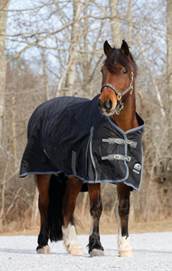
A frequently asked question is: does my horse need a blanket? In general, horses with an adequate hair coat, in good flesh and with access to shelter probably do not need blanketed. However, horses that have been clipped, recently transported to a cold climate, or are thin or sick may need the additional warmth and protection of outerwear.

Horses begin to grow their longer, thicker winter coats in July, shedding the shorter, thinner summer coats in October. The summer coat begins growing in January with March being prime shedding season. This cycle is based on day length—the winter coat is stimulated by decreasing daylight, the summer coat is stimulated by increasing daylight. Owners can inhibit a horse’s coat primarily through providing artificial daylight in the fall but also by clothing their horse as the temperature begins to fall. If the horse’s exercise routine in the winter causes him to sweat and the long hair hampers the drying and cooling down process, body clipping may be necessary. Blanketing is then a must.

Health

There are a number of health conditions that seem to be made worse by the winter environment. The risk of impaction colic may be decreased by stimulating your horse to drink more water either by providing warm water as the only source or feeding electrolytes. More time spent inside barns and stalls can exacerbate respiratory conditions like “heaves” (now called recurrent airway obstruction), GI conditions like ulcers, and musculoskeletal conditions like degenerative joint disease. Control these problems with appropriate management—such as increasing ventilation in the barn and increasing turnout time—and veterinary intervention in the form of medications and supplements.

Freeze/thaw cycles and muddy or wet conditions can lead to thrush in the hooves and “scratches,” or, pastern dermatitis, on the legs. Your best protection against these diseases is keeping the horse in as clean and dry surroundings as possible, picking his feet frequently, and keeping the lower limbs trimmed of hair. Another common winter skin condition is “rain rot,” caused by the organism Dermatophilus congolensis. Regular grooming and daily observation can usually prevent this problem, but consult your veterinarian if your horse’s back and rump develop painful, crusty lumps that turn into scabs.

About Dr. Lydia Gray


Winter Resources


Preparing your horse and barn for winter

Winter Horse Care Must Haves

Around the Barn Winter Prep

Winter Nutrition Tips for Horses

Penn State: Winter Care for Your Horses

Barn Tips for Winter

Horse Barn Health Checker

Cold Weather Barn Management Check List

15 Winter Tips

Eyes Wide Shut

I had the opportunity to work with a “horse communicator” today.  She was recommended to me by an equine vet who, after reading my blog, felt that I would be open to the idea, and introduced me to her via email.  According to the vet, she often works with this particular equine communicator due to her ability to point out exactly where the horse’s issues are, allowing the vet to adjust/manipulate/treat the main issue.

I chatted with her at length a few days ago as she explained the process and we scheduled an appointment.

Today I gave her a call, as she explained, connecting remotely allows for the horse to be in his natural setting without the influence of an unknown person.  That way the horse could be relaxed and the owner can observe, ask questions, and engage.  So, that is what I did.  She went onto explain that sometimes the horse needs energy work in order to open up to the process and that the horse must trust the process, her, and obviously, the owner.

I was asked to have questions ready to ask my horse, along with something I would like to tell him at the end of the session.  (If you have been following this blog then you will know I had some difficulty narrowing down a couple of questions- I have a lot! 😉 ) She began connecting with Chance.

I will not be able to convey all the details of what was said, Chance’s reactions, or even mine…It is almost a blur… I wish I could.

I was asked to feel around Chance’s right forehead/eye area for a lump or bump.  I did as I was asked and didn’t feel anything abnormal…but remembered he had a gash that was healing right above his right eye.  She informed me that he had a “headache”.  She continued to move over him and explained that his “energy” was “blocked” on his right side.  This makes sense…Chance has a “swagger” at the walk- he pokes his butt to the side and has a twist on the back right leg (Chance’s swagger has gone up and down- it was worse when he had the tendon issues, resolved after stem cell injections, came back when he got EPM, went away ish, and came back with his Lyme).  While she was working on his energy, I massaged Chance’s back, neck, hip, and shoulders.  She went on to explain that Chance had some right shoulder pain. Thankfully, Chance allowed her to work on his jaw (he pretty much has TMJ), his head, his back, etc.  The energy was “pouring out” even on the hind end which, if I recall correctly, is commonly seen on horses with head injuries.

This is where my one question came in…I wanted to know what happened to Chance when he came to my college.  I didn’t give many details…I didn’t know many details but I always wondered what may have happened on Chance’s trip down to my college.

I had gone off to college in January and decided to have someone trailer Chance down (about 3 and a 1/2 hours) once I got settled and found a barn, etc.  Two months later Chance was arrived at her new barn.  Despite the cool March weather, he was covered in sweat and was visibly scared.  I didn’t inquire too much since he was in one piece and I chalked up the sweating and fear to exactly that- fear and anxiety.  However, as the months progressed, Chance began bucking and rearing while under saddle….this was really strange..When he had left home we were doing dressage and jumping and he was sound and calm.  Once again, I chalked it up to being in a new place- a barn that hosted Friday night Bullbucking no less.  I decided to switch to a different farm, one preferably without bulls, even though the show was awesome to go and see, and work with a trainer.  Still the behaviors persisted and the episodes of lameness increased.  The vet finally diagnosed Chance with arthritic changes in his back and suggested I no longer jump him.  I decided that summer instead of bringing Chance home and have him endure another long trailer ride, to board him at my new vet’s farm. Chance had the summer to recuperate while under the care of an equine vet.

Anyways, after that summer, I decided to retire Chance for good.  I would occasionally get home him to walk around, I still can and do today.  But, that was the beginning of a chronic condition that was never given a diagnosis.  Instead, Chance’s symptoms were treated as they came.  

Back to my session with my very own horse whisperer..

Chance “showed” her what happened on his trip to college- a trailer wheel falling off the side of the road.  His head hitting one side of the trailer and slamming the other side.  The pain.  The concussion.  His neck and back becoming misaligned.  His jaw coming out of position. His body compensating. He showed the decline of his once functioning body- starting with the hit on his head, to his jaw, and his neck.  Down his neck and through his back towards his hips and down his legs.  The wear and tear of his body.  Chance stated that he is still angry with the person driving the trailer; he wasn’t ready to forgive.  I have forgiven them.  I have no doubt it was a mistake and that there was no ill intent.  But, I am not the one feeling the pain that he is.  I am not the one who went from a racehorse to a jumper to practicing dressage to retirement long before I should have. And like the “horse whisperer” said, she will “hold the forgiveness for him until he is ready.”  I will do the same.  

She spoke of his time on the racetrack.  Chance was happy to hear that he was being remembered for who he once was, and will always be to me- a strong, beautiful and crazy talented 17.1 hand red-headed thoroughbred and not a “weak old man” as he put it.  When asked what his name was during his time on the track, he said, “Hot Stuff”, which could be a nickname and not his actual race name.

At one point during Chance’s session he fell asleep; standing in an odd way- hind legs spread out.  Suddenly, his body gave out and he caught himself from falling.  This entire time his eyes were still closed!  They remained closed for another minute after this.  His body reacting to something, perhaps a shift in his energies, and all the while he was a a state of peace; trusting that nothing bad would happen to him. 

The session lasted an hour and a half.  Honestly, we could have continued because of all the “blockages” but decided to stop for the day and pick up again another day.  I was told that the effects of the energy work or Reiki, would continued throughout the week and that he would be emotionally vulnerable.  As the session wrapped up Chance apparently said that he was the lucky one because I found him all those years ago.  


Energy Work and Reiki Resources


 The Benefits of Equine Reiki

Reiki for Horses: Workshops, Training, Courses, and Resources

Reiki Related Research and Resources for Two and Four Legged Friends

Equine Reiki Academy

Amorosa Equestrian Center in Ohio

The History of Reiki

Reiki Forum on Horse and Hound

Reiki Handout: Full history, explanation, and how to pictures


Equine Communication


How Horses Communicate

How to Speak Horse

Horse Forum: Horse Communicators


Head Trauma and Headaches in Horses


Symptoms of Equine Concussions

Trauma, Concussions or Other Brain injuries in Horses

How to Handle Horse Head Injuries

Helping Horses with Traumatic Brain Injuries

Merck Vet Manual: Equine Trauma and First Aid

Do Horses Get Headaches?

Chronic Lyme in Horses: Headaches

EPM Tilter. What Do The Numbers Mean?

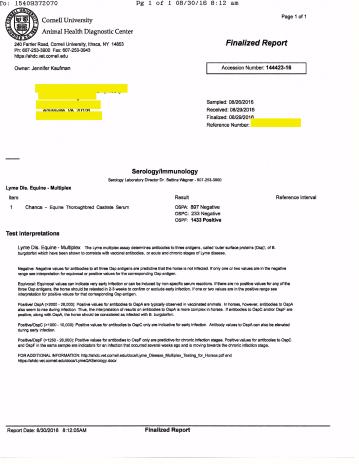
During my horse’s recent Lymphingitis flare-up, the vet advised that we run labs to test for Lyme and EPM due to his presenting symptoms (hind weakness, twisting his back leg at the walk/walking sideways I refer to it as- “Chance’s swagger”).  As I noted previously, Chance’s Lyme test revealed that he was at the beginning stages of an acute infection…yay for the labs at Cornell University for their amazing ability to give you more than a positive or negative!

A little history before getting to the EPM Tilter results.

About 2ish years ago, Chance was diagnosed with EPM (and one of the reasons opossums and I are not friends since they host the disease as do a few other culprits).  Chance immediately began EPM treatment- he received Protazil in his feed for one month. After hours of research I chose Protazil, although extremely expensive (if you order from http://www.drfosterandsmith.com they sometimes have promotions where you receive store credit for every $100.00 you spend…they did when I ordered and I got a “free” dog bed that my dogs adore), due to the decreased likelihood of Chance experiencing a “Treatment Crisis” (worsening of symptoms) and the ease of administration (other brands require the drug being administered 1 hour before eating or an hour after and so on).  Typically, EPM treatment is done for 30 days and, depending on the residual symptoms, some may require subsequent treatments.  While Chance’s symptoms improved, I wanted to ensure that we annihilated the disease and did another round of treatment but this time with Marquis.  At the end of two months, Chance’s ataxia was gone!

Fast forward to September 2016…Chance, just having a Lymphingitis flare-up, has been tested for Lyme and EPM. Lyme came back positive.  And….so did the EPM test..well, kind of.  Wonderful.  (See why I loathe opossums?)

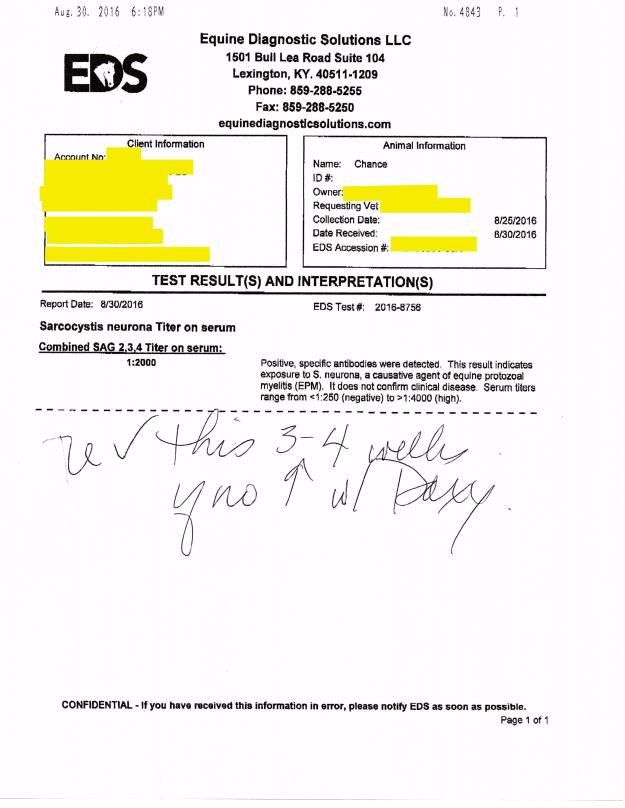
Chance’s EPM test #2 on 8/30/16 (the 1st one was 2ish years ago) showed the following:

“Combined SAG 2,3,4 Tilter on serum= 1:2000”

So, what does this mean?

The test revealed that Chance had “positive, specific antibodies” detected in the blood work.  This means that he had EXPOSURE to S. Neurona, a causative agent of EPM.   Serum tilters range from <1:250 (negative) to >1:4000 (high positive).  S. Neurona (SarcoFluor) is one of two protozoa found in EPM infected horses, the other protazoa is N. Hughesil (NeoFluor). S. Neurona is most frequently seen, whereas N. Hughesil is not as common.

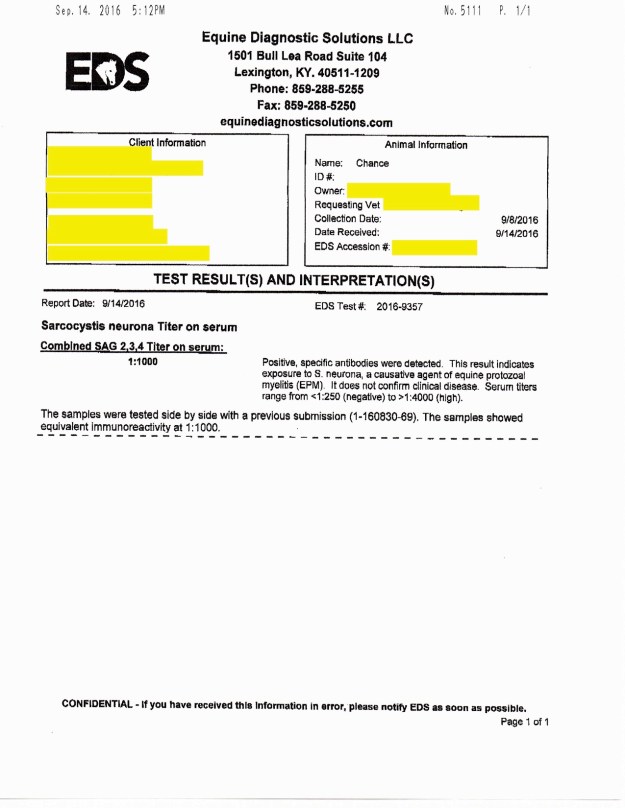
The vet ran another EPM test to confirm the findings in the 8/30/16 test.  The results showed that Chance had “Combined SAG 2,3,4 Tilter on serum= 1:1000.  Again, Chance showed EPM protozoa in the positive-ish range.

I initially had not seen the results but was told by the vet that he was EPM negative.  So when I asked for the test results to be emailed to me and saw the numbers I sort of freaked out…I emailed the vet to ask for clarification.  She explained,

“The EPM test shows that he was exposed to the organism in the first test we did which is why we did a follow-up test. Since his exposure level dropped from 1:2000 to 1:1000 this shows that he does not have the disease. There is no good one time test for EPM once they are exposed which is why we had to do the repeat to compare the two.”

While this explanation offered me comfort, I was confused…why does he have any protozoa in his blood if he doesn’t have EPM?

I spoke to another vet and she explained it in a bit more detail…I am hoping I am summarizing what she said correctly..

When a horse tests positive for EPM they either have an active disease or they may not.  However, when the test does from 1:2000 down to 1:1000 this typically means that the horse’s immune system is working correctly to fight the disease off- active or not.  EPM testing typically provides you with a % of the chance your horse has an active EPM infection, or at least if you send it to Cornell University.  For instance, lets say a horse gets the results back and it shows that they are “positive” or have been exposed to S. Neurona (one of the two EPM protozoa)…their results are  1:647.  This means that, after doing a bunch of adding and multiplying that this vet kindly did for me, the horse has a 60-70% chance of having ACTIVE EPM.  Meaning, he most likely would be symptomatic (ie: behavioral changes, ataxia, weight loss, difficulty eating, changes in soundness, and a bunch of other neurological symptoms).

My hunch is that Chance’s immune system was boosted because I started him on Transfer Factor (amazing stuff… more information can be found in some of my older posts) again as soon as his results came back positive for Lyme.

Here are the 3 EPM tilters that were run on Chance (oldest to most recent) along with his Lyme test results:

epm-2014

epm-test-results-8-31-16

EPM results 9-8-16 copy.jpg

lyme-titer-8-30-16

Horse Record Keeping? There’s An App For That!

I have been using the app “HorseNotes” on my iPhone for over a year.  It is by far the best software I have ever used and the best part is…you can access it on your computer as well as your iPhone (I believe it is also available for other smartphones).

Horsenotes.co allows me to make a profile for each of my horses and track their health, shoeing, tack, feed, vaccinations, worming, everything….There is a note section where I am able to log what I did that day with my horse.  I can log everything I purchase or every horse-related expense and with a press of a button the app/website even generates an expense report.  I can keep all of my contacts in one place- vets, stables, farriers, tack stores, etc. The app has a calendar that alerts you when you need to book the farrier or when the vet is coming. Plus, I can provide a log in for other people to add information as well.  You can upload records (sales, purchases, competition info, coggins) and pictures as well. Seriously, I don’t know how I was able to keep track of everything before I began using this incredible app!