Tag Archives: Cervical Spine

The Perfect storm

So, I wish I did not have to start this process again…but unfortunately, I do. Once again I have a senior horse with a variety of acute and chronic conditions that all hit at the same time. Right now I am trying to make her comfortable while also trying to figure out what is what and how to best respond.

Three months ago Tilly was tested for EPM due to muscle wasting and weight loss.The first time she was in the lower end of an active infection. We started a compounded medicine for 1 month and her numbers decreased. We decided to do another round as she responded well to the first round. However, the numbers remained the same. We also tested her for Lyme which showed a chronic and an active infection but the numbers were in the high normal range and the vet felt that it was not treatment worthy at the time.

Last month Tilly began “crab walking” out of the blue. Called the vet. They came out. Her ataxia was bilateral- both her left and right hind- whereas EPM tends to be unilateral. Further, her presentation was not suggestive of Lyme.

We started steroids (dexamethasone oral power) for 5 days with Banamine, tapering as we went, and she seemed to recover. The consensus was it was an acute attack that may have occurred given she is a senior with a history of being an Amish workhorse and perhaps, she pulled something in her neck.

Treatment was complete and another week went by and again, she showed some ataxia. This time less severe. The vet felt that since she responded well to the first round of steroids that it was not EPM-related as you would not see improvement. Further, if it were Lyme related the presentation would be more consistent. Again, a round of Dex and improved quickly. The next week we had her neck x-rayed and there were some arthritic changes. However, she was running around and moving well so the vet felt injections in her neck would not be necessary at that time.

Seventy two hours later, she had some trouble getting up but eventually succeeded. The next morning my sweet girl was spinning, crab walking, and falling over. It was absolutely terrible to see. I immediately gave her 10cc IV Banamine and she calmed down and stopped spinning. The vet came out and administered Dex IV and thought that due to her inflammatory bowel disease we should try Dex IM to ensure absorption. We also decided to pull blood to test for Cushings as she seemed to lose weight overnight and was not shedding out well. The next day she was lame on her right front. Panicked I called the vet fearing that if she did have Cushings, she was trying to founder due to the steroid use. Thankfully, the vet came out, did a nerve block on her right front (this helps to see if the horse has laminitis as they will improve once blocked) and checked for pulses (if a horse has laminitis typically they will have pulses in their hooves) and Tilly did not have any. So, the vet did not feel we were dealing with founder. However, the lameness presented a major challenge due to her still being ataxic on the hind end. The vet did cortisone injections into her neck hoping to help with inflammation due to arthritis. Tilly did great and suddenly, began freaking out. Spinning, knocking into the doors, etc. The vet explained that the injections likely added more pressure on her spinal cord causing her to react. Again, once the vet was able to safely administer Banamine and some Dorm, she calmed and laid down for the first time in over a week for a good 45 minutes. We decided to make sure she was able to get back up. Although she had some trouble, after a couple tries, she was able to do so. Her breathing was heavy, wheezy, almost like she was having a panic attack and hyperventilating. A few minutes later, her breathing returned to normal.

Tilly’s Cushing’s text level was about 100 pg/mL (it should be about 30 pg/mL during mid-November to mid-July) meaning, she does have Cushings. The vet decided to wean her off of the steroid as to not increase the risk of Laminitis even more but also to give neck injections time to work (5-7 days). We also immediately began Prescend (2 tabs) a day to treat her Cushings.

We are on day 5 since the 3rd ataxic episode and day 3 post neck injection and she is still lame on her right front along with ataxic on her hind end. However, she is still eating, engaging, and is bright and alert. She does not seemed distressed or in pain thankfully. Due to Tilly not showing much improvement (even though it can take 5-7 days to see improvements from the neck injections) I decided to start her on a non-compounded EPM medication, Protazil. According to the vet, Protazil should not cause any harm whether her symptoms are EMP related or not. I also began 10cc of Vitamin E oil. Tilly was previously on pelleted Vitamin E but due to her inflammatory bowel disorder, she may struggle to absorb the pelleted form of the supplement. Further, there are a number of studies showing the benefits of Vitamin E and the connection between Vitamin E and ataxia.

On a positive note, since starting Prescend for her Cushings, I have noticed that she is drinking less water. Increased water intake is a symptom of unmanaged Cushings. I am hopeful that means the medication has started to work at regulating her hormones. We are now at a wait and see point. I continue to try to make her comfortable. Tons of bedding in her huge foaling stall, hay everywhere, fans on, doors open. She has been a trooper. My hope is that she recovers from this and enjoy whatever time she has left and fights this as she has so many other things- the reason she was given the name, Ottilie.


RESOURCES

https://www.horseillustrated.com/horse-health-equine-cushings-disease-24321

https://www.horseillustrated.com/horse-experts-horse-vet-advice-cushings-disease-diet

https://cvm.msu.edu/vdl/laboratory-sections/endocrinology/equine-endocrine-testing

https://www.horseillustrated.com/horse-experts-horse-vet-advice-cushings-horse-treats

https://resources.integricare.ca/blog/cushings-disease-in-horses
https://equine-vets.com/health/l/laminitis-is-one-of-the-most-common-causes-of-lameness-in-horses-and-ponies/

Spotting Lameness: The Game Plan

Spotting Lameness: The Game Plan
— Read on horsenetwork.com/2018/10/spotting-lameness-game-plan/

Pump, Pump, Pump It Up!

The vet came out to give Chance and Lucky their fall shots and do some follow up acupuncture on Chance.  The vet said that Chance has increased flexibility especially in his cervical spine and has gained weight and muscle mass!!!!!!

His feeding regiment is as follows:

AM:

  1. 6 quarts of Nutrina Safe Choice Senior Feed
  2. 3 quarts hay stretcher
  3. Alfalfa hay mix (as much as he wants through out the day)

PM:

  1. 6 quarts of Nutrina Safe Choice Senior Feed
  2. 3 quarts hay stretcher
  3. Alfalfa hay mix (as much as he wants through out the day)
  4. 1 Scoops of DuraLactin (Natural anti-inflammatory and pain supplement)
  5. 1 SmartPak (Senior Flex, Immune Boost)

He is out all day when it is cool and all night when it is hot during the day. So he has tons of green grass to eat.  He walks constantly- up and down the hills- and runs around with Lucky.  We also walk ground poles and do stretches and massage every time I come out to the barn.

IMG_9796

We still need to continue upping his weight and muscle mass preferably before winter.  Fingers crossed.

Save

New Concerns Have Sprung

image

Chance greeting me as I drive up

The days are finally feeling like spring!  The grass is green, the blankets put away, the sun is shining, and the horses are shedding.

Chance is continuing to gain weight, although as I said in the previous post, he still needs to put on a good 50-75 lbs.  As the days continue to get warmer, Chance’s arthritis seems to become more manageable for him; his stride is longer and he runs around (mostly after Lucky) more frequently.

Unfortunately, when the farrier came out about two weeks ago Chance was too stiff to get his back right shoe on. The farrier decided to come back out to try and re-shoe him and, during that time in between, Chance must have tweaked it…AGAIN! 

 While Chance did not have a shoe on his back right I kept it wrapped to provide some protection and also even out all of his hooves.  However, when I arrived I noticed that Chance was significantly twisting his back right leg inward at the walk & it had some swelling.  The swelling was not horrible but it was noticeable. I cold hosed his leg for about 45 minutes while I groomed him & gave him a dose of Equinox (pain medication) and Ulcer Guard.  I put on his back leg wrap to help with reducing the swelling and provide some extra support.  Chance did his neck stretches effortlessly and was baring weight on his back hind. 

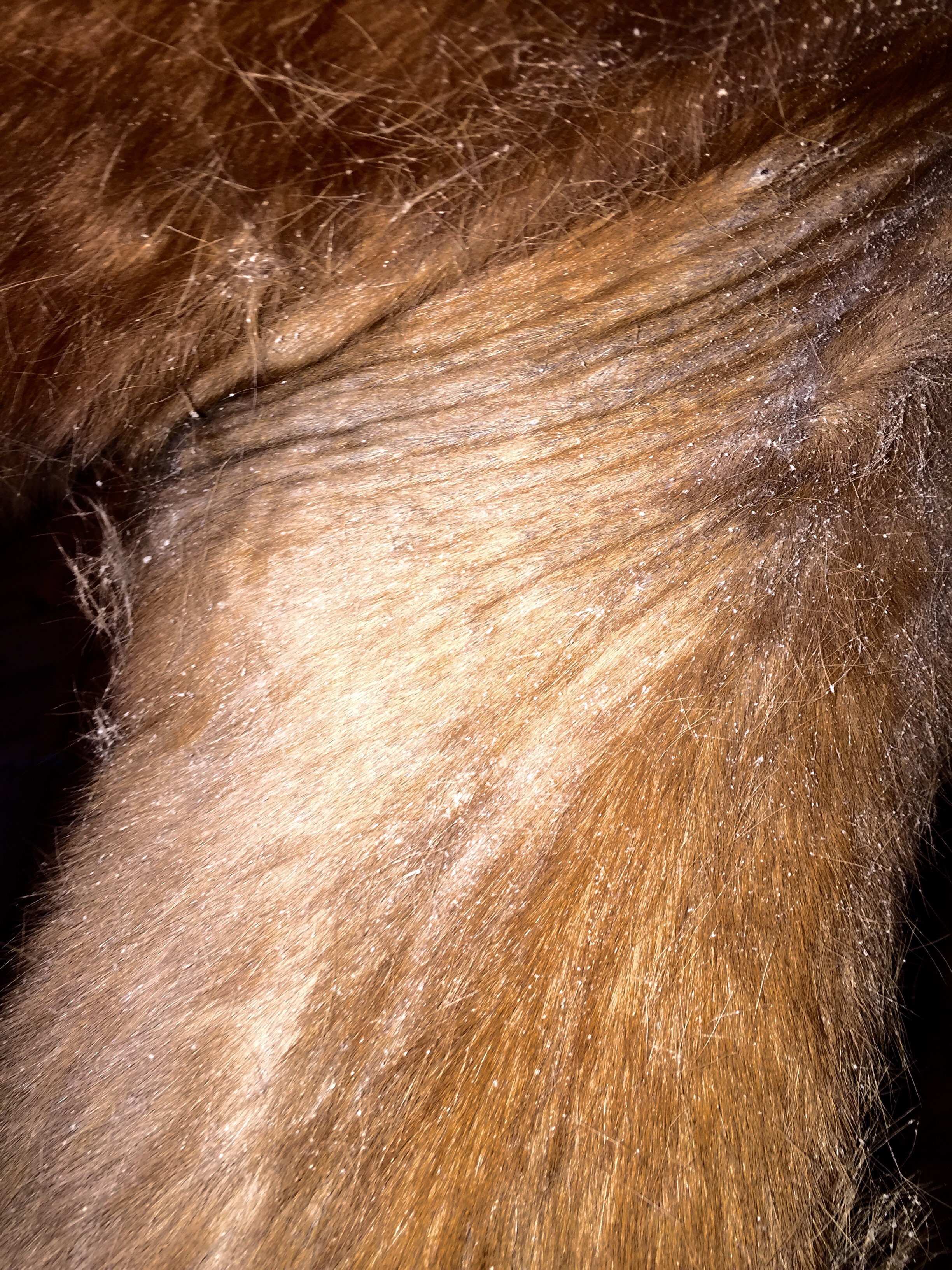
But as I was grooming him I noticed, on the left side his chest, he had patches of hair loss and dandruff.  The area did not look red or inflamed, nor did it seem itchy or painful.  So I continued grooming him and decided to put a call into the vet to come and check his leg and the hair loss.

Of course, I turned to Google to try and find out what exactly could be the cause of the patches of hair loss.

image

According to a handful of sources, there are a few possibilities for hair loss- mites or Lice, a vitamin deficiency, rain rot or crud, or even just his natural shedding tendency. A skin scrape would help to confirm what may be the cause. 

 As for the swelling of Chance’s back right leg, I decided to call our previous vet who collected and injected Chance’s DDFT with stem cells to heal the hole in his tendon. We have some stem cells left over and I wanted to see if injecting his leg again would be of any benefit.  I also would like to get an ultrasound recheck to ensure that there is not another injury to his DDFT tendon sheath again.

The twisting of his back hind leg is worrisome as well.  

Everything I have read about EPM states that horses can have a relapse in symptoms after treatment is complete. My concern is that the twisting are due to the neurological symptoms coming back since Chance’s EPM treatment has been finished for a little over two weeks…. 

 Our current vet believes that Chance’s ataxia and twisting is not due to EPM but his cervical spine instead.  Could the twisting be worse due to the swelling of his hind leg?  Or is the swelling and the twisting two separate issues all together?

Wobbler Syndrome in Older Horses

Wobbler Syndrome in Older Horses

By Erica Larson, News Editor

Mar 28, 2013

Wobbler Syndrome in Older HorsesThe gold standard for diagnosing CVSM is the meylogram (seen here), a procedure that involves injecting dye into the spinal canal before taking a set of radiographs to evaluate the spinal column’s width and to identify possible sites of compression.

Photo: University of Kentucky Gluck Equine Research Center

The neurologic condition cervical vertebral stenotic myopathy (CVSM, commonly known as wobbler syndrome) is much less common in older horses than it is in young, growing animals. But according to one clinician, this condition should be on all veterinarians’ differential diagnoses list when evaluating an aged horse presenting with neurologic signs and/or neck pain.

At the 2013 Western Veterinary Conference, held Feb. 17-21 in Las Vegas, Nev., Laurie Beard, DVM, MS, Dipl. ACVIM, associate clinical professor at Kansas State University’s College of Veterinary Medicine, presented a review of CVSM in aged horses.

Horses affected by CVSM essentially have a damaged spinal cord. The major causes of spinal cord damage include cervical (neck) vertebrae malformation or trauma.

“The exact pathogenesis of CVSM in older horses is unknown and likely different than younger horses,” Beard said. She said older horses are more likely to have lesions located in the caudal cervical vertebral column (near the base of the neck), between the vertebrae C5 and C6 or C6 and C7. She noted that some studies suggest biomechanical loading related to “wear and tear” could contribute to lesions. Additionally, she said, articular process osteophytosis (bony remodeling) is a common finding in older horses with CVSM.

Beard said common clinical signs associated with CVSM in older horses include:

  • Spinal ataxia (incoordination), generally symmetric with the hind limbs affected more than the front limbs. Beard noted that in some cases, however, mature horses with CVSM might appear more lame than ataxic;
  • Neck pain or stiffness;
  • Neck arthritis; and
  • Decreased appetite.

Beard said veterinarian frequently use standing cervical radiographs to diagnose CVSM in mature horses. However, if cervical radiograph results are inconclusive, a myelogram, considered the gold standard CVSM test, might be required. This procedure involves injecting dye into the spinal canal before taking a set of radiographs to evaluate the spinal column’s width and to identify possible sites of compression.

Treatment options for mature horses diagnosed with CVSM include:

  • Anti-inflammatory drugs (both steroidal and non-steroidal, depending on disease severity);
  • Natural vitamin E supplementation (Beard explained that vitamin E is an antioxidant that could act as an anti-inflammatory in horses with CVSM);
  • Cervical facet steroid injections (this procedure must be repeated every six months or so, but can reduce pain and soft tissue swelling); and
  • Surgical correction (which typically consists of fusing the affected vertebrae–the movement of which causes the spinal cord compression–together using a metal implement called a “basket” in a surgical procedure called cervical stabilization).

The prognosis for for return to work in mature horses with CVSM is variable and depends on the degree of ataxia present, Beard said.

“A horse with mild clinical disease that is a trail riding horse (or low-level performance horse) probably does have a reasonable chance of still performing,” she said. “However, higher level performance horses probably will not be able to perform at the level they were.”

Additionally, horses used for pleasure riding are more likely to have a good prognosis for full return to athletic function than higher performance athletes, she said.

Take-Home Message

Although it’s commonly thought of as a young horse disorder, Beard stressed that veterinarians should consider CVSM as a differential diagnosis in any horse with spinal ataxia. Prognosis for return to work depends on the degree of ataxia present, but many horses show improvement with medical management, she said.

The Equine Spa Treatment

This cold weather does a number on my joints, so I can only imagine what it must do to my old and arthritic horse. The last few days, Chance has been inside due to the single digit temperature outside, the strong winds, and the ice and snow.  (He used to “stock-up” when left inside, even for only one day, and now he no longer has this reaction).  The stall rest and hand walking will probably do him some good anyways!

Chance has always had Cervical Spine issues and over the years, you can feel the “knots” (for lack of a better word) on his neck.  Due to that, and his EPM, I decided to contact a massage therapist, chiropractor, and acupuncturist to come and work their magic on Chance!  Basically, a full day at the spa:).

I contacted one vet that incorporates run of the mill equine healthcare with chiropractic and acupuncture work, along with holistic medicine as well.  One review stated that she looked at/worked with the “whole horse” in order to assess, diagnose, and treat. Interestingly, I believe that this vet used to work on Chance about 10-12 years ago when he lived in Lorton, VA.  I sent her an email and I hope she has some availability.

I also found an equine massage therapist, who was certified through Equissage, and I will be contacting her tomorrow.

And, I have found Chance a dentist, and once again, he is Chance’s previous dentist from over a decade ago!

The equine world is a small one- at least in Virginia!