
Exposing The People Behind the Biggest Horse Slsugher Exposed
Tag Archives: equine health

Horses that Eat Everything! Including the barn
A Woodchuck or a Horse?
EQUINE BOTULISM: An unknown threat
Equine Botulism
Written by Dr. Tom Lenz on behalf of AQHA
Few horse owners are aware of this disease which is a progressive, paralyzing disease that is 80-100% fatal in affected horses. Botulism is sometimes referred to as “forage poisoning” in adult horses or “shaker foal syndrome” in foals. The disease is caused by a potent toxin that is produced by the bacterium Clostridium botulinum. This bacterium lives in the soil as well as the intestinal tract of many normal birds and mammals, including the horse. It produces dormant spores that can be found in 18.5% of soil samples tested in the United States. The disease is most prevalent in Kentucky, Ohio, Maryland, Pennsylvania, California, and Tennessee although it can occur in any state in the U.S. Clostridium botulinum produces several different toxins. Type A toxins are often implicated in human infant botulism and are most often found west of the Rocky Mountains. Types B, C, and D toxins are usually involved in cases of equine botulism, with Type B responsible for 85% of horse cases in the U.S.
Horses of any age are susceptible to botulism which may be initiated by one of three ways. In the case of “forage poisoning” the horse ingests toxins that are contaminating feedstuffs such as grain or hay. Feed contamination is most often due to putrefied carcasses of birds or rodents. A Type C botulism outbreak that killed a number of horses in California several years ago was traced back to hay that contained the infected carcass of a rabbit. The bacteria can also enter a horse’s body via contamination of a wound, especially a deep puncture wound. A good example is “Shaker foal syndrome” which is most frequently caused by the bacteria entering the newborn foal’s body through the foal’s moist navel. Something that can be minimized by dipping the foal’s navel in mild iodine solution soon after birth. The third method in which the disease can be initiated is by ingestion of the spores in the soil. The ingested spores activate in the horse’s intestinal tract where they produce potent toxins that are then absorbed. Regardless of the route, once the bacteria have entered the horse’s body they produce toxins that block transmission of nerve impulses to the horse’s muscles. This results in a progressive paralysis of all the major muscle groups and is concluded with paralysis of the diaphragm, which results in death. Once symptoms develop, death may ensue in several hours or take up to a week.
The disease is difficult to diagnose because it resembles several other medical conditions and diseases such as choke, colic, rabies, EPM, and sleeping sickness. Blood samples very rarely contain toxin and necropsy following the death of the horse usually does not provide a conclusive diagnosis. Because the bacteria often occur naturally in the horse’s intestinal tract, isolation of the organism from the sick horse’s intestine is not diagnostic.
Clinical signs of the disease in adult horses suffering from “forage poisoning” initially include loss of facial expression, a sleepy appearance, saliva drooling from the corner of the mouth, loss of tongue control and loss of tail tone. The horse’s appetite is good, but it has a great deal of difficulty in chewing food and appears to be “playing” in their feed and water buckets. As muscular weakness becomes more profound, the horse will experience muscle trembling, generalized sweating and labored breathing. A weakened, shuffling gait may develop and the horse may take stiff, short steps as if walking on eggs. Eventually, the horse goes down and death results due to paralysis of the respiratory muscles. “Shaker foal syndrome” is usually seen in foals one to two months of age but can develop as early as two weeks or as late as 8 months of age. Early signs in foals are similar to those seen in adults in that the foal shows generalized weakness, poor tail tone, and loss of tongue control. The foal will often dribble milk from the mouth and nostrils because of an inability to swallow. Because of muscle weakness, the foal will lie down frequently. When it does rise, it soon develops muscle tremors and collapses. Affected foals may die within 12 hours of exhibiting symptoms or may linger for as long as a week.
Botulism is usually fatal if left untreated. Prior to the advent of antitoxin, the death rate among affected foals was greater than 90%. With the use of antitoxins in conjunction with antibiotics and supportive therapy, the mortality rate can be reduced to less than 25%. Animals unable to swallow should be fed through a nasogastric tube and placed on IV fluids. Once the toxin produced by the bacteria is attached to the nerve ending it cannot be neutralized by the antitoxin. Therefore, early treatment is critical. Even with aggressive therapy, recovery is slow and may require up to two weeks before the affected horse recovers.
Because of the high death rate and the difficulty in diagnosing this disease, prevention through vaccination is critical. A Type-B Toxoid vaccine is available and is quite effective in preventing the disease. In areas where the disease is prevalent, pregnant mares should be initially vaccinated at the 8th, 9th and 10th month of gestation and thereafter at the 10th month of each pregnancy. Yearly vaccination of adults in areas where the disease frequently occurs is also recommended. If unable to vaccinate the mare prior to foaling, limited information suggests that foals vaccinated with the toxoid at 2 weeks, 4 weeks and at 8 weeks of age developed adequate protection, even in the presence of passive maternal antibodies. Currently, no licensed vaccines are available for preventing botulism due to Cl. botulinum types A or C or other subtypes of toxins. Cross-protection between subtypes does not occur.
As in all horse health issues, your local veterinarian is your best source of information.
ABOUT THE AUTHOR: Thomas R. Lenz, DVM, M.S., Diplomate of the American College of Theriogenologists, is a trustee of the American Horse Council, past chairman of AQHA’s research committee and past president of the American Association of Equine Practitioners. This article is provided courtesy of AAEP Alliance Partner, AQHA.
Reviewed and updated by original author in 2016.
Spotting Lameness: The Game Plan
Spotting Lameness: The Game Plan
— Read on horsenetwork.com/2018/10/spotting-lameness-game-plan/
Core Vaccination: Protecting Horses From 5 Deadly Diseases – The Horse
Learn about the diseases veterinarians recommend protecting your horse against and how vaccination could save your horse’s life.
— Read on thehorse.com/features/core-vaccination-protecting-horses-from-5-deadly-diseases/
When it rains…
Core Vaccinations Every Horse Needs
Ask TheHorse Archives – The Horse
— Read on thehorse.com/topics/podcasts/ask-thehorse/
Dealing With Equine Colic: Here are 33 Do’s and Don’ts – The Horse
What should you do (or not do) if your horse shows signs of colic? And how do you prevent colic in the first place? Find out from our veterinary experts.
— Read on thehorse.com/features/dealing-with-equine-colic/
Disaster Prep for Equine
Equine Vaccination Cheat Sheet – The Horse
Equine Vaccination Cheat Sheet – The Horse
— Read on thehorse.com/137994/equine-vaccination-cheat-sheet/

You’re Always with Me
Tonight I lost my best friend, Chance. The one who whinnied the moment my car pulled up, would run away and wait for me to catch him only to turn around and run away again. He made me laugh, knew all my secrets and nuzzled me when I was sad. He taught me about unconditional love and having a positive attitude despite circumstances. He nodded when I asked if he loved me and gave kisses to get treats. He’s the 17.1 hand horse who would stand behind me and fall asleep as I did my school work and would get upset if any horse got near me but would never hurt a fly. He let children hug him and dogs run into his stall and let me dress him up with flowers. He loved rolling in the snow, laying in the sunshine, and would light up the moment he saw me. I’ll miss playing in the barn on cold nights and curling up reading in his stall when he wasn’t feeling well. I’m thankful that he waited for me to get there tonight to say goodbye so I could hold his head in my lap and talk to him while he passed. There will never be a sweeter horse with a more gentle and pure soul. Thank you, Bubba, for being with me through it all- high school, college, the break ups, the losses, the good and bad days. You gave one hell of a fight for 30+ years. Lucky and I will miss you- there will never be another you❤️ #myfavoriteredhead #chancewetake #20yearstogether #thebesthorseintheworld #myheart

Wobbler Syndrome: Proof At Last!
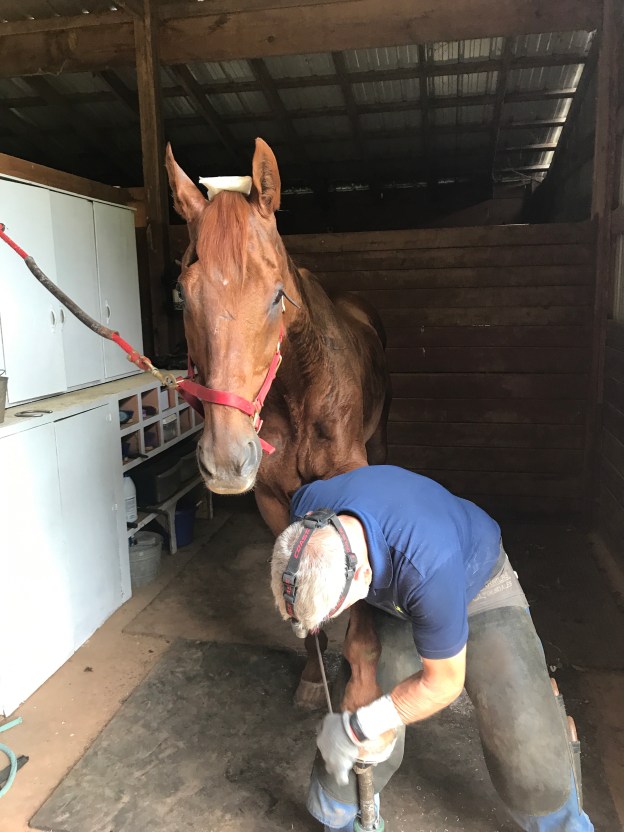
Ice Packs & Horseshoes
When it’s hot outside and you are getting your feet done, it’s imperative to have an ice pack on your head.


Diagnose and Track Your Horse’s Health with Your Phone
Carrying a smartphone or tablet is like having a spare brain in your pocket, one that helps you keep track of all the details in your busy life. At the barn, that device can also help you keep your horse healthy.
Health Data in Your Hand
The latest tool for this task is Horse Health Tracker, a smartphone app released by Equine Guelph, the horse-focused education and research center at the University of Guelph in Ontario, Canada. It’s designed to help you monitor vital health information for your horse.
The heart of the app is the Horse Health Check feature. It guides you through a 16-point health checklist that covers the horse from ears to hooves. Videos show you how to monitor heart rate and other vital signs. You can record results as often as you like, even several times a day, which makes this feature important for monitoring a sick horse.
Other features in the app help you determine and record the horse’s body condition score or estimate his body weight. A video library gives you quick access to all the instructional videos presented in the app. The app retains data from each health tool for 13 months and it will generate graphs so you can compare the results over time. Built-in email capability allows you to send the data directly to your veterinarian or others. You can also enter reminders for vet and farrier visits and other appointments. If you want, the app will sync the reminders with your smartphone’s calendar.
Horse Health Tracker is available for download at the App Store and Google Play. The basic version, which is free, allows you to track information for one or two horses. Upgrades ($4.59 to $11.99) can handle as many as 50 horses. Each horse is tracked separately, and you can add pictures taken with your device to the records. A user guide is online at equineguelph.ca.
Five-Minute Parasite Egg Counts
Does your horse need deworming right now or can he wait until fall? Soon a smartphone may help answer that question, thanks to an innovative new fecal-testing system developed in collaboration with scientists at the University of Kentucky.
Current veterinary guidelines call for individualized deworming programs, using fecal testing to determine the best intervals between treatments and to gauge whether the drugs you’re using are effective. The tests look for the eggs of strongyles, ascarids and some other parasites in manure samples. You collect a sample and send it to a lab (directly or through your veterinarian), where a technician prepares a slide, views it with a microscope and manually counts each visible egg with a clicker. This work requires skill and training, and the results take some time. Generally you’ll wait a week to 10 days for the them to come back.

The new Parasight imaging unit attaches to a smartphone. Veterinarians can use it in the field to get immediate information about a horse’s parasite load. | Courtesy, MEP Equine Solutions, LLC
The new system, called Parasight, shortens that time to less than five minutes. This means that vets can use it in the field to get real-time information about parasite loads. The system includes a smartphone app, an imaging unit (a simple device that attaches to a smartphone) and a kit for prepping manure samples. Samples are first treated with chemicals that cause parasite eggs to glow under blue light. Then they are placed in the imaging unit and photographed with a smartphone.
The smartphone app counts the glowing eggs and emails the results to the veterinarian, along with recommendations for treatment. It can distinguish between different types of parasite eggs and is as accurate as traditional lab tests, the developers say. A companion follow-up kit, which gives less detailed information, is intended for horse owners to use in monitoring the effectiveness of treatment.
MEP Equine Solutions, LLC, the Lexington, Kentucky, company that developed the Parasight System, expects to have a commercial version on the market within a year. Last spring, the company was awarded a $100,000 Small Business Innovation Research grant from the U.S. Department of Agriculture to help move the process along. The people behind the company include Chief Scientific Officer and Co-founder Paul Slusarewicz, PhD, an adjunct professor at the University of Kentucky’s Gluck Equine Research Center who focuses on the commercial development of new animal-health technologies. MEP’s other co-founders are company President Eric Hauk, a businessman, and Technical Adviser Martin Nielsen, DVM, PhD, an international expert in parasitology research who is an assistant professor at the Gluck Center.—Elaine Pascoe
This article originally appeared in the July 2015 issue of Practical Horseman.
 The Chances We Take