Category Archives: Hole in Tendon

DDFT Lesions

Text from Vet4 after ultra sound #3:

“I can see that he has a deep digital flexor tendon lesion and the medial side of the tendon sheath has improve but lateral side is about the same. The DDFT may the cause of all this in the first place and everything else is secondary. We will re ultrasound in 10 days or so just to confirm my findings. If they are correct, it would help to treat that area.”

Conversation with Vet4 :
So far, Chance has received; shock wave therapy, compression therapy and laser therapy.

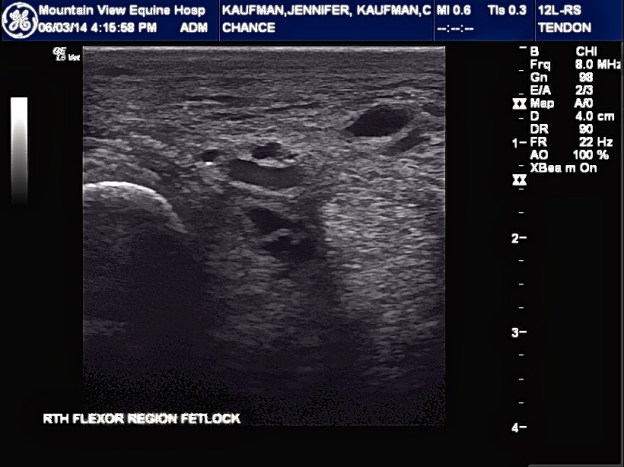
Chance has a hole in his tendon. Vet4 believes that this is due to an infection/bowed tendon and severe lameness. The ultrasound, done yesterday, shows no change in size of the tendon hole after the previous two rounds of injections.

“Lymphangitis is a symptom rather than a cause and the cause was never treated.” Vet1 continued to treat it like a disorder rather than a symptom!

The swelling and infection have dissipated, as has the severity of the lameness. Though still lame, he is running around in the pasture.
Pain meds were started again due to increased discomfort and soreness.

Vet4 suggests doing one of the following:

1. Stem cell- which can take about two days if sample drawn has enough stem cells. If not, it could take about 4-6 wks to culture. Once injected he can move home. He is to be hand walked for a few days and then can go out as normal. Vet4 will come out in about a month to do another ultrasound and, depending on the size of the hole, may need to do further injections.

2. Surgery to clean out but NOT repair the tendon. This was not discussed in detail.
Payment plans may be an option. I emailed the office for payment options.

Time to make another decision!

100% Turn Around!

Spoke with Vet4 today. He said Chance has made a “100% turn around”. He trotted him today and Chance was putting full weight on both hind feet! Swelling is disappearing as well!

We spoke about further treatments aside from the Baytril.

I asked about potassium penicillin- He is apprehensive to do potassium penicillin due to horses on antibiotics having DNA changing effects. That it is best to stick to the Baytril and do an ultrasound tomorrow (Friday) to view any changes to the masses. He suggests to have Baytril on hand when Chance leaves to begin immediately if swelling occurs again, which he believes will not be the case after this hospitalization.

I asked about Hydraulic acid: He also is hesitant to inject the SS with the Hydraulic acid due to it’s effects on certain bacterial strains- often allowing the bacteria to hide from the antibiotics. He does agree that another round of injections would probably be helpful and will know more after the next ultrasound.

When asked whether scratches can lead to Lymphangitis, thus leading to the infected SS, he said it is hard to tell but certainly possible.

Chance is currently receiving laser therapy and cold compression therapy along with Baytril, pain meds, and supplements.

Vet4 believes that Chance should be able to leave within a week to two weeks depending on progress!

Dr. Fortier’s “Lameness Originating from Tendon Sheaths”

Lameness originating from tendon sheathes.
Lisa A. Fortier, DVM, PhD, Diplomate ACVS Cornell University, Ithaca, New York, USA
Laf4@cornell.edu

(Below is cut and pasted from Dr. Fortier’s “Lameness Originating from Tendon Sheaths”)

The most commonly affected tendon sheathes associated with lameness is horses are the digital, carpal, and tarsal sheaths. In general, the diagnoses of lameness originating from tendon sheathes is increasing with awareness and with the more common use of MRI. Clinical signs associated with tendon sheath lameness are variable with respect to degree of lameness and extent of synovial distension. In general, the lameness will worsen with flexion and with work, but the degree of lameness is not directly associated with prognosis for return to athletic performance.

Lameness associated with the digital sheath

Lameness can be localized to the digital sheath with a low 4-point block or intrathecal anesthesia. If sepsis is suspected, a clean (non blood-contaminated) synovial fluid sample can be obtained at the base of the sesamoid bones and axial to the palmar digital neurovascular bundle.

Simple annular ligament constriction, without involvement of the superficial (SDFT) or deep digital flexor tendons (DDFT) is a common cause of lameness associated with the digital sheath. When viewed from the side, the palmar/plantar profile of the digital sheath will have a “notched” or “cut-in” appearance at the fetlock joint. The integrity of the annular ligament (thickness and structure) should be evaluated using ultrasonography to be sure there are no other structures involved such as the SDFT or DDFT. Horses can be treated with intrathecal hyaluronic acid with variable success prior to surgical intervention. If the annular ligament is the sole structure involved and there are no adhesions within the tendon sheath, then a closed or semi-open annular ligament transection could be performed rather than a tenoscopic transection. If ultrasound examination reveals adhesions or synovial masses within the sheath, then tenoscopic exploration and removal of the masses/adhesions is warranted.
Performing surgical maneuvers or exploratory surgery under tenoscopic guidance has distinct advantages as compared to open approaches. Tenoscopy allows for more complete examination of the entire tendon and tendon sheath, resulting in a more accurate diagnosis than can be provided by ultrasonography and the surgeon has an opportunity for removal of pathologic tissues such as synovial proliferative masses, hyperplasic synovial tissue, and adhesions. Additionally, the use of tenoscopic portals instead of an open approach reduces potential iatrogenic damage to neighboring structures and decreases the incidence of postoperative synovial fistulation. The biggest take-home message of these notes should be that the presence or extent of synovial masses/adhesions is not directly correlated with prognosis and many horses return to full athletic performance after tenoscopic surgery and removal of adhesions/masses and annular ligament transection.

Longitudinal tears in deep flexor tendon are increasing commonly diagnosed. Like adhesions and masses, tears are frequently worse on tenoscopic exam than on ultrasound. In these cases, the tendon tear appears to be the primary cause of the tenosynovitis and the annular ligament constriction is likely secondary. Currently, debriding the tendon edges is the only treatment, but some tendon repair technique seems warranted. Ian Wright described a combined approach to repair these tears, but has subsequently discontinued this practice and simple debridement of the granulation tissue between tendon edges is recommended.

Research, Research, Research

Tendon Injury Handbook

After I left the barn, I drove home and went straight to my computer.

What was happening?  What are the masses? Scar tissue?  Nothing was able to be extracted out of them…How can I get rid of them in order to see behind them?

Again, I stayed up until the sun came out the next morning.  I already had two binders full of research and now I had a third.

Research made me believe that C has an infection in the Synovial Tendon Sheath that was being masked by the masses on the outer lining of the SS. The masses could be scar tissue from his MANY past Lymphangitis flare-ups. Perhaps, his immune system was not able to fight last attack and the infection settled in the SS and was walled off.  Thus his CBC & WBC were normal and no fluid was extracted from SS masses due to the large size of the scar tissue.
C has a major hx with his RH and “flare-ups” and lameness. I never realized this until I took the time to study his past records from the first 5 years I owned him.

Symptoms are similar to an infection- what if we proceeded as if it were?
Lack of a positive culture does NOT mean that there is not an infection in the sheath!

Current Symptoms:
1. Swelling decreases after being active
2. Fails to extend fetlock
3. Lame- exasperated by flexion
4. Positioning for fetlock flexion

Septic Synovitis: Cartilage degradation ischemia, Fibrin deposition lead to lameness to pannus form and adhesive form

Entrobacteriacaea
Strep
Staph
Most common is Staph

Treatment: 

Systematic Procaine Penicillin 22000 iU/kg or Sodium Benzyl Penicillin & Gentamicin 6.6 mg/kg for 2-9 days

Then change to oral potentiated sulfonamides 5mg.kg Trimethoprim and 25 mg/kg of Sulphadiazine

Other potassium penicillin w/ Amikacin Cectiofur or Enrofloxacin

IV antibiotics for 7-10 days switch to oral for 2 weeks

Regional limb profusion or placement of impregnated Polymethyylmethacralate or PMMA

I immediately called Vet4 and told him my theory.  He said that it was possible and that we should begin treatment asap.  He was still out of town so I called Vet3 to order Baytril. Vet3 felt my theory was legit and immediately ordered the antibiotic!

“Ask him what he wants…you will know what to do from there.”

When I arrived at the farm I was greeted by those familiar big brown eyes and a whinny.

I brought him out of his stall and gave him a bath.  He has always loved to be groomed and bathed, even if he is apprehensive to walk into the wash stall. After his bath, we went outside for him to graze and get some sunshine.  When we walked inside the barn, I stopped him and looked into his eyes and asked him, “do you want to keep trying to get better or are you ready to give up?”  He just looked at me.  A lump immediately formed in my throat.  He nuzzled me and rubbed against me.  I said again, “Do you want to keep fighting?”  He shook his head up and down! I swear to you!  This actually happened!

The decision was made, we would keep on fighting as long as we were able to keep him comfortable.  There was nothing I wanted more than to bring him home with me, let him live out the last days of his life pain-free, and with me by his side.

This was his turn.  He had always done what I asked of him- lessons, moving stables and even cities, and he was patient while I was in school- and it was his turn for me to make it about him.  For Chance to get every ounce of my time and for me to fight for him!

IMG_1795

Road blocks


IMG_1892


The first round of injections provided Chance with some relief, in his ability to move around and the swelling went down a bit, but that only lasted about a week.  At about day 8, Chance was swollen again and 3 legged lame.  Thankfully, a family friend of the farms owner called me.  She explained that the farrier was out shoeing one of the horses and saw Chance’s leg, and when he arrived to shoe her horses, he expressed his concern.  I immediately contacted Vet4 an he was out the following day.

Vet4 injected the masses again as a temporary fix, until we could make some decisions.  The ultrasound showed that the masses were the exact same as they were in the first ultrasound- they hadn’t increased or decreased in size.

Later that evening, Vet4 and I had a lengthy conversation about where to go from here.

We discussed the options again, at length.  We could do an MRI to gain more insight into what is happening with that leg, go in with an Arthroscope and clean it out, or look into Stem Cell Therapy.

Well, I wasn’t comfortable putting Chance under anesthesia…he was too old and too frail.  Plus, he could break a leg or a hip going down.  So, that ruled out the MRI (unless I could find a standing one) and the surgery.  The Stem Cells would run about $3000.00, plus he would need to goto the hospital to have the procedure done.

I took the night to think it over, and stayed up until sunrise reading as much as I could on leg issues, the different options vet4 and I had discussed, and other potential causes.

That next morning, I received a call that Chance was worse.  Vet4 was out of town due to an emergency, so I called Vet3.  She got out to the farm immediately.

Vet3 gave Chance Surpass topical to put on the leg, Banamine, Ulcer Guard, and continued with the Prevacox to keep him comfortable.

I asked her what she thought about the options- she felt, as I did, the surgery wasn’t a good idea and that an MRI should only be done without sedation.

I called Vet4 and we spoke about the current situation.  What else is going on? He suggested changing the course and trying different diagnostics.  He explained that TSMs (Tendon Sheath Masses) can cause swelling and pain, but they are usually relieved by the injections.  The ultrasounds showed that his suspensory tendon and ligaments looked good.  Could this be an infection? Soft tissue damage? A bone issue?

I asked him if he felt moving forward with more tests was a bad thing…was I being cruel keeping Chance alive like this?  Something that had been weighing on me from the start.  And what Vet4 said, empowered me to continue down the path I initially felt in my gut to be the right decision.  He said, “I am not the kind of person to ever give up on someone or something.” I asked if we were able to manage his pain adequately and make sure he was comfortable and he said, yes.  He advised me to “make a decision based on the horse” and “not to listen to the opinions of everyone else”.

The next day, I cleared my schedule, and headed to the farm.


Coming Home to Love & Peace

Chance was able to come home a week later.  Sam & John went to pick him up at the hospital. However, upon arriving, they soon found out that Chance did not want to get on the trailer.  Sam later told me that one of my sweatshirts was in the truck, so she brought it out and let him smell it- he finally loaded.

I got his stall ready- tons of fresh shavings, hay, a new water bucket…

The moment he got off of the trailer he was shaking!  I gave him a warm bath and let him out in a small, flat paddock so he could be in the sunshine.

This is what happened when I let him out!  He did something he had not been capable of doing for months and months, if not longer.

Answers

Vet4 came out immediately.  I was beyond grateful!

He did an ultrasound of the back right leg and called me.  He found that Chance has Chronic Cellulitis and that there was Vascular constriction, and masses on the tendon sheath between the superficial and deep tendon sheaths.  The Doppler showed good blood flow and a thickening of the synovial lining. Hoof testers- Negative

We spoke about my opinions- MRI, Arthroscopic surgery, Regional Diffusion, Cold Compression Therapy, Nerve Block Injections, Steroid Injections

We decided  to try the Steroid Injections into the 3 Synovial masses to hopefully reduce the size and thickening.  Thus allowing us to see behind the masses to see what is actually happening.

Injections were into the Proximal Digital Flexor Tendon Sheath with 6mg Betamethasone and d100mg of Amikacon. Leg was covered with SSD and DMSO and bandaged.

Once injected, cold compression therapy for about 5 days twice a day and stall rest. Banamine daily.

The Guessing Game

IMG_7563The month passed by slowly….I kept hitting a brick wall over and over again…with each diagnostic test we ran.

Vet2: This was Chance’s vet for many years and where Chance lived the summer I moved home.  Vet1 was used because of connivence and due to being the vet of the owner of the farm.   I called Vet2, desperate, and she came out to see him.  Vet2 had always been amazing with Chance- kind, calm, and seems to act on intuition in conjunction with science.  She ran a CBC, tested for Cushings, Lymes, an did x-rays on the back right leg.

RESULTS:

* Metabolic Syndrome- Cornell

GLUCOSE: 10mg/dl

LIPEMIA: 8mg/dl

HEMOLYSIS: 1mg/dl

ICTERUS: 2mg/dl

*Endocrinology

ACTH endo 21.4 pg/ml

INSULIN 15.22 uIU/ml

THYROXINE T4 baseline 0.77 ug/dl

*Lyme Mitpix- Cornel

OspA Value 1253- Equivocal

OspC Value 79- Negative

OspF Value 592- Negative

Temp: 99.1, HR: 42, RR: 12, No murmur

Received Potomac Rabies and Stanozanol 4ml 7 vit B12

The X-rays of his back right showed nothing that could cause his flare-ups.  While his thyroid was a bit low, it was not clinically significant.  He was negative for Lymes and Cushings.  Next step, aside from pain management, is to call Vet3- the holistic approach.

Horse's Leg

Tendon Injury Handbook

The Call

One day I received a call that I needed to come out and see Chance because he wasn’t doing well and, according to Vet1, he needed to be put down.  I quickly canceled my appointments and got on the road.  The 4 hour drive was excruciating…once we finally arrived, my heart broke.

My old guy was skin and bones.  His back right leg was swollen and he wasn’t able to bare weight on it.  His eyes were dull.  He could barely walk, and when he did, he wouldn’t put any weight on the right hind.  There were even times when he would do this “neurologic dance” (coined by the farm’s owner and C’s other mom) where he would lift up his back right leg and hop!

But when he saw me pull up, he whinnied.  He was excited to see me.  He ate the pureed carrots but refused the apple puree (only my mom would make this for him).  He wasn’t ready to die.


I called the vet who said that Chance should be put down to see what his thoughts were.

Me:   What do you think is going on with C?

Vet1: I think he is ready to be put down. 

Me: Because of what?

Vet1: Lymphangitis

Me: Okay, well, what is the cause of the Lymphangitis? Did you run any diagnostics?

Vet1: No

Me:  I would like to manage his pain and run a few tests before making that decision.  (I reviewed the research that I had done and asked where to go from there.) Could it be EPM?

Vet1: “It’s not EPM”

Me: How about Cushings? Or Laminitis? Lymes?

Vet1: Nope. Just old age.

Me: The journals I read said that some of the symptoms…(I was cut off)

Vet1: “I don’t care what journals you read!  It’s a bunch of…”

Me: One was from VA Tech actually…


Well, that was that! Vet1 did not completely lack compassion but he was more “old school” I guess one could say.  He was well respected in the horse world and up until this point, he did the job I needed. But I will say I was disheartened by our conversation.  

I decided to contact the other vets that I had worked with in the past, who also knew Chance, and get second, third, fourth opinions.  

IMG_8299IMG_8296IMG_8293IMG_8300