Category Archives: How-To Guides

Extra Care for Horses in Cold Weather

Horses Require Extra Attention when Temperatures Plummet

With freezing temperatures comes the need for extra care and attention for horses and other equids.

Favorite

Horses Require Extra Attention When Temperatures Plummet
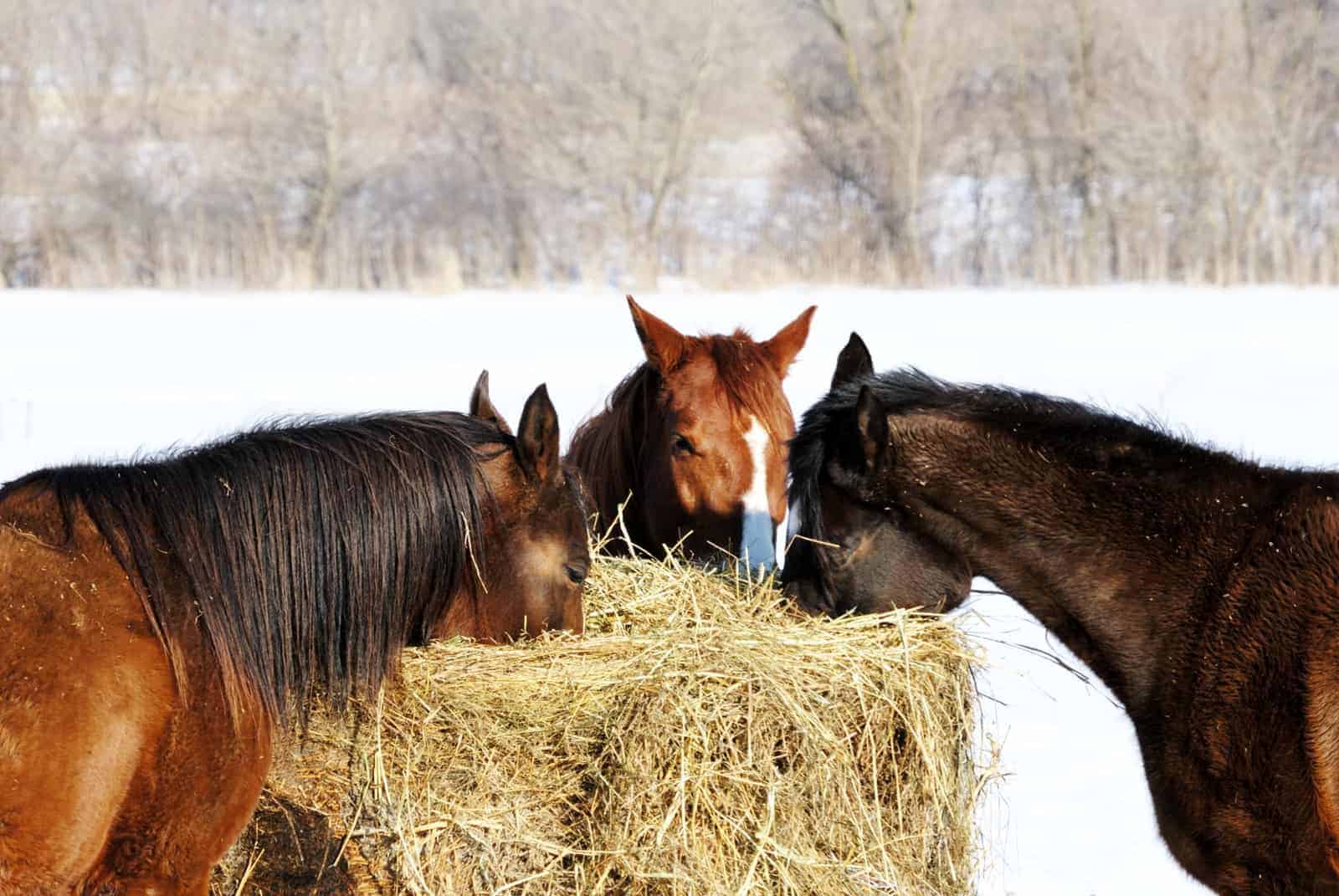
The next few days will bring freezing weather to many parts of the country, and with that comes the need for extra care and attention for horses, donkeys, ponies, mules, and any other outdoor animals.As the temperatures decrease, a horse’s feed requirements increase. Allowing horses free choice to good quality forage (hay) is the surest way to ensure that they consume enough energy, and the process of digesting forage will actually produce heat. Horses will typically consume 2 to 2.5% of their body weight in forage each day; that would be 25 pounds per day for a 1,000 pound horse. Winter pasture alone will not provide enough forage to sustain a horse and, therefore, must be supplemented with hay and/or grain.

The growing season some parts of the nation had last year produced overly stemmy or fibrous hay with a lower digestibility. As a result, making certain that horses are supplemented with grain when fed lower quality hay will help them maintain body weight and condition, a key factor in withstanding cold temperatures.

Constant access to clean, fresh water at 35 to 50°F is an absolute necessity to keeping horses healthy. This can be achieved via heated tanks or buckets, or by filling a tank, letting it freeze, cutting an access hole in the frozen surface, and then always filling the tank to below the level of the hole from that point on. This provides a self-insulating function and will typically keep the water below from freezing. Regardless of the method you choose, it’s important to check tanks frequently to ensure your horse’s water remains free of ice.

Additional ways to keep horses comfortable in cold weather include making sure they have access to shelter. A well-bedded, three-sided shed facing south or east will typically provide adequate protection from wind and snow, as can appropriate bluffs or treed areas.

When the temperatures get colder, mature horses will not typically move around much in an effort to conserve energy. Making an attempt to keep hay, shelter, and water fairly close together can limit the energy expenditure required, thus conserving body condition.

And, finally, keeping horses at a body condition score of 5 or 6 (on a 9-point scale) will help prevent surprises when horses shed their winter hair in the spring, and improve conception rates for those choosing to breed.

When it rains…

ker.com/equinews/white-line-disease-requires-early-diagnosis-and-aggressive-treatment/

Dealing With Equine Colic: Here are 33 Do’s and Don’ts – The Horse

What should you do (or not do) if your horse shows signs of colic? And how do you prevent colic in the first place? Find out from our veterinary experts.
— Read on thehorse.com/features/dealing-with-equine-colic/

Three Ways You May Be Inadvertently Putting Your Barn at Risk for Fire

We all love our horses. Sometimes in the interest of expedience we can inadvertently create unsafe conditions. ©Thomas Gumbrecht

More so than from other tragedies, I find myself physically as well as emotionally affected by these stories. As the horses usually have absolutely no chance of escaping, I think it is probably the horse owner’s worst nightmare.

Emotions aside, in my job as a professional electrician, I am mindful that many of these fires are caused by faulty electrical wiring or fixtures. Over the year,s I have borne witness to my share of potential and actual hazards. Designing a barn’s electrical system to today’s codes and standards is a topic for another day. For today, let’s address what we can do to make the existing horse barn safer.

I can’t cite statistics or studies, but my own experience shows the main safety issues that I am exposed to fall into three general categories:

 
  1. Using extension cords in place of permanent wiring
  2. Exposed lamps in lighting fixtures, and
  3. Overloading of branch circuits.

The first item I am addressing is extension cords.

I am often asked how extension cords can be UL-listed and sold if they are inherently unsafe. The answer is that cords are not unsafe when used as intended, but become so when used in place of permanent wiring.

The main concern is that most general purpose outlets in barns are powered by 15 or 20 ampere circuits, using 14 or 12 gauge building wiring, respectively. Most cords, however, for reasons of economy and flexibility, are rated for 8 or 10 amperes, and are constructed of 18 or 16 gauge wiring. That’s no problem if you are using the cord as intended—say, powering a clipper that only draws 1 to 4 amperes.

The problem comes when the cord is left in place, maybe tacked up on the rafters for the sake of “neatness.” You use it occasionally, but then winter comes and you plug a couple of bucket heaters into it. When the horses start drinking more water because it’s not ice cold, two buckets become four—or more.

If they draw 2.5 amperes each, you are now drawing 10 amperes on your 18 gauge extension cord that is only rated to carry 8 amperes. The circuit breaker won’t trip because it is protecting the building wiring, which is rated at 20 amperes. A GFCI outlet won’t trip either because the problem is an overload, not a ground fault.

Anyway, next winter, you decide to remove two of the buckets and add a trough outside the stall with a 1500 watt heater, which draws 12.5 amps at 120 volts. If you thought of it, you even replaced the old 18 gauge cord with a 16 gauge one that the package called “heavy duty.” Now the load is 17.5 amperes on a cord that is designed to handle 10 amperes.

In this case, it is possible to overload a “heavy duty” cord by using it at 175% of its rated capacity and never trip a circuit breaker. What has happened is, we’ve begun to think of the extension cord as permanent wiring, rather than as a temporary convenience to extend the appliance cord over to the outlet.

In doing so, we have created an unsafe condition.

Overloaded cords run hot. Heat is the product of too much current flowing over too small a wire. The material they are made of isn’t intended to stand up over time as permanent wiring must. It’s assumed that you will have the opportunity to inspect it as you unroll it before each use.

 
“Love means attention, which means taking care of that which we love. We call this stable management” —George Morris. ©Thomas Gumbrecht

The second item on our list is exposed lamps (bulbs) in lighting fixtures.

Put simply, they don’t belong in a horse barn. A hot light bulb that gets covered in dust or cobwebs is a hazard. A bulb that explodes due to accumulating moisture, being struck by horse or human, or simply a manufacturing defect introduces the additional risk of a hot filament falling onto a flammable fuel source such as hay or dry shavings.

In the case of an unguarded fluorescent fixture, birds frequently build nests in or above these fixtures due to the heat generated by the ballast transformers within them. Ballasts do burn out, and a fuel source—such as that from birds’ nesting materials—will provide, with oxygen, all the necessary components for a fire that may quickly spread to dry wood framing.

The relatively easy fix is to use totally enclosed, gasketed and guarded light fixtures everywhere in the barn. They are known in the trade as vaporproof fixtures and are completely enclosed so that nothing can enter them, nothing can touch the hot lamp, and no hot parts or gases can escape in the event of failure.

The incandescent versions have a cast metal wiring box, a Pyrex globe covering the lamp, and a cast metal guard over the globe. In the case of the fluorescent fixture, the normal metal fixture pan is surrounded by a sealed fiberglass enclosure with a gasketed lexan cover over the lamps sealed with a gasket and secured in place with multiple pressure clamps.

Unsafe conditions tend to creep up on us. We don’t set out to create unsafe conditions for our horses. ©Thomas Gumbrecht

The last item, overloaded branch circuits, is not typically a problem if the wiring was professionally installed and not subsequently tampered with. If too much load is placed on a circuit that has been properly protected, the result will be only the inconvenience of a tripped circuit breaker.

The problem comes when some “resourceful” individual does a quick fix by installing a larger circuit breaker. The immediate problem, tripping of a circuit breaker, is solved, but the much more serious problem of wiring that is no longer protected at the level for which it was designed, is created.

Any time a wire is allowed to carry more current than it was designed to, there is nothing to stop it from heating up to a level above which is considered acceptable.


Unsafe conditions tend to creep up on us—we don’t set out to create hazardous conditions for our horses.

Some may think it silly that the electrical requirements in horse barns (which are covered by their own separate part of the National Electric Code) are in many ways more stringent than those in our homes.

I believe that it makes perfect sense. The environmental conditions in a horse barn are much more severe than the normal wiring methods found in the home can handle. Most importantly, a human can usually sense and react to the warning signals of a smoke alarm, the smell of smoke, or of burning building materials and take appropriate action to protect or evacuate the occupants. Our horses, however, depend on us for that, so we need to use extra-safe practices to keep them secure.

As I always state in closing my electrical safety discussions, I know that we all love our animals. Sometimes in the interest of expedience, we can inadvertently cause conditions that we never intended. Electrical safety is just another aspect of stable management. I often use the words of George Morris to summarize:


“Love means giving something our attention, which means taking care of that which we love. We call this stable management.”


About the Author

Thomas Gumbrecht began riding at age 45 and eventually was a competitor in lower level eventing and jumpers. Now a small farm owner, he spends his time working with his APHA eventer DannyBoy, his OTTB mare Lola, training her for a second career, and teaching his grandson about the joy of horses. He enjoys writing to share some of life’s breakthroughs toward which his horses have guided him.

Diagnose and Track Your Horse’s Health with Your Phone

Carrying a smartphone or tablet is like having a spare brain in your pocket, one that helps you keep track of all the details in your busy life. At the barn, that device can also help you keep your horse healthy. 

Health Data in Your Hand 
The latest tool for this task is Horse Health Tracker, a smartphone app released by Equine Guelph, the horse-focused education and research center at the University of Guelph in Ontario, Canada. It’s designed to help you monitor vital health information for your horse. 

The heart of the app is the Horse Health Check feature. It guides you through a 16-point health checklist that covers the horse from ears to hooves. Videos show you how to monitor heart rate and other vital signs. You can record results as often as you like, even several times a day, which makes this feature important for monitoring a sick horse. 

Other features in the app help you determine and record the horse’s body condition score or estimate his body weight. A video library gives you quick access to all the instructional videos presented in the app. The app retains data from each health tool for 13 months and it will generate graphs so you can compare the results over time. Built-in email capability allows you to send the data directly to your veterinarian or others. You can also enter reminders for vet and farrier visits and other appointments. If you want, the app will sync the reminders with your smartphone’s calendar.

Horse Health Tracker is available for download at the App Store and Google Play. The basic version, which is free, allows you to track information for one or two horses. Upgrades ($4.59 to $11.99) can handle as many as 50 horses. Each horse is tracked separately, and you can add pictures taken with your device to the records. A user guide is online at equineguelph.ca

Five-Minute Parasite Egg Counts 
Does your horse need deworming right now or can he wait until fall? Soon a smartphone may help answer that question, thanks to an innovative new fecal-testing system developed in collaboration with scientists at the University of Kentucky. 

Current veterinary guidelines call for individualized deworming programs, using fecal testing to determine the best intervals between treatments and to gauge whether the drugs you’re using are effective. The tests look for the eggs of strongyles, ascarids and some other parasites in manure samples. You collect a sample and send it to a lab (directly or through your veterinarian), where a technician prepares a slide, views it with a microscope and manually counts each visible egg with a clicker. This work requires skill and training, and the results take some time. Generally you’ll wait a week to 10 days for the them to come back.

The new Parasight imaging unit attaches to a smartphone. Veterinarians can use it in the field to get immediate information about a horse’s parasite load. | Courtesy, MEP Equine Solutions, LLC

The new Parasight imaging unit attaches to a smartphone. Veterinarians can use it in the field to get immediate information about a horse’s parasite load. | Courtesy, MEP Equine Solutions, LLC

The new system, called Parasight, shortens that time to less than five minutes. This means that vets can use it in the field to get real-time information about parasite loads. The system includes a smartphone app, an imaging unit (a simple device that attaches to a smartphone) and a kit for prepping manure samples. Samples are first treated with chemicals that cause parasite eggs to glow under blue light. Then they are placed in the imaging unit and photographed with a smartphone. 

The smartphone app counts the glowing eggs and emails the results to the veterinarian, along with recommendations for treatment. It can distinguish between different types of parasite eggs and is as accurate as traditional lab tests, the developers say. A companion follow-up kit, which gives less detailed information, is intended for horse owners to use in monitoring the effectiveness of treatment. 

MEP Equine Solutions, LLC, the Lexington, Kentucky, company that developed the Parasight System, expects to have a commercial version on the market within a year. Last spring, the company was awarded a $100,000 Small Business Innovation Research grant from the U.S. Department of Agriculture to help move the process along. The people behind the company include Chief Scientific Officer and Co-founder Paul Slusarewicz, PhD, an adjunct professor at the University of Kentucky’s Gluck Equine Research Center who focuses on the commercial development of new animal-health technologies. MEP’s other co-founders are company President Eric Hauk, a businessman, and Technical Adviser Martin Nielsen, DVM, PhD, an international expert in parasitology research who is an assistant professor at the Gluck Center.—Elaine Pascoe

This article originally appeared in the July 2015 issue of Practical Horseman.

Home is Whereever You Are 

Recently, I had to move to a new farm. And, if you are anything like me you loathe not only moving but moving your horse. The what-ifs running though my head- what if he won’t load? What if he hits his head? What if he freaks out? (Or to be completely transparent, what if I do?). What if he falls? Etc.  Personally, when I am faced with a anxiety provoking situation, I need to have a sense of control however small it is. So, I did what I do best and planned and organized. Everything.  

Chance had a bad prior experience with being trailered. Plus, with his age (31) and past health issues my anxiety was at an all time high. It was recommended that I plan to meet him at the new farm instead of being there for loading. Made sense. I scheduled the vet to be there in case medications were needed. And they scheduled a therapeutic trailering service with a large trailer that had an forward unloading ramp. The horse communicator was also scheduled as she knew of Chance’s past experience and did energy work. 

The day arrived. I went to the farm early and wrapped Chance’s legs, brought he and Lucky inside, packed up all my stuff, and met with the horse communicator. She did some grounding exercises with Chance and myself.  I left when everyone arrived and went to the new farm and unloaded our stuff. About 1 hour later the phone rang and of course, I thought the worse. Chance refused to load even after 2 rounds of medications. Lucky was on the trailer. They requested I come and try. I drove the 30 minutes back to the farm- praying to everyone and anything- that Chance would load. I read some tips on Google (yes, I’m ashamed to admit, while driving). One article suggested doing groundwork to get the horse to pay attention. For example, stop him, make him stand, back up, etc. Once he was listening that is when you try to load. The article went on to say that anger and frustration would not work. Because a horse is in sync with our emotions. And that physically, a horse has stamina that we as humans do not share. However, mentally the horse will give up quicker. Patience. Kindness. Persistence. 

I arrived. I followed the advice of the article. I walked him and gave commands. I was cool, collected, firm, and kind. We tried once. He walked part way up the ramp, stopped, and backed up. Again, I did the commands. Tried once more. Same thing. The third time the lady who was there to Trailer him lightly smacked his butt with a crop and suddenly, he was on the trailer! I couldn’t believe it. We quickly shut the doors and off we went. 

The trip was about 45 minutes. And, thankfully, uneventful. The trailering company was amazing and patient. I’m beyond grateful for everyone’s help! 

Below is information for trailering issues, how-tos, and professionals that can make the transition 10000% easier and, almost, stress free.

Resources:

1. True North Equine in Marshall, Virginia

2. Trailering service: Always There Horsecare: 703-915-6255 or http://www.alwaystherehorsecare.com

3. Article: Think like a horse

4. Article: The hard to load horse

5. ArticleLets Get Loaded


How To Read Equine (Horse and donkey) Blood Work?

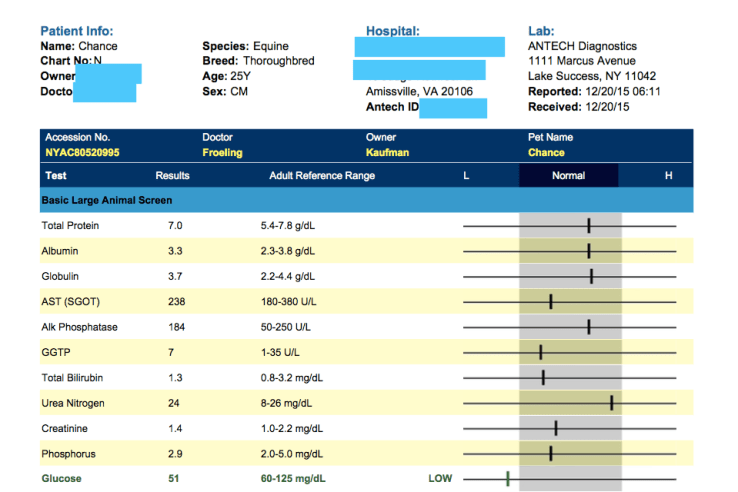
I had the vet run some blood work on Luck and Chance as a precaution, because of the “Panic Grass” in Virginia has been causing liver failure in horses, and because I like to do a full work up every 6-12 months.


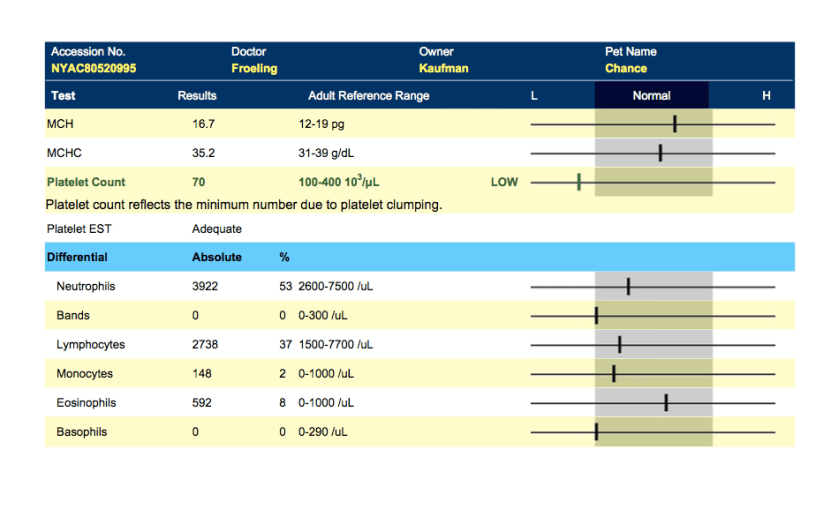
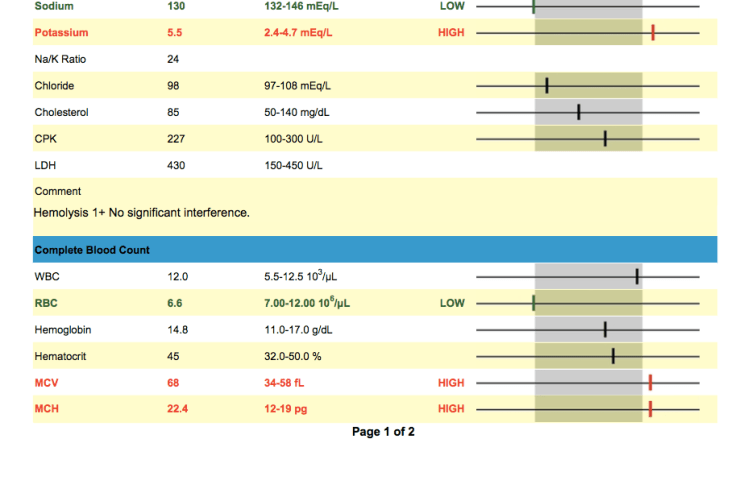
Chance’s Blood Work


C 1

C 3


L 2


INTERPRETATION OF RESULTS


Elevated Potassium (6.6 mEq/L):

“Low levels indicate depletion and are often a predisposing factor, along with
dehydration, in fatigue, muscle cramps, colic, synchronous diaphragmatic flutter (“th
umps”), diarrhea and other symptoms of exhausted horse syndrome. Even seemingly normal or high-normal levels may in reality be lower, but appear higher due to concentration secondary to dehydration as measured by total protein and albumin levels.
Therefore, levels at the lower end of the normal range should be evaluated relative to concurrent dehydration” (https://www.quia.com/files/quia/users/medicinehawk/2407-Vet/labs.pdf).

Low Sodium:

“Low levels commonly indicate loss through excessive sweating, or through kidney or intestinal disease. Low levels may also be found in young foals with bladder damage. Increased sodium levels are usually a sign of dehydration” (http://www.minstervets.co.uk).

Low Platelets: 

This was the most worrisome in regards to the potential immediate issues that could ensue because of the low platelet count. 

“The platelets are the third cellular component of blood (along with red and
white blood cells). These cells contain a number of biologically active molecules that are
critical to the blood clotting process. Low levels may indicate a number of disease
processes not necessarily directly related to a bleeding disorder. Chronic or acute blood
loss, immune disease, toxemia, liver, spleen or bone marrow disease, or even critically
reduced or increased body temperatures can also cause low platelets counts. Any
significantly low platelet counts should be further investigated by a veterinarian. High
levels are generally clinically insignificant unless the condition persists, in which case it may be indicative of bone marrow neoplastic disease” (Susan Garlinghouse).

Low Glucose:

“Glucose is the source of the body’s energy. It is measured in suspected cases of equine metabolic syndrome and sometimes in cases of equine Cushing’s disease. Blood glucose may also be measured as part of a glucose tolerance test, assessing small intestinal function” (http://www.minstervets.co.uk).

Chance was tested for Cushing’s Disease within the last year and the test showed that he did NOT have Cushings. 
Elevated CPK (337 U/L):

Levels 2-3x the highest number in range are considered significant according to vetstream.com.  Levels are easily increased due to poor handling techniques as well as lab error.

According to Dr. Christine Woodford and Carla Baumgartner on vipsvet.com, “Elevations of CPK and SGOT are indictors of muscle inflammation–tying-up or rhabdomyolysis. The term “rhabdo” means muscle and “myolysis” means rupture of muscle cells. The CPK and SGOT are very sensitive indicators of skeletal muscle damage, and they rise in concentration proportionally with the amount of damage. A bit of timing is required in order to obtain the most sensitive results; CPK rises (due to its leakage from muscle cells into the blood system) approximately six to eight hours after the onset of muscle inflammation, and SGOT rises after approximately 12-14 hours. The absolute peak of CPK concentration and the time it takes to return to normal are important indicators of the severity of muscle damage and the response to therapy.”

Elevated MCV: Is the average volume of red blood cells.

  • Macrocytosis.
  • Indicates immature RBC in circulation (suggests regenerative anemia).
  • Very rare in the horse, but may observe increasing MCV within normal range as horses increase erythropoiesis.

According to Vetstream.com, “Macrocytosis (increased MCV) resulting from release of immature RBC from the bone marrow during regeneration is very rare in the horse therefore the MCV is less useful in the horse than in other species.”

Elevated MCH: Is the average amount of hemoglobin in an individual red blood cell.

  • Hemolysis, if intravascular in nature .
  • Errors can occur during processing

Low RBC:

“You may be inclined to think that red blood cell levels need to drop significantly before they cause a problem for your horse. But the truth is that even low-grade anemia – levels hovering around that 30% range on a PCV – can impact your horse physically and may indicate a health problem. This is especially true for high performance athletes. The greater your horse’s physical condition and demand, the higher on the range of normal her red blood cell counts will typically be. Therefore, a red blood cell level low on the normal range or just below may indicate a concern for a racehorse, for example, where it wouldn’t for that pasture pet.”  See more at: http://www.succeed-equine.com/succeed-blog/2014/02/05/anemia-horses-part-1-just-equine-anemia/#sthash.JJuWN5ob.dpuf


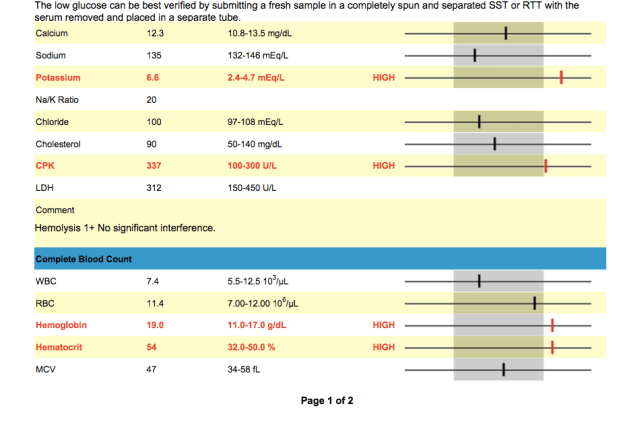
Luck’s blood work


L 1

C 2

Elevated Potassium: Potassium can become elevated for a number of reasons.

According to Vetstream.com,

  • 98% of potassium is intracellular.
  • Changes in serum or plasma potassium levels reflect fluid balance, rate of renal excretion and changes in balance between intra- and extracellular fluid.
  • Hypokalemia increases membrane potential, resulting in hyperpolarization with weakness or paralysis.
  • Hyperkalemia decreases membrane potential with resulting hyperexcitability.
Susan Garlinghouse states that, “High serum levels of potassium during an endurance ride are generally not a concern. These increases often reflect nothing more serious than a delay between blood collection (when potassium is actively sequestered inside cells) and sample measurement (after potassium has had time to “leak” from inside the cells out into the plasma or serum).”  This could also be a result of Luck and Chance running around in the heat when the vet arrived.
Increased [potassium] (hyperkalemia) can occur from;
  • Results can be false due to processing time (ie: if the lab waited too long to process blood sample)
  • Immediately after high intensity exercise.
  • In association with clinical signs in horses with hyperkalemic periodic paraysis (HYPP)    .
  • Bladder rupture (neonate)    .
  • Hypoadrenocorticism  [Pituitary: adenoma]  (rare).
  • Metabolic acidosis.
  • Acute renal failure    .
  • Extensive tissue damage (especially muscle).
  • IV potassium salts, eg potassium benzyl penicillin, potassium chloride    .
  • Phacochromocytoma (rare in the horse).
    Hypokalemia
  • Chronic diarrhea.
  • Diuretic therapy, especially potassium-losing diuretics.
  • Excess bicarbonate/lactate therapy.
  • Chronic liver disease    .
  • Acute renal failure (polyuric phase)    .
  • Recovery from severe trauma.
  • Metabolic/respiratory alkalosis.
  • Prolonged anorexia.
  • Recovery period after high intensity exercise (30-60 min after).
  • Parenteral feeding.

In combination with clinical signs and results of other tests results could signify the following;

Elevated GGTP:

* Donkeys tend to have 3x higher levels then horses.  This means that in stead of the typical equine range being 1-35 U/L a typically donkey’s range would be up to ~105 U/L.  Lucky’s test showed he had 120 U/L which is still elevated but not much.  It took sometime to get Luck from the field when the vet arrived- he ran around non stop.  The excitement and anxiety could be the cause of the elevated levels.

RBC:

Katherine Wilson, DVM, DACVIM, of the Virginia–Maryland Regional College of Veterinary Medicine (See more at: http://equusmagazine.com/article/decode-horses-bloodwork-27122#sthash.sc4J1ISJ.dpuf) explains “RBC count is probably the least helpful information because horses usually don’t have big changes in red blood cell numbers. It is not uncommon for horses to have an RBC count a little lower than normal range, however. The term we use for low RBC is anemia, but unless the count gets very low, a horse doesn’t necessarily need to be treated for that condition. A lot of diseases or any chronic long-term disease can cause mild anemia. Usually if we see mild anemia on the bloodwork and the horse has other issues, the anemia is just an indication that we need to fix/treat another problem.”

Low or Elevated Values

  • Splenic contraction.
  • Polycythemia (rare) .
  • Dehydration.
  • Consider causes of anemia
  • Blood loss    .
  • Hemolysis (i in vivo or artifact).
  • Decreased bone marrow production.
  • Poor technique at sampling.
  • Poor handling and storage of samples.
  • Poor technique in laboratory.

Low Bilirubin:

Heather Smith Thomas of Equus states,  “Another indication of liver health is a pigment called bilirubin, which is formed from the breakdown of red blood cells. Elevated levels can mean unusual loss of red cells or liver dysfunction. However, in horses, unlike other animals, elevated levels of bilirubin often isn’t serious. “This value can increase fairly rapidly when horses go off feed, and this is something that is unique to the horse,” says Wilson. “Often we get phone calls from veterinarians who don’t work on horses much or owners who see the blood work and note that the bilirubin is above normal range and are concerned about liver disease. If the horse is off feed for 24 to 48 hours, that value will increase, but this is just a temporary elevation.”

Elevated Hemoglobin (19 g/dL):

According to vetstream.com, Thoroughbred and other “hot-blooded” horses Hemoglobin range differs from other equine- the thoroughbred range = 11.0-19.0g/l.

Elevated Hematocrit (54 %):

 Elevated levels could be due to;

  • Dehydration.
  • Splenic contraction.
  • Polycythemia .

“A measurement of the relative amount of red blood cells present in a blood
sample. After blood is drawn, a small tube is filled and centrifuged to separate the heavier
blood cells from the lighter white blood cells and the even lighter fluid (plasma or serum)
portion. A higher than normal reading generally indicates dehydration (same number of
cells in less plasma volume) or may be due to splenic contraction secondary to
excitement or the demands of exercise. A low reading may indicate anemia, though not
invariably. Highly fit athletic horses may normally have a slightly lower hematocrit at
rest due to an overall more efficient cardiovascular system. Evaluation of true anemia in
horses requires several blood samples over a 24-hour period” (Susan Garlinghouse, 2000/ http://www.equinedoc.com/PrideProjectInfo.html).

It took sometime to get Luck from the field when the vet arrived- he ran around non stop.  The excitement and anxiety could be the cause of the elevated levels.

Low Sodium:

According to horseprerace.com, “Low levels indicate depletion and are often a predisposing factor, along with dehydration, in fatigue, muscle cramps, colic, synchronous diaphragmatic flutter (“thumps”), diarrhea and other symptoms of exhausted horse syndrome. Even seemingly normal or high-normal levels may in reality be lower, but appear higher due to concentration secondary to dehydration as measured by total protein and albumin levels. Therefore, levels at the lower end of the normal range should be evaluated relative to concurrent dehydration.”


More information on your horse’s blood work

Decoding your horse’s blood work

CBC and Chemistry Profile

A Better Understanding of the Results


The vet suggested that I add water to Luck’s and C’s feed in case their values are due to dehydration. She also explained that some of the values may be a result of running around in the field right before drawing them along with anxiety.  

The anxiety and running around seemed fair but I am hesitant on the dehydration portion.  Yes, I know it is winter and that horses are less likely to drink as much water.  But if it were due to dehydration then the Albumin would be low as well.  But, the blood work revealed that the Albumin was 2.8 (Luck) and 3.2 (Chance).  These values are within the normal range…. that being said, the results could also be due to lab handling especially the Potassium levels.

While speaking with my uncle Jerry (the horse whisperer), he suggested adding a salt block to the horse’s feed.  This will increase the horse’s thirst which will get them  drinking more.  I also added heated water buckets so that the water won’t freeze and in case they are less inclined to drink when the water is cold.

In order to feel comfortable about my horse and donkey being healthy, I will have more blood work done this week to make sure everything is in fact okay.


“But Baby It’s Cold Outside…”

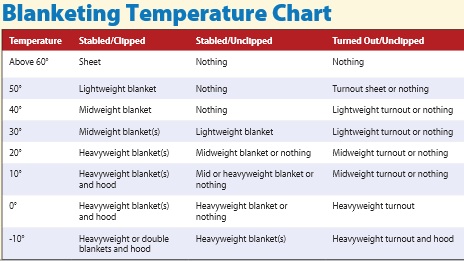
Here are some helpful ways to know when you should blanket your horse and what type of blanket to use.

BlanketTempChart_0 Untitled 2 Temperature-Chart* Sources: Weatherbeeta.com, Auburn University

How To Prepare For An Equine Emergency

Be Prepared for an Equine Emergency

You don’t want to waste time in an equine emergency! The American Association of Equine Practitioners (AAEP) offers these tips to keep you organized and calm in your horse’s time of need.


If you own horses long enough, sooner or later you are likely to confront a medical emergency. From lacerations to colic to foaling difficulties, there are many emergencies that a horse owner may encounter. You must know how to recognize serious problems and respond promptly, taking appropriate action while awaiting the arrival of your veterinarian.

Preparation is vital when confronted with a medical emergency. No matter the situation you may face, mentally rehearse the steps you will take to avoid letting panic take control. Follow these guidelines from the American Association of Equine Practitioners (AAEP) to help you prepare for an equine emergency:

    1. Keep your veterinarian’s number by each phone, including how the practitioner can be reached after hours.
    1. Consult with your regular veterinarian regarding a back-up or referring veterinarian’s number in case you cannot reach your regular veterinarian quickly enough.
    1. Know in advance the most direct route to an equine surgery center in case you need to transport the horse.
    1. Post the names and phone numbers of nearby friends and neighbors who can assist you in an emergency while you wait for the veterinarian.
    1. Prepare a first aid kit and store it in a clean, dry, readily accessible place. Make sure that family members and other barn users know where the kit is. Also keep a first aid kit in your horse trailer or towing vehicle, and a pared-down version to carry on the trail.First aid kits can be simple or elaborate. Here is a short list of essential items:
        • Cotton roll
        • Cling wrap
        • Gauze pads, in assorted sizes
        • Sharp scissors
        • Cup or container
        • Rectal thermometer with string and clip attached
        • Surgical scrub and antiseptic solution
        • Latex gloves
        • Saline solution
        • Stethoscope
        • Clippers

Many accidents can be prevented by taking the time to evaluate your horse’s environment and removing potential hazards. Mentally rehearse your emergency action plan. In an emergency, time is critical. Don’t be concerned with overreacting or annoying your veterinarian. By acting quickly and promptly, you can minimize the consequences of an injury or illness.

For more information about emergency care, ask your equine veterinarian for the “Emergency Care” brochure, provided by the AAEP in partnership with Bayer Corporation, Animal Health. More information can also be obtained by visiting the AAEP’s horse health web site, www.myHorseMatters.com.

The American Association of Equine Practitioners, headquartered in Lexington, Kentucky, was founded in 1954 as a non-profit organization dedicated to the health and welfare of the horse.

– See more at: http://practicalhorsemanmag.com/article/eqemergenc2576#sthash.YFzhhSOX.dpuf

Coming Home to Love & Peace

Chance was able to come home a week later.  Sam & John went to pick him up at the hospital. However, upon arriving, they soon found out that Chance did not want to get on the trailer.  Sam later told me that one of my sweatshirts was in the truck, so she brought it out and let him smell it- he finally loaded.

I got his stall ready- tons of fresh shavings, hay, a new water bucket…

The moment he got off of the trailer he was shaking!  I gave him a warm bath and let him out in a small, flat paddock so he could be in the sunshine.

This is what happened when I let him out!  He did something he had not been capable of doing for months and months, if not longer.

The Guessing Game

IMG_7563The month passed by slowly….I kept hitting a brick wall over and over again…with each diagnostic test we ran.

Vet2: This was Chance’s vet for many years and where Chance lived the summer I moved home.  Vet1 was used because of connivence and due to being the vet of the owner of the farm.   I called Vet2, desperate, and she came out to see him.  Vet2 had always been amazing with Chance- kind, calm, and seems to act on intuition in conjunction with science.  She ran a CBC, tested for Cushings, Lymes, an did x-rays on the back right leg.

RESULTS:

* Metabolic Syndrome- Cornell

GLUCOSE: 10mg/dl

LIPEMIA: 8mg/dl

HEMOLYSIS: 1mg/dl

ICTERUS: 2mg/dl

*Endocrinology

ACTH endo 21.4 pg/ml

INSULIN 15.22 uIU/ml

THYROXINE T4 baseline 0.77 ug/dl

*Lyme Mitpix- Cornel

OspA Value 1253- Equivocal

OspC Value 79- Negative

OspF Value 592- Negative

Temp: 99.1, HR: 42, RR: 12, No murmur

Received Potomac Rabies and Stanozanol 4ml 7 vit B12

The X-rays of his back right showed nothing that could cause his flare-ups.  While his thyroid was a bit low, it was not clinically significant.  He was negative for Lymes and Cushings.  Next step, aside from pain management, is to call Vet3- the holistic approach.

Horse's Leg

Tendon Injury Handbook