Category Archives: Psychology

Eyes Wide Shut

I had the opportunity to work with a “horse communicator” today.  She was recommended to me by an equine vet who, after reading my blog, felt that I would be open to the idea, and introduced me to her via email.  According to the vet, she often works with this particular equine communicator due to her ability to point out exactly where the horse’s issues are, allowing the vet to adjust/manipulate/treat the main issue.

I chatted with her at length a few days ago as she explained the process and we scheduled an appointment.

Today I gave her a call, as she explained, connecting remotely allows for the horse to be in his natural setting without the influence of an unknown person.  That way the horse could be relaxed and the owner can observe, ask questions, and engage.  So, that is what I did.  She went onto explain that sometimes the horse needs energy work in order to open up to the process and that the horse must trust the process, her, and obviously, the owner.

I was asked to have questions ready to ask my horse, along with something I would like to tell him at the end of the session.  (If you have been following this blog then you will know I had some difficulty narrowing down a couple of questions- I have a lot! 😉 ) She began connecting with Chance.

I will not be able to convey all the details of what was said, Chance’s reactions, or even mine…It is almost a blur… I wish I could.

I was asked to feel around Chance’s right forehead/eye area for a lump or bump.  I did as I was asked and didn’t feel anything abnormal…but remembered he had a gash that was healing right above his right eye.  She informed me that he had a “headache”.  She continued to move over him and explained that his “energy” was “blocked” on his right side.  This makes sense…Chance has a “swagger” at the walk- he pokes his butt to the side and has a twist on the back right leg (Chance’s swagger has gone up and down- it was worse when he had the tendon issues, resolved after stem cell injections, came back when he got EPM, went away ish, and came back with his Lyme).  While she was working on his energy, I massaged Chance’s back, neck, hip, and shoulders.  She went on to explain that Chance had some right shoulder pain. Thankfully, Chance allowed her to work on his jaw (he pretty much has TMJ), his head, his back, etc.  The energy was “pouring out” even on the hind end which, if I recall correctly, is commonly seen on horses with head injuries.

This is where my one question came in…I wanted to know what happened to Chance when he came to my college.  I didn’t give many details…I didn’t know many details but I always wondered what may have happened on Chance’s trip down to my college.

I had gone off to college in January and decided to have someone trailer Chance down (about 3 and a 1/2 hours) once I got settled and found a barn, etc.  Two months later Chance was arrived at her new barn.  Despite the cool March weather, he was covered in sweat and was visibly scared.  I didn’t inquire too much since he was in one piece and I chalked up the sweating and fear to exactly that- fear and anxiety.  However, as the months progressed, Chance began bucking and rearing while under saddle….this was really strange..When he had left home we were doing dressage and jumping and he was sound and calm.  Once again, I chalked it up to being in a new place- a barn that hosted Friday night Bullbucking no less.  I decided to switch to a different farm, one preferably without bulls, even though the show was awesome to go and see, and work with a trainer.  Still the behaviors persisted and the episodes of lameness increased.  The vet finally diagnosed Chance with arthritic changes in his back and suggested I no longer jump him.  I decided that summer instead of bringing Chance home and have him endure another long trailer ride, to board him at my new vet’s farm. Chance had the summer to recuperate while under the care of an equine vet.

Anyways, after that summer, I decided to retire Chance for good.  I would occasionally get home him to walk around, I still can and do today.  But, that was the beginning of a chronic condition that was never given a diagnosis.  Instead, Chance’s symptoms were treated as they came.  

Back to my session with my very own horse whisperer..

Chance “showed” her what happened on his trip to college- a trailer wheel falling off the side of the road.  His head hitting one side of the trailer and slamming the other side.  The pain.  The concussion.  His neck and back becoming misaligned.  His jaw coming out of position. His body compensating. He showed the decline of his once functioning body- starting with the hit on his head, to his jaw, and his neck.  Down his neck and through his back towards his hips and down his legs.  The wear and tear of his body.  Chance stated that he is still angry with the person driving the trailer; he wasn’t ready to forgive.  I have forgiven them.  I have no doubt it was a mistake and that there was no ill intent.  But, I am not the one feeling the pain that he is.  I am not the one who went from a racehorse to a jumper to practicing dressage to retirement long before I should have. And like the “horse whisperer” said, she will “hold the forgiveness for him until he is ready.”  I will do the same.  

She spoke of his time on the racetrack.  Chance was happy to hear that he was being remembered for who he once was, and will always be to me- a strong, beautiful and crazy talented 17.1 hand red-headed thoroughbred and not a “weak old man” as he put it.  When asked what his name was during his time on the track, he said, “Hot Stuff”, which could be a nickname and not his actual race name.

At one point during Chance’s session he fell asleep; standing in an odd way- hind legs spread out.  Suddenly, his body gave out and he caught himself from falling.  This entire time his eyes were still closed!  They remained closed for another minute after this.  His body reacting to something, perhaps a shift in his energies, and all the while he was a a state of peace; trusting that nothing bad would happen to him. 

The session lasted an hour and a half.  Honestly, we could have continued because of all the “blockages” but decided to stop for the day and pick up again another day.  I was told that the effects of the energy work or Reiki, would continued throughout the week and that he would be emotionally vulnerable.  As the session wrapped up Chance apparently said that he was the lucky one because I found him all those years ago.  


Energy Work and Reiki Resources


 The Benefits of Equine Reiki

Reiki for Horses: Workshops, Training, Courses, and Resources

Reiki Related Research and Resources for Two and Four Legged Friends

Equine Reiki Academy

Amorosa Equestrian Center in Ohio

The History of Reiki

Reiki Forum on Horse and Hound

Reiki Handout: Full history, explanation, and how to pictures


Equine Communication


How Horses Communicate

How to Speak Horse

Horse Forum: Horse Communicators


Head Trauma and Headaches in Horses


Symptoms of Equine Concussions

Trauma, Concussions or Other Brain injuries in Horses

How to Handle Horse Head Injuries

Helping Horses with Traumatic Brain Injuries
Merck Vet Manual: Equine Trauma and First Aid

Do Horses Get Headaches?

Chronic Lyme in Horses: Headaches

GRIT

A while ago, one of my good girlfriends, sent me an article about perseverance; why some are able to withstand tremendous adversity while others can’t? The article referred to this concept of an individual’s strength to endure life’s obstacles, to succeed in the face of adversity, to remain positive and continue to move forward despite what is thrown ones way, as Grit. Those who are able to endure the obstacles-have it- and those who are unable to endure- don’t.

“In a recent article published by People in Aid, Scott Breslin argues that grit, and not just resilience, is a key component for aid workers. Grit is defined ‘as perseverance and passion for long-term goals. Grit entails working strenuously toward challenges, maintaining effort and interest over years despite failure, adversity, and plateaus in progress’ (Duckworth, et al. 2007: 1087-1088). Resilience instead is the human capacity to bounce back from difficult experiences.” (See more at: http://mindfulnext.org/aid-work-is-not-a-survival-contest/#sthash.OsqxZNnG.dpuf)

I can’t help but wonder if the concept of Grit may also apply to our four-legged friends? Because I am pretty sure that Chance has it. What makes living things able to remain positive and enthusiastic and continue to persevere despite being in tremendous pain?

I am truly humbled every time I look at Chance and I see a 25+ year old horse who has lived for years with painful flare-ups without a known cause…yet even at his absolute worse, he was still engaged in life…eating, whinnying, trying to run and play, giving kisses for treats…and now, after a year of ups and downs, triumphs and tribulations, stumbles and falls, medications and supplements, pokings and probings, needles and adjustments, samples and tests, and changes in just about every aspect of his life, he is finally in a healthy place!  (He is no longer on pain medications daily.  He maybe gets a dose a month or so. And does not have bouts of lameness or swelling).

What enables him to remain his calm and happy self despite all of the above?  How was he not biting and kicking with every prick of a needle?  How is his soul still gentle? How was he determined to walk up a small hill a year ago and now is able to run up that very same hill?  He loves every second of his life.  This may sound odd, but my old guy revels in every single second of his day.

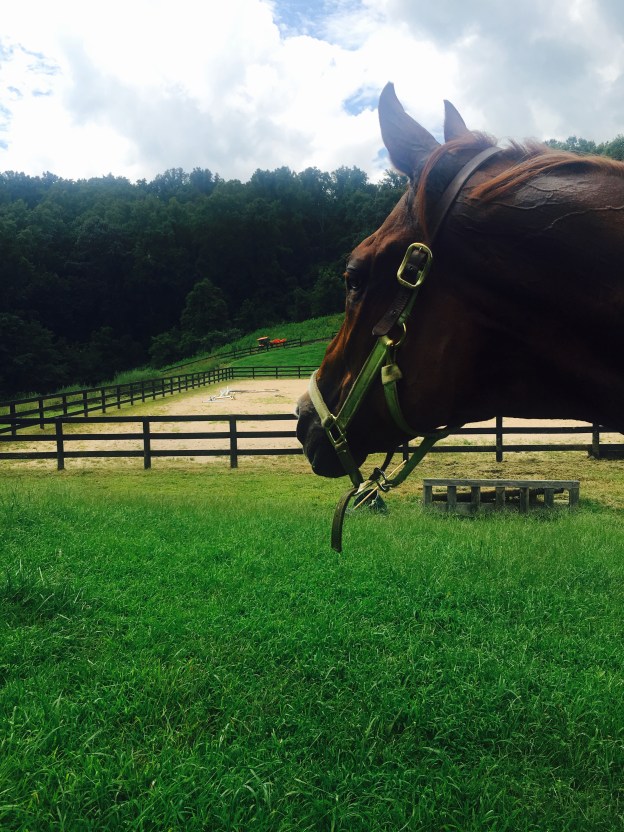
He whinnies the moment I pull up into the driveway and greets me.  He devours every ounce of grass he can.  He often follows his friend and co-caretaker, John, to feed the chickens in the morning. He yells for his buddy, Lucky, when he can’t find him.  He runs every where he is able to including back and forth from the house to the barn- racing with Lucky.  He rolls around in the grass, the snow, or mud.  He will lay in the green grass basking in the sunshine.  He investigates everything around him.  And each and every time he stumbles, or even falls, he gets right back up and tries again.

To me, that is the essence of Grit…to keep on trucking through life with a soft heart and grateful and determined soul.

Duckworth, A. Peterson, C. Matthews, M., Kelly, D. (2007) “Grit: Perseverance and Passion for Long-Term Goals”, Journal of Personality and Social Psychology, Vol. 92(6), 1087-1101.

Research, Research, Research

Tendon Injury Handbook

After I left the barn, I drove home and went straight to my computer.

What was happening?  What are the masses? Scar tissue?  Nothing was able to be extracted out of them…How can I get rid of them in order to see behind them?

Again, I stayed up until the sun came out the next morning.  I already had two binders full of research and now I had a third.

Research made me believe that C has an infection in the Synovial Tendon Sheath that was being masked by the masses on the outer lining of the SS. The masses could be scar tissue from his MANY past Lymphangitis flare-ups. Perhaps, his immune system was not able to fight last attack and the infection settled in the SS and was walled off.  Thus his CBC & WBC were normal and no fluid was extracted from SS masses due to the large size of the scar tissue.
C has a major hx with his RH and “flare-ups” and lameness. I never realized this until I took the time to study his past records from the first 5 years I owned him.

Symptoms are similar to an infection- what if we proceeded as if it were?
Lack of a positive culture does NOT mean that there is not an infection in the sheath!

Current Symptoms:
1. Swelling decreases after being active
2. Fails to extend fetlock
3. Lame- exasperated by flexion
4. Positioning for fetlock flexion

Septic Synovitis: Cartilage degradation ischemia, Fibrin deposition lead to lameness to pannus form and adhesive form

Entrobacteriacaea
Strep
Staph
Most common is Staph

Treatment: 

Systematic Procaine Penicillin 22000 iU/kg or Sodium Benzyl Penicillin & Gentamicin 6.6 mg/kg for 2-9 days

Then change to oral potentiated sulfonamides 5mg.kg Trimethoprim and 25 mg/kg of Sulphadiazine

Other potassium penicillin w/ Amikacin Cectiofur or Enrofloxacin

IV antibiotics for 7-10 days switch to oral for 2 weeks

Regional limb profusion or placement of impregnated Polymethyylmethacralate or PMMA

I immediately called Vet4 and told him my theory.  He said that it was possible and that we should begin treatment asap.  He was still out of town so I called Vet3 to order Baytril. Vet3 felt my theory was legit and immediately ordered the antibiotic!

“Ask him what he wants…you will know what to do from there.”

When I arrived at the farm I was greeted by those familiar big brown eyes and a whinny.

I brought him out of his stall and gave him a bath.  He has always loved to be groomed and bathed, even if he is apprehensive to walk into the wash stall. After his bath, we went outside for him to graze and get some sunshine.  When we walked inside the barn, I stopped him and looked into his eyes and asked him, “do you want to keep trying to get better or are you ready to give up?”  He just looked at me.  A lump immediately formed in my throat.  He nuzzled me and rubbed against me.  I said again, “Do you want to keep fighting?”  He shook his head up and down! I swear to you!  This actually happened!

The decision was made, we would keep on fighting as long as we were able to keep him comfortable.  There was nothing I wanted more than to bring him home with me, let him live out the last days of his life pain-free, and with me by his side.

This was his turn.  He had always done what I asked of him- lessons, moving stables and even cities, and he was patient while I was in school- and it was his turn for me to make it about him.  For Chance to get every ounce of my time and for me to fight for him!

IMG_1795

Answers

Vet4 came out immediately.  I was beyond grateful!

He did an ultrasound of the back right leg and called me.  He found that Chance has Chronic Cellulitis and that there was Vascular constriction, and masses on the tendon sheath between the superficial and deep tendon sheaths.  The Doppler showed good blood flow and a thickening of the synovial lining. Hoof testers- Negative

We spoke about my opinions- MRI, Arthroscopic surgery, Regional Diffusion, Cold Compression Therapy, Nerve Block Injections, Steroid Injections

We decided  to try the Steroid Injections into the 3 Synovial masses to hopefully reduce the size and thickening.  Thus allowing us to see behind the masses to see what is actually happening.

Injections were into the Proximal Digital Flexor Tendon Sheath with 6mg Betamethasone and d100mg of Amikacon. Leg was covered with SSD and DMSO and bandaged.

Once injected, cold compression therapy for about 5 days twice a day and stall rest. Banamine daily.

The Guessing Game

IMG_7563The month passed by slowly….I kept hitting a brick wall over and over again…with each diagnostic test we ran.

Vet2: This was Chance’s vet for many years and where Chance lived the summer I moved home.  Vet1 was used because of connivence and due to being the vet of the owner of the farm.   I called Vet2, desperate, and she came out to see him.  Vet2 had always been amazing with Chance- kind, calm, and seems to act on intuition in conjunction with science.  She ran a CBC, tested for Cushings, Lymes, an did x-rays on the back right leg.

RESULTS:

* Metabolic Syndrome- Cornell

GLUCOSE: 10mg/dl

LIPEMIA: 8mg/dl

HEMOLYSIS: 1mg/dl

ICTERUS: 2mg/dl

*Endocrinology

ACTH endo 21.4 pg/ml

INSULIN 15.22 uIU/ml

THYROXINE T4 baseline 0.77 ug/dl

*Lyme Mitpix- Cornel

OspA Value 1253- Equivocal

OspC Value 79- Negative

OspF Value 592- Negative

Temp: 99.1, HR: 42, RR: 12, No murmur

Received Potomac Rabies and Stanozanol 4ml 7 vit B12

The X-rays of his back right showed nothing that could cause his flare-ups.  While his thyroid was a bit low, it was not clinically significant.  He was negative for Lymes and Cushings.  Next step, aside from pain management, is to call Vet3- the holistic approach.

Horse's Leg

Tendon Injury Handbook

The Call

One day I received a call that I needed to come out and see Chance because he wasn’t doing well and, according to Vet1, he needed to be put down.  I quickly canceled my appointments and got on the road.  The 4 hour drive was excruciating…once we finally arrived, my heart broke.

My old guy was skin and bones.  His back right leg was swollen and he wasn’t able to bare weight on it.  His eyes were dull.  He could barely walk, and when he did, he wouldn’t put any weight on the right hind.  There were even times when he would do this “neurologic dance” (coined by the farm’s owner and C’s other mom) where he would lift up his back right leg and hop!

But when he saw me pull up, he whinnied.  He was excited to see me.  He ate the pureed carrots but refused the apple puree (only my mom would make this for him).  He wasn’t ready to die.


I called the vet who said that Chance should be put down to see what his thoughts were.

Me:   What do you think is going on with C?

Vet1: I think he is ready to be put down. 

Me: Because of what?

Vet1: Lymphangitis

Me: Okay, well, what is the cause of the Lymphangitis? Did you run any diagnostics?

Vet1: No

Me:  I would like to manage his pain and run a few tests before making that decision.  (I reviewed the research that I had done and asked where to go from there.) Could it be EPM?

Vet1: “It’s not EPM”

Me: How about Cushings? Or Laminitis? Lymes?

Vet1: Nope. Just old age.

Me: The journals I read said that some of the symptoms…(I was cut off)

Vet1: “I don’t care what journals you read!  It’s a bunch of…”

Me: One was from VA Tech actually…


Well, that was that! Vet1 did not completely lack compassion but he was more “old school” I guess one could say.  He was well respected in the horse world and up until this point, he did the job I needed. But I will say I was disheartened by our conversation.  

I decided to contact the other vets that I had worked with in the past, who also knew Chance, and get second, third, fourth opinions.  

IMG_8299IMG_8296IMG_8293IMG_8300

From Sunset Beach to Take A Chance

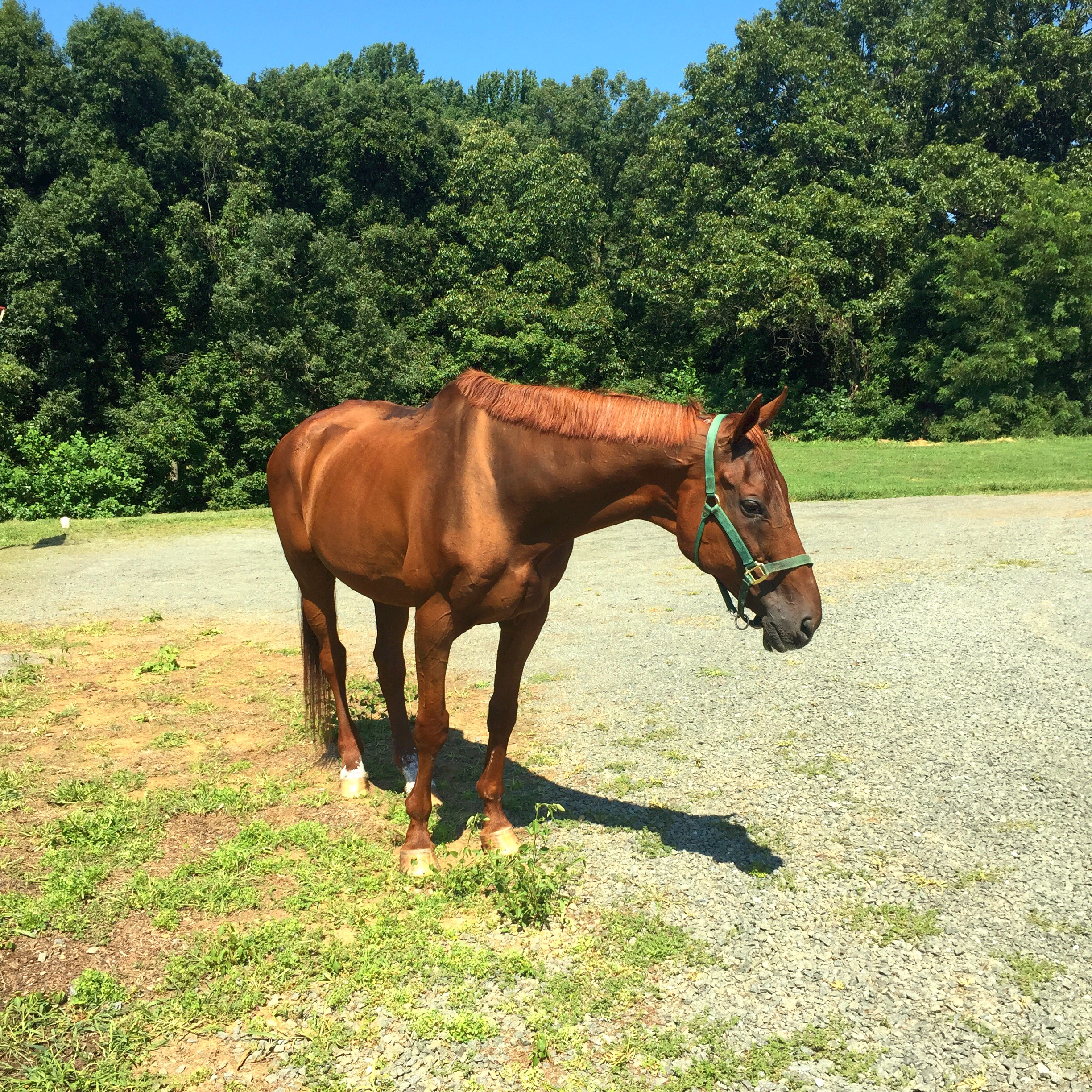
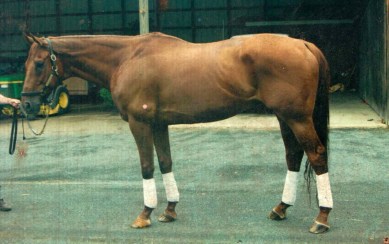
I purchased Chance from a farm in Middleburg, Virginia.  I remember the first time I saw him- this big 17.1 hand, 10 year old, chestnut thoroughbred gelding.  He had these sad big brown eyes that made me instantly fall in love. I got on him and we cantered around a field together and over a handful of jumps.

We vetted him and trailered him back to the farm in Lorton, Virginia.

Immediately upon his arrival, we all noticed that this horse was scared of everything! He was a cribber. He was constantly hurting himself.  And he refused to pick up his left lead.

We began working with our trainer- mostly on our flatwork- and he loved to rear! Yay! (note sarcasm). He hated trail riding and riding in the field.  What horse dislikes being ridden in a huge green field!?  We managed to jump a bit here and there.  Every time we made progress, Chance would get hurt!  Colic, a huge gash above his eye, a hurt leg- you name it, he had it/did it/hurt it.

After much consideration, I decided that I should lease him out so that he would have more time under the saddle.  Next, we decided to try Dressage to build up his back muscles.  We worked with an awesome trainer, actually two, who were pretty well known in the Dressage world.  And, honestly, Chance was amazing at Dressage!  And what a difference it made! I began to actually enjoy riding him!  He was much calmer and easier to handle.

I left to goto college and a few weeks later Chance came to meet me.  My poor trainer trailered Chance the 4 hours and it took much longer than expected because of the directions! Chance’s behaviors were all over the place.  The only stable with availability was one the held a rodeo on the weekends.  It was great fun, but Chance was not a fan of the bulls.  We ended up moving to another facility where he was receiving training and I was receiving lessons.  That soon stopped because of the frequent encounters with lameness and back issues.

That summer I went home and decided to leave him at vet2’s stable where he would have 24 hour care and someone who knew him well. Plus, maybe a break would do him some good.  However, after that summer he was officially retired.

I moved him to another stable closer to school.  It was a perfect place- a three stall barn, with individual runs, and big green pastures. He soon fell in love with the mare there and was content.

Thankfully, after graduation, I was able to leave him at this farm while I completed my Masters degree and almost finish my Doctorate.  Without the care the farm’s owner extended to Chance (and the care extended to me as well), I have no idea what I would have done. The truth is though, I wasn’t able to make the drive as frequently as I would have liked with school and everything…4 hours there and 4 hours back in one day… I had always envisioned bringing Chance home upon graduation….

Chance lived there for almost 8 years.  He had flare ups of Lymphangitis and would stock up if left inside.  The symptoms were treated with each episode but the flare ups would continue and each episode would last a couples days and was manageable with medication. The mistake I made was instead of doing my own research about Lymphangitis, I took the vet’s word for it.  I was under the impression that Lymphangitis was more of a disease instead of a symptom.  If I had only done my homework I would have known that is was in fact the symptom of a much larger problem.

The day "Sunset Beach" became "Take A Chance"

The day “Sunset Beach” became “Take A Chance”