www.southernequineservice.com/doctors-say/2020/1/6/understanding-equine-cushings


I decided to get on Tilly and see how she was under saddle.
The saddle fit nicely and I chose a bit-less bridle. Tilly was calm throughout tacking her up and getting on her back. One hiccup….she would not respond to my leg or move forward at all. My friend decided to lead her and Tilly walked easily forward. I decided to end with that for the day. A few days later I got on her back again. Same thing happened- she would just stand there. Small spurs, leg, a crop (which I hit gently against my leg)…none of them worked. I was frustrated despite it not being my sweet girl’s fault so I ended our ride. I knew nothing could be accomplished with me being frustrated. I decided to do some research on work horses and posted on some Facebook forums about my situation. I received some awesome advice!
The advice I received is below.
“If she was used in harness you will probably have to use driving commands as you teach her.Walk on, or get up to go forward. Gee to turn right, Ha to turn left. May have to tap her hind quarter with the crop.”
 Same history as your mare. As workhorses, they were not trained to ride, and they don’t know the commands or how to respond to leg pressure or the bit (other than pulling). So you need to start with groundwork and then at the very beginning, because basically they are green. I do not use a crop on my boy. Never will.”
When It’s Time
— Read on horsenetwork.com/2020/06/when-its-time/

In the evening I take Ottille for a walk and set her free. Her carefree happiness is palpable and her beauty takes my breathe away every time. I still can not fathom how anyone would work this sweet girl until she reached 17 only to send her to a slaughter auction. Welcome to the rest of your life, sweet girl! Like I promised the first day we met, you can trust me to take care of you the rest of your days. ❤️


I take naming seriously. Maybe too seriously. I feel like a name should mean something, stand for something, and ultimately, it should “fit” the person or animal or farm.
My new 17 year old Belgian Draft mare was rescued from slaughter after being an Amish workhorse for her entire life. She came off the trailer after traveling from Texas to Virginia, skin and bones. She had a dull coat, hip bones high, cracked hooves, a very runny nose, but her eyes were warm. This sweet girl had never had a moment of TLC and was noticeably sick. I walked her to her new temporary quarantine home. She was alert but considerably calm but weary none the less. The vet came out and gave her a physical. Her legs were in good shape as were her feet despite the cracking. She did not have a fever but did have congestion in her chest and her teeth were all sharp points. She had a worn down mark across her nose from what looked to be a harness and her tail had been lopped off, bone and all.

We began an round of Exceed and Banamine and let her rest. She drank gallons of water and as she ate her “draft safe” diet (low sugar, low starch and high fat) I could hear her teeth grinding and knocking against each other; it was painful to watch (and hear). I left for the evening to allow her to settle in. The following day I brought her a fly sheet (bright pink :)). I groomed her and she began to fall asleep. I put ointment on her raw nose, and sprayed her with fly spray. As I went to put on her flysheet, her skepticism was evident. I could tell she had never worn a blanket, or maybe she was skeptical of the color… but she allowed me to put the sheet over her skinny body. As I finished for the evening and said goodbye, she looked at me, straight in my eyes, and I could see that she knew the rest of her days would be carefree.
I took about a week to get to know her and think long and hard about what to call her. I thought about the small details I knew about her past… 17 years as an Amish workhorse. They shipped her off to a slaughter auction after her years of service. She was worn and ragged but still strong and relatively healthy.
I decided on the name Ottilie meaning strength in battle. Numerological, the Soul urge number is 11 which states that people with this number have a deep inner desire to inspire others in a higher cause. The name’s Expressive number is 9 and states that those with this name tend to be compassionate, intuitive and highly sensitive, but also have magnetic personalities and serve humanity. How fitting, her strength during her battle (workhorse to slaughter auction) lead her to me…still strong and able but worn and haggard. The other reason I chose the name Ottilie was due to my late aunt, MaryJane. Maryjane passed in the late 1990’s tragically. She loved animals and was the reason I began my journey with horses as a child. She had a dog named, Tilly, which is the perfect nickname from Ottilie.
So, I introduce, Ottilie “Tillie”, the 17 year old Belgian draft mare who has found her forever home.
While agreeing to save the ponies from slaughter, I saw a beautiful, senior mare. She is a 17 hand, 17-year old, Belgian mare who was an Amish workhorse until put into the auction. She is visibility underweight and her coat is dull and patchy but her eyes bright and soulful. I watched to see if she got rescued as her slaughter date was for 5/7/2020. Well, last night, I took the plunge and purchased the sweet girl.
Ever since losing Chance I have not had a desire to get another horse. Over a year ago a neighbor gave me a thoroughbred mare but shortly after she arrived I realized I was not ready and I had just learned I was pregnant. Fortunately, I was able to find her a wonderful forever home. However, upon coming across this Belgian I knew she was my next heart horse. The thing is I only have one paddocked fenced in that holds three miniature donkeys. So I am quickly getting things in order- scheduled to have another paddock fenced in, a large run-in dropped off, and everyones vaccinations up-to-date. One of my neighbors has a barn and paddocks and no other horses on the property and generously offered to allow my new mare and friend’s two ponies quarantine there for 30 days. By the time quarantine is over, the fence and run-in will be up and ready for the new members of the family!
There is also a ton of research that I need to do about owning a draft horse. They are a special breed and more susceptible to metabolic disorders and a ton of hoof issues. Once again I will be using this platform as a way to organize my ongoing research. Wish me luck!
National Day of the Horse
— Read on www.nationaldayofthehorse.com/celebrate.html
Spotting Lameness: The Game Plan
— Read on horsenetwork.com/2018/10/spotting-lameness-game-plan/

The study also suggests that horses alter their communicative behavior based on humans’ knowledge of the situation. These findings were published in the online version of Animal Cognition on November 24.
Communicating with other individuals in order to get information about foraging sites and predators is a valuable survival skill. Chimpanzees, who are evolutionarily close to humans, are especially skilled at understanding others. Studies suggest that chimpanzees distinguish the attentional states of other individuals (seeing or not seeing), and they are also able to understand others’ knowledge states (knowing or not knowing).
Some domestic animals are also very good at communicating with humans—recent studies of dogs have revealed that they are excellent at understanding various human gestures and expressions. It is thought that these abilities were influenced by the domestication process.
Since they were domesticated 6000 years ago, horses have contributed to human society in various shapes and forms, from transport to companionship. Horse-riding has recently drawn attention for its positive effects on our physical and mental health. The high social cognitive skills of horses towards humans might partially explain why humans and horses have a collaborative relationship today. However, the scientific evidence for this ability is still scarce.
In this study, scientists investigated horses’ social cognitive skills with humans in a problem-solving situation where food was hidden in a place accessible only to humans. The experiment was carried out in a paddock belonging to the equestrian club at Kobe University, where eight horses from the club participated with the cooperation of their student caretakers.
For the first experiment, an assistant experimenter hid food (carrots) in a bucket that the horse could not reach. The researchers observed whether and how the horse sent signals to the caretaker when the caretaker (unaware of the situation) arrived. The horse stayed near the caretaker and looked at, touched, and pushed the caretaker. These behaviors occurred over a significantly longer period compared to cases when they carried out the experiment without hiding the food.
The results showed that when horses cannot solve problems by themselves they send signals to humans both visually (looking) and physically (touching and pushing).
Building on these results, for the second experiment they tested whether the horses’ behavior changed based on the caretakers’ knowledge of the hidden food. If the caretaker hadn’t watched the food being hidden, the horses gave more signals, demonstrating that horses can change their behavior in response to the knowledge levels of humans.
These two experiments revealed some behaviors used by horses to communicate demands to humans. They also suggest that horses possess high cognitive skills that enable them to flexibly alter their behavior towards humans according to humans’ knowledge state. This high social cognitive ability may have been acquired during the domestication process.
In order to identify the characteristic that enables horses to form close bonds with humans, in future research the team aims to compare communication between horses, as well as looking more closely at the social cognitive ability of horses in their communication with humans.
By deepening our understanding of the cognitive abilities held by species who have close relationships with humans, and making comparisons with the cognitive abilities of species such as primates who are evolutionarily close to humans, we can investigate the development of unique communication traits in domesticated animals.
This is connected to the influence of domestication on the cognitive ability of animals, and can potentially provide valuable information for realizing stronger bonds between humans and animals.
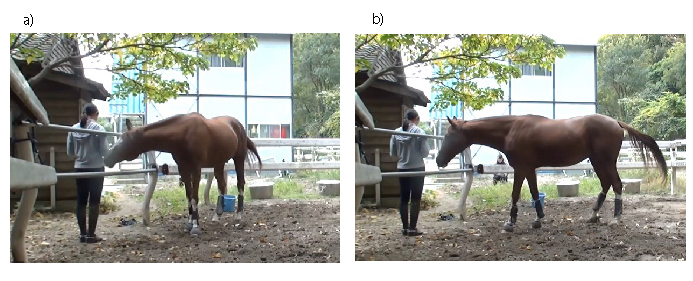
Figure 1. Horse making demands: The horse a) lightly pushes and b) looks at the caretaker standing outside the paddock. Food is hidden inside one of the two silver buckets behind them. When horses cannot obtain this food by themselves, they give humans visual and tactile signals.

Photo provided by Monamie Ringhofer.
Figure 2. Horse with caretaker at the equestrian club

 I hope you enjoyed reading about Misunderstood, Misused, & Misdiagnosed Disease #1: EPM. In that post I explained how some horse enthusiasts (trainers, owners, etc) have used this disease to e…
Source: Misunderstood, Misused, & Misdiagnosed Disease #2: Lyme Disease

Today Chance had swelling of his back right fetlock. He had a fever around 104 and didn’t eat his feed. His eyes were dull and he was lethargic. He wasn’t limping but was walking slower than normal (he usually runs to the paddock or back to the barn). I decided, due to the Lymphingitis flare up on his back right leg, I would give him a shot of 5 mls (or 5 cc) of Banamine and wrap his leg. Once the medication set in, I would bring him in to give him a bath (it was 80 degrees today). So, that is what I did. By the time he was back at the barn he was covered in sweat. I cold hosed him and drenched the wrap in cool water and let him roam around the barn.
Thankfully, the vet was able to meet me at her veterinary practice so that I could pick up Baytril and more Banamine. Since Chance just had Lyme Disease (and had finished his medication less than a week ago), we are not 100% if this is a Lyme reaction or something else. The plan is to administer 25 cc of Baytril either orally, in his feed, or via IV for 6 days and Banamine 10 mls (or a 1000 lbs) twice a day for 3 days. The vet suggested that I do 5 cc of Banamine if his fever remains between 101-103 degrees and 10 cc if his fever is 103 degrees or above. During this time I will begin Prevacox- one 1/4 of a tablet once a day. After 3 days, I will discontinue the Banamine and continue the Prevacox. If his fevers are not down in two days, I will continue the Baytril but start the doxycycline as it maybe a Lyme disease symptom.
While researching Lyme Disease, I found that many people do two+ months of doxycycline instead of 30 days to ensure the disease has been erraticated completely. However, since Chance had shown such improvement after 30 days, I decided to not do another month. Maybe I should have…
However, Chance had similar symptoms when we found a small laceration in the DDFT tendon of his back left hind- swelling, Lymphingitis, fever, lethargy, no appetite, etc. If he does have an issue with his tendon I will most likely do another round of Stem Cell treatments which proved to be helpful last time. Thankfully I stored his stem cells in a Stem Cell Bank (via Vet-Stem) and can easily have them shipped.
 The Chances We Take