Category Archives: Vet

Our Regiment


IMG_1792


Chance receives the following:


AM:

1. Protazil 50mls

2. Vitamin E 4 scoops (Watch for loose stools.  This would indicate that his VitE should be cut down)

PM:

1. SmartPak: Immune Boost

2. SmartPak: Senior Flex

3. Equinyl 2 scoops first two weeks, 1 scoop after

OTHER:

If Chance’s symptoms are worse, he can receive Equinox and UlcerGuard.

CHRONIC PROGRESSIVE LYMPHEDEMA (CPL) due to Scratches

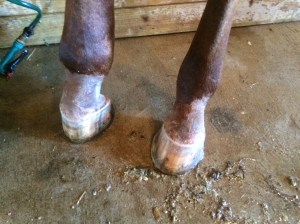
Chance has always been fighting “scratches” on his back legs.  Frustrating, painful, and never seem to completely go away.  Could scratches have caused this?  My thoughts- scratches allowed bacteria to enter the leg, the infection settled on the DDFT sheath and caused the current flare up.  Below is some research I found on possible conditions due to scratches that caused similar symptoms Chance had been experiencing.

CHRONIC PROGRESSIVE LYMPHEDEMA (CPL) due to Scratches

A condition characterized by progressive swelling, hyperkeratosis and fibrosis of distal limbs has been characterized in Shires, Clydesdales and Belgian Draft horses and unfortunately affects numerous horses within these breeds. The disease has also been recognized in Gipsy Vanners; however, only a few horses have been evaluated at this point of time. This chronic progressive disease starts at an early age, progresses throughout the life of the horse and often ends in disfigurement and disability of the legs, which inevitably leads to the horse’s premature death. The pathologic changes and clinical signs closely resemble a condition known in humans as chronic lymphedema or elephantiasis nostras verrucosa. The condition has therefore been referred to as chronic progressive lymphedema (CPL). The lower leg swelling is caused by abnormal functioning of the lymphatic system in the skin, which results in chronic lymphedema (swelling), fibrosis, decreased perfusion, a compromised immune system and subsequent secondary infections of the skin.

The clinical signs of this disease are highly variable. It is often first addressed as a marked and “therapy-resistant” pastern dermatitis (scratches). The earliest lesions, however, are characterized by skin thickening, slight crusting and possible skin folds in the pastern area. While readily palpable, these early lesions are often not appreciated visually as the heavy feathering in these breeds covers these areas. Upon clipping of the lower legs, it becomes obvious that the lesions are far more extensive than expected. Secondary infections develop very easily in these horse’s legs and usually consist of chorioptic mange and/or bacterial infections. Pigmented and non-pigmented skin of the lower legs are affected. Appropriate treatment of the infections (pastern dermatitis) is not successful as underlying poor perfusion, lymphedema and hyperkeratosis in association with the heavy feathering present perfect conditions for repetitive infections with both chorioptic mange as well as bacterial infections. Recurrent infections and inflammation will enhance the lymphedema and hence, the condition becomes more chronic. As a result, the lower leg enlargement becomes permanent and the swelling firm on palpation. More thick skin folds and large, poorly defined, firm nodules develop. The nodules may become quite large and often are described as “golf ball” or even “baseball” in size. Both skin folds and nodules first develop in the back of the pastern area. With progression, they may extend and encircle the entire lower leg. The nodules become a mechanical problem because they interfere with free movement and frequently are injured during exercise. This disease often progresses to include massive secondary infections that produce copious amounts of foul-smelling exudates, generalized illness, debilitation and even death.

TREATMENT/MANAGEMENT

Please keep in mind that none of these treatments listed below will “heal” chronic progressive lymphedema (CPL). However, a rigorous management following our suggestions below will assist you to slow down the process and even make some of the nodular lesions disappear. Your horse will need this management the rest of its life.

• Clipping of the feathers
Long and dense feathering makes management of lymphedema more difficult. We highly recommend clipping the feathers and keep them short, if horses are not presented at shows. If you have a show horse, we still recommend to clip the feathers to initiate a rigorous treatment. As the skin condition improves and the edema is reducing – you may have a better chance to keep the horse’s legs in better condition by. careful repetitive treatment, while the feathering is growing back. The feathers are usually back to their original length in about 10-12 months.

• Treatment of skin infections
Progression of lymphedema is also associated with deposition of fibrous tissue and formation of fibrotic nodules.. As a result, these horses have a poor blood circulation and immune response in the skin of their legs. They tend to built up a thick keratin layer. The long feathering further occludes the skin surface, which then remains humid. These factors provide the perfect culture environment for infectious pathogens. This explains why horses with CPL constantly battle recurrent infections with mites (Chorioptic mange) and bacterial infections (Staphylococcus, Dermatophilus).

Horses with CPL should consistently be treated against reinfestation of mites and bacteria:

Topical treatments:

• Careful washing, cleaning and drying of the legs on a routine basis is essential. Horses with long feathering may require blow-drying of their legs. We recommend using a product manufactured by HydroSurge Inc. ( http://www.hydrosurge.com ) called Apricot Sulfur Skin Treatment Shampoo.

• Frontline spray to treat chorioptic mange (do not use Frontline on pregnant and nursing mares)

• The best and most economical topical treatment is to find a source of wettable sulfur powder (“flowers of sulfur”). This can usually be found through a vineyard supply or at your local nursery (certain “rose dust” preparations). Mix this powder with mineral oil in to form a creamy paste. You can mix a moderate amount in a plastic lidded container or glass jar so that you have enough to last 2-4 weeks at a time. Apply this mixture to the ulcerated and/or affected areas of skin daily. This preparation is the best and most economical topical treatment we have found. You can use it indefinitely. Sulfur is safe to use in pregnant mares.

Systemic antiparasitic treatment: Frequent ivermectine treatment will also assist to keep the mites away.

• Exercise
Regular exercise is crucial. It will increase the circulation and the lymph drainage.

• Manual Lymph-drainage
Manual lymph-drainage is regularly used in humans with lymphedema as long as there is no inflammation present within the tissue. MLD has been successfully used in horses with more acute lymphedema, but has not been established yet in horses with progressed CPL. A massaging coldwater stream may assist a massage. It is important to dry the skin before applying anything else after massage and rinsing. If the feathers were not clipped this may take a long time and you may have to use a hair dryer. Your horse may become more compliant to this treatment as swelling reduces over time

• Bandaging and stockings
We have some limited experience with using special bandages developed for people with lymphedema. For horses, which always move around, “short-stretch” bandages should be used (example: Rosidal ®). Short stretch bandages have been successfully used in three horses with clipped feathering; but bandaging was not as successful on horses with long feathers. Of course it is crucial to have very good padding and keeping the bandages fairly tight. If tolerated, the best results will be achieved by keeping the bandages on 24/7. Of course they need to be redone at least every other day – better every day to control the legs. At first, there will be oozing from the lymphedema through the skin – so the bandages will get wet and have to be changed every day. With the reduction of the edema – this will stop. If the horse is only walked quietly the bandages can be left on for the exercise; very likely the legs have to be rewrapped after the exercise as the swelling will somewhat reduce. For more exercise it may be better to take the bandages off, use working bandages and then switch back to the short–stretch bandages after work. Again make sure the skin is dry when you rewrap.

After the edema has been reduced by using bandages – stockings are used for people to maintain avoid recurrence of lympedema. The use of such stockings in horses are currently under investigation.

It should be noted that horses suffering from CPL often are susceptible to reapeated bouts of “Thrush”. Consequently, thorough and routine foot trimming care is an essential part of the health care management for these horses.
IMG_9814

“Ask him what he wants…you will know what to do from there.”

When I arrived at the farm I was greeted by those familiar big brown eyes and a whinny.

I brought him out of his stall and gave him a bath.  He has always loved to be groomed and bathed, even if he is apprehensive to walk into the wash stall. After his bath, we went outside for him to graze and get some sunshine.  When we walked inside the barn, I stopped him and looked into his eyes and asked him, “do you want to keep trying to get better or are you ready to give up?”  He just looked at me.  A lump immediately formed in my throat.  He nuzzled me and rubbed against me.  I said again, “Do you want to keep fighting?”  He shook his head up and down! I swear to you!  This actually happened!

The decision was made, we would keep on fighting as long as we were able to keep him comfortable.  There was nothing I wanted more than to bring him home with me, let him live out the last days of his life pain-free, and with me by his side.

This was his turn.  He had always done what I asked of him- lessons, moving stables and even cities, and he was patient while I was in school- and it was his turn for me to make it about him.  For Chance to get every ounce of my time and for me to fight for him!

IMG_1795

Road blocks


IMG_1892


The first round of injections provided Chance with some relief, in his ability to move around and the swelling went down a bit, but that only lasted about a week.  At about day 8, Chance was swollen again and 3 legged lame.  Thankfully, a family friend of the farms owner called me.  She explained that the farrier was out shoeing one of the horses and saw Chance’s leg, and when he arrived to shoe her horses, he expressed his concern.  I immediately contacted Vet4 an he was out the following day.

Vet4 injected the masses again as a temporary fix, until we could make some decisions.  The ultrasound showed that the masses were the exact same as they were in the first ultrasound- they hadn’t increased or decreased in size.

Later that evening, Vet4 and I had a lengthy conversation about where to go from here.

We discussed the options again, at length.  We could do an MRI to gain more insight into what is happening with that leg, go in with an Arthroscope and clean it out, or look into Stem Cell Therapy.

Well, I wasn’t comfortable putting Chance under anesthesia…he was too old and too frail.  Plus, he could break a leg or a hip going down.  So, that ruled out the MRI (unless I could find a standing one) and the surgery.  The Stem Cells would run about $3000.00, plus he would need to goto the hospital to have the procedure done.

I took the night to think it over, and stayed up until sunrise reading as much as I could on leg issues, the different options vet4 and I had discussed, and other potential causes.

That next morning, I received a call that Chance was worse.  Vet4 was out of town due to an emergency, so I called Vet3.  She got out to the farm immediately.

Vet3 gave Chance Surpass topical to put on the leg, Banamine, Ulcer Guard, and continued with the Prevacox to keep him comfortable.

I asked her what she thought about the options- she felt, as I did, the surgery wasn’t a good idea and that an MRI should only be done without sedation.

I called Vet4 and we spoke about the current situation.  What else is going on? He suggested changing the course and trying different diagnostics.  He explained that TSMs (Tendon Sheath Masses) can cause swelling and pain, but they are usually relieved by the injections.  The ultrasounds showed that his suspensory tendon and ligaments looked good.  Could this be an infection? Soft tissue damage? A bone issue?

I asked him if he felt moving forward with more tests was a bad thing…was I being cruel keeping Chance alive like this?  Something that had been weighing on me from the start.  And what Vet4 said, empowered me to continue down the path I initially felt in my gut to be the right decision.  He said, “I am not the kind of person to ever give up on someone or something.” I asked if we were able to manage his pain adequately and make sure he was comfortable and he said, yes.  He advised me to “make a decision based on the horse” and “not to listen to the opinions of everyone else”.

The next day, I cleared my schedule, and headed to the farm.


Coming Home to Love & Peace

Chance was able to come home a week later.  Sam & John went to pick him up at the hospital. However, upon arriving, they soon found out that Chance did not want to get on the trailer.  Sam later told me that one of my sweatshirts was in the truck, so she brought it out and let him smell it- he finally loaded.

I got his stall ready- tons of fresh shavings, hay, a new water bucket…

The moment he got off of the trailer he was shaking!  I gave him a warm bath and let him out in a small, flat paddock so he could be in the sunshine.

This is what happened when I let him out!  He did something he had not been capable of doing for months and months, if not longer.

Answers

Vet4 came out immediately.  I was beyond grateful!

He did an ultrasound of the back right leg and called me.  He found that Chance has Chronic Cellulitis and that there was Vascular constriction, and masses on the tendon sheath between the superficial and deep tendon sheaths.  The Doppler showed good blood flow and a thickening of the synovial lining. Hoof testers- Negative

We spoke about my opinions- MRI, Arthroscopic surgery, Regional Diffusion, Cold Compression Therapy, Nerve Block Injections, Steroid Injections

We decided  to try the Steroid Injections into the 3 Synovial masses to hopefully reduce the size and thickening.  Thus allowing us to see behind the masses to see what is actually happening.

Injections were into the Proximal Digital Flexor Tendon Sheath with 6mg Betamethasone and d100mg of Amikacon. Leg was covered with SSD and DMSO and bandaged.

Once injected, cold compression therapy for about 5 days twice a day and stall rest. Banamine daily.

The Guessing Game

IMG_7563The month passed by slowly….I kept hitting a brick wall over and over again…with each diagnostic test we ran.

Vet2: This was Chance’s vet for many years and where Chance lived the summer I moved home.  Vet1 was used because of connivence and due to being the vet of the owner of the farm.   I called Vet2, desperate, and she came out to see him.  Vet2 had always been amazing with Chance- kind, calm, and seems to act on intuition in conjunction with science.  She ran a CBC, tested for Cushings, Lymes, an did x-rays on the back right leg.

RESULTS:

* Metabolic Syndrome- Cornell

GLUCOSE: 10mg/dl

LIPEMIA: 8mg/dl

HEMOLYSIS: 1mg/dl

ICTERUS: 2mg/dl

*Endocrinology

ACTH endo 21.4 pg/ml

INSULIN 15.22 uIU/ml

THYROXINE T4 baseline 0.77 ug/dl

*Lyme Mitpix- Cornel

OspA Value 1253- Equivocal

OspC Value 79- Negative

OspF Value 592- Negative

Temp: 99.1, HR: 42, RR: 12, No murmur

Received Potomac Rabies and Stanozanol 4ml 7 vit B12

The X-rays of his back right showed nothing that could cause his flare-ups.  While his thyroid was a bit low, it was not clinically significant.  He was negative for Lymes and Cushings.  Next step, aside from pain management, is to call Vet3- the holistic approach.

Horse's Leg

Tendon Injury Handbook

The Call

One day I received a call that I needed to come out and see Chance because he wasn’t doing well and, according to Vet1, he needed to be put down.  I quickly canceled my appointments and got on the road.  The 4 hour drive was excruciating…once we finally arrived, my heart broke.

My old guy was skin and bones.  His back right leg was swollen and he wasn’t able to bare weight on it.  His eyes were dull.  He could barely walk, and when he did, he wouldn’t put any weight on the right hind.  There were even times when he would do this “neurologic dance” (coined by the farm’s owner and C’s other mom) where he would lift up his back right leg and hop!

But when he saw me pull up, he whinnied.  He was excited to see me.  He ate the pureed carrots but refused the apple puree (only my mom would make this for him).  He wasn’t ready to die.


I called the vet who said that Chance should be put down to see what his thoughts were.

Me:   What do you think is going on with C?

Vet1: I think he is ready to be put down. 

Me: Because of what?

Vet1: Lymphangitis

Me: Okay, well, what is the cause of the Lymphangitis? Did you run any diagnostics?

Vet1: No

Me:  I would like to manage his pain and run a few tests before making that decision.  (I reviewed the research that I had done and asked where to go from there.) Could it be EPM?

Vet1: “It’s not EPM”

Me: How about Cushings? Or Laminitis? Lymes?

Vet1: Nope. Just old age.

Me: The journals I read said that some of the symptoms…(I was cut off)

Vet1: “I don’t care what journals you read!  It’s a bunch of…”

Me: One was from VA Tech actually…


Well, that was that! Vet1 did not completely lack compassion but he was more “old school” I guess one could say.  He was well respected in the horse world and up until this point, he did the job I needed. But I will say I was disheartened by our conversation.  

I decided to contact the other vets that I had worked with in the past, who also knew Chance, and get second, third, fourth opinions.  

IMG_8299IMG_8296IMG_8293IMG_8300