
ker.com/equinews/white-line-disease-requires-early-diagnosis-and-aggressive-treatment/
Tag Archives: medical
Dealing With Equine Colic: Here are 33 Do’s and Don’ts – The Horse
What should you do (or not do) if your horse shows signs of colic? And how do you prevent colic in the first place? Find out from our veterinary experts.
— Read on thehorse.com/features/dealing-with-equine-colic/
Botulism: It Takes Less to Kill a Horse than a Mouse!
|
|
|
Equine Vaccination Cheat Sheet – The Horse
Equine Vaccination Cheat Sheet – The Horse
— Read on thehorse.com/137994/equine-vaccination-cheat-sheet/

Wobbler Syndrome: Proof At Last!

Fat Little Donkey
I have been desperately trying to get my miniature donkey, Lucky, to drop some lbs. The thing with Lucky- he literally gained weight overnight. One day he was a skinny mini and the next he had a potbelly. I was really concerned that the weight suddenly appeared and had the vet run a heptic panel to ensure he wasn’t experiencing some sort of liver dysfunction. Sort of like how humans can develop Ascites when they have liver related disease. Anyways, his blood work came back and all was okay….he was just fat!
Unlike horses, donkeys develop “fat deposits” around their neck, abdomen, and butt and even once the weight has been lost the deposits stay for life!
The Dangers of Obesity in Donkeys
According to the Scarsdale Vets;
“Obesity increases the risk of developing hyperlipaemia and laminitis, both of which can be fatal. Prevention of obesity is better than cure, because rapid loss of condition in overweight donkeys can trigger hyperlipaemia.
Hyperlipaemia is a condition in which triglycerides (fats) are released into the circulation which can result in organ failure and death unless treated rapidly. The early signs of dullness and reduced appetite can be difficult to detect. Hyperlipaemia can be triggered by anything that causes a reduction in food intake e.g. stress, transport, dental disease.
Laminitis is a condition in which there is inflammation in the laminae of the foot that connect the pedal bone to the hoof wall. This can progress to rotation or sinking of the pedal bone within the foot. The cause is not fully understood and many factors are involved but obese animals are more prone to develop the disease.”
Equine Metabolic Syndrome: “Overweight donkeys often develop a fat, crest neck and fat pads around their tail base. When this occurs the donkey can develop a metabolic disease known as ‘Equine Metabolic Syndrome’. This causes insulin resistance and increased levels of blood glucose (blood sugar) in the blood stream. In equids this can lead to recurrent episodes of laminitis or founder. This disease involves inflammation of the white lining or laminar junctions of the feet, extreme foot pain and difficulty walking. In severe cases this can also cause changes in the bone of the foot and hoof wall” (Yarra Ranges Animal Clinic)
How To Help Your Donkey Lose Weight Safely
- Use a muzzle
- Limit grazing
- Ask your vet to do blood work to ensure your donkey is healthy
- Have the dentist come out and examine the donkey’s teeth
- Engage in an exercise routine
Donkey Related Resources and Information
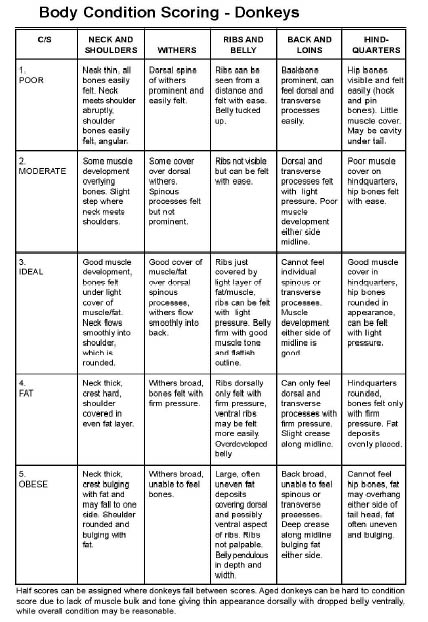
DonkeyBCS3posterDonkey Body Scoring by Dr_ Judy Marteniuk
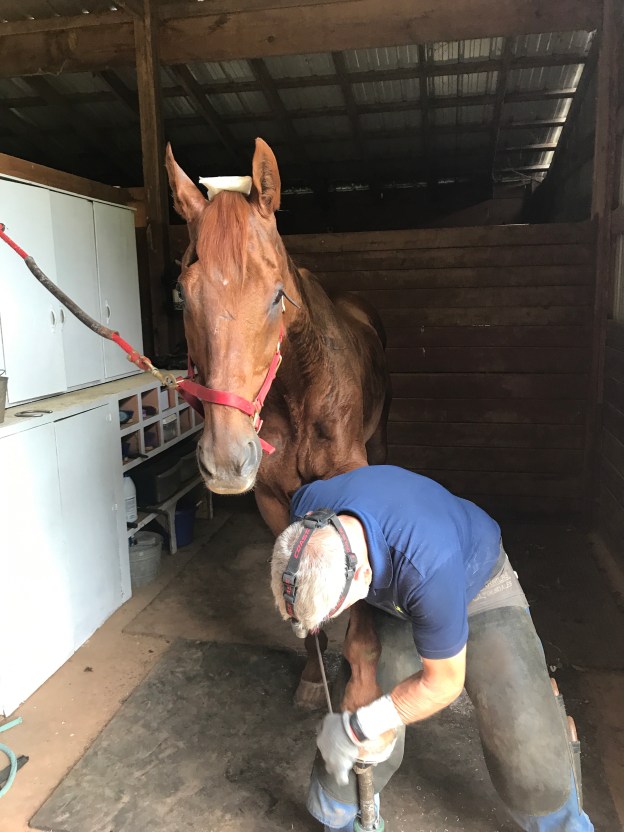
Ice Packs & Horseshoes
When it’s hot outside and you are getting your feet done, it’s imperative to have an ice pack on your head.


Gut Check: A New View from the Inside
By Sushil Dulai Wenholz

Researchers are testing an endoscopic camera, contained in a small capsule and placed directly into the horse’s stomach, to gather imagery of the equine intestinal tract. The capsule sends images to an external recorder, held in place by a harness.
Courtesy, Western College of Veterinary Medicine
Traditionally, veterinarians’ and researchers’ view of the equine intestinal tract has been limited. Endoscopy (inserting through the horse’s mouth a small camera attached to a flexible cable to view his insides) allows them to see only as far as the stomach. While ultrasound can sometimes provide a bigger picture, the technology can’t see through gas—and the horse’s hindgut (colon) is a highly gassy environment.
These limitations make it hard to diagnose certain internal issues and also present research challenges. But the view is now expanding, thanks to a “camera pill” being tested by a team at the University of Saskatchewan, led by Julia Montgomery, DVM, PhD, DACVIM. Dr. Montgomery worked with a multi-disciplinary group, including equine surgeon Joe Bracamonte, DVM, DVSc, DACVS, DECVS, electrical and computer engineer Khan Wahid, PhD, PEng, SMIEEE, a specialist in health informatics and imaging; veterinary undergraduate student Louisa Belgrave and engineering graduate student Shahed Khan Mohammed.
In human medicine, so-called camera pills are an accepted technology for gathering imagery of the intestinal tract. The device is basically an endoscopic camera inside a small capsule (about the size and shape of a vitamin pill). The capsule, which is clear on one end, also contains a light source and an antenna to send images to an external recording device.
The team thought: Why not try it for veterinary medicine?
They conducted a one-horse trial using off-the-shelf capsule endoscopy technology. They applied sensors to shaved patches on the horse’s abdomen, and used a harness to hold the recorder. They employed a stomach tube to send the capsule directly to the horse’s stomach, where it began a roughly eight-hour journey through the small intestine.
The results are promising. The camera was able to capture nearly continuous footage of the intestinal tract with just a few gaps where the sensors apparently lost contact with the camera. For veterinarians, this could become a powerful diagnostic aid for troubles such as inflammatory bowel disease and cancer. It could provide insight on how well internal surgical sites are healing. It may also help researchers understand normal small-intestine function and let them see the effect of drugs on the equine bowel.
The team did identify some challenges in using a technology designed for humans. They realized that a revamp of the sensor array could help accommodate the horse’s larger size and help pinpoint the exact location of the camera at any given time. That larger size also could allow for a larger capsule, which in turn could carry more equipment—such as a double camera to ensure forward-facing footage even if the capsule flips.
With this successful trial run, the team plans additional testing on different horses. Ultimately, they hope to use the information they gather to seek funding for development of an equine-specific camera pill.
“From the engineering side, we can now look at good data,” Dr. Wahid explained. “Once we know more about the requirements, we can make it really customizable, a pill specific to the horse.”
This article was originally published in Practical Horseman’s October 2016 issue.

Science: When Horses Are in Trouble They Ask Humans for Help, Finds New Study
Research Fellow Monamie Ringhofer and Associate Professor Shinya Yamamoto (Kobe University Graduate School of Intercultural Studies) have proved that when horses face unsolvable problems they use visual and tactile signals to get human attention and ask for help.
The study also suggests that horses alter their communicative behavior based on humans’ knowledge of the situation. These findings were published in the online version of Animal Cognition on November 24.
Communicating with other individuals in order to get information about foraging sites and predators is a valuable survival skill. Chimpanzees, who are evolutionarily close to humans, are especially skilled at understanding others. Studies suggest that chimpanzees distinguish the attentional states of other individuals (seeing or not seeing), and they are also able to understand others’ knowledge states (knowing or not knowing).
Some domestic animals are also very good at communicating with humans—recent studies of dogs have revealed that they are excellent at understanding various human gestures and expressions. It is thought that these abilities were influenced by the domestication process.
Since they were domesticated 6000 years ago, horses have contributed to human society in various shapes and forms, from transport to companionship. Horse-riding has recently drawn attention for its positive effects on our physical and mental health. The high social cognitive skills of horses towards humans might partially explain why humans and horses have a collaborative relationship today. However, the scientific evidence for this ability is still scarce.
In this study, scientists investigated horses’ social cognitive skills with humans in a problem-solving situation where food was hidden in a place accessible only to humans. The experiment was carried out in a paddock belonging to the equestrian club at Kobe University, where eight horses from the club participated with the cooperation of their student caretakers.
For the first experiment, an assistant experimenter hid food (carrots) in a bucket that the horse could not reach. The researchers observed whether and how the horse sent signals to the caretaker when the caretaker (unaware of the situation) arrived. The horse stayed near the caretaker and looked at, touched, and pushed the caretaker. These behaviors occurred over a significantly longer period compared to cases when they carried out the experiment without hiding the food.
The results showed that when horses cannot solve problems by themselves they send signals to humans both visually (looking) and physically (touching and pushing).
Building on these results, for the second experiment they tested whether the horses’ behavior changed based on the caretakers’ knowledge of the hidden food. If the caretaker hadn’t watched the food being hidden, the horses gave more signals, demonstrating that horses can change their behavior in response to the knowledge levels of humans.
These two experiments revealed some behaviors used by horses to communicate demands to humans. They also suggest that horses possess high cognitive skills that enable them to flexibly alter their behavior towards humans according to humans’ knowledge state. This high social cognitive ability may have been acquired during the domestication process.
In order to identify the characteristic that enables horses to form close bonds with humans, in future research the team aims to compare communication between horses, as well as looking more closely at the social cognitive ability of horses in their communication with humans.
By deepening our understanding of the cognitive abilities held by species who have close relationships with humans, and making comparisons with the cognitive abilities of species such as primates who are evolutionarily close to humans, we can investigate the development of unique communication traits in domesticated animals.
This is connected to the influence of domestication on the cognitive ability of animals, and can potentially provide valuable information for realizing stronger bonds between humans and animals.
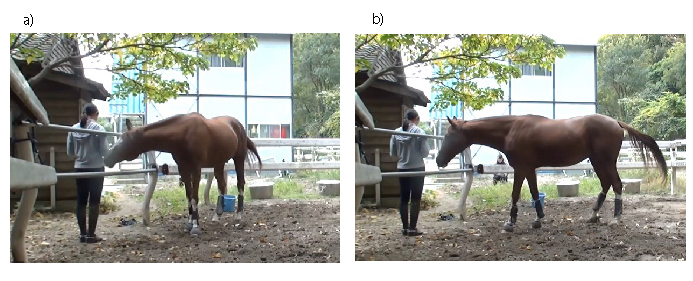
Figure 1. Horse making demands: The horse a) lightly pushes and b) looks at the caretaker standing outside the paddock. Food is hidden inside one of the two silver buckets behind them. When horses cannot obtain this food by themselves, they give humans visual and tactile signals.

Photo provided by Monamie Ringhofer.
Figure 2. Horse with caretaker at the equestrian club

Fall Fever
Today Chance had swelling of his back right fetlock. He had a fever around 104 and didn’t eat his feed. His eyes were dull and he was lethargic. He wasn’t limping but was walking slower than normal (he usually runs to the paddock or back to the barn). I decided, due to the Lymphingitis flare up on his back right leg, I would give him a shot of 5 mls (or 5 cc) of Banamine and wrap his leg. Once the medication set in, I would bring him in to give him a bath (it was 80 degrees today). So, that is what I did. By the time he was back at the barn he was covered in sweat. I cold hosed him and drenched the wrap in cool water and let him roam around the barn.
Thankfully, the vet was able to meet me at her veterinary practice so that I could pick up Baytril and more Banamine. Since Chance just had Lyme Disease (and had finished his medication less than a week ago), we are not 100% if this is a Lyme reaction or something else. The plan is to administer 25 cc of Baytril either orally, in his feed, or via IV for 6 days and Banamine 10 mls (or a 1000 lbs) twice a day for 3 days. The vet suggested that I do 5 cc of Banamine if his fever remains between 101-103 degrees and 10 cc if his fever is 103 degrees or above. During this time I will begin Prevacox- one 1/4 of a tablet once a day. After 3 days, I will discontinue the Banamine and continue the Prevacox. If his fevers are not down in two days, I will continue the Baytril but start the doxycycline as it maybe a Lyme disease symptom.
While researching Lyme Disease, I found that many people do two+ months of doxycycline instead of 30 days to ensure the disease has been erraticated completely. However, since Chance had shown such improvement after 30 days, I decided to not do another month. Maybe I should have…
However, Chance had similar symptoms when we found a small laceration in the DDFT tendon of his back left hind- swelling, Lymphingitis, fever, lethargy, no appetite, etc. If he does have an issue with his tendon I will most likely do another round of Stem Cell treatments which proved to be helpful last time. Thankfully I stored his stem cells in a Stem Cell Bank (via Vet-Stem) and can easily have them shipped.

Recommended Equine Professionals and Services
True North Equine Vets www.truenorthequinevets.com 540-364-9111
Genesis Farriers: Dave Giza www.genesisfarriers.com 571-921-5822
Ken Pankow www.horsedentistvirginia.com 540-675-3815
Full Circle Equine www.fullcircleequine.com 540-937-1754
Farriers Depot: (Farrier related supplies) www.farriersdepot.com 352-840-0106
StemVet (Stem cell acquisition and storage) www.vet-stem.com
SmartPak Equine Supplements www.smartpakequine.com
|
|
|
|
|
|
|
|
|
|
||
|
|
||
|
|
||

The Weather Outside is Frightful…
I walked outside to sit on my porch and enjoy the evening, when I realized that the time is fast approaching where I can not longer do so without bundling up first. I decided it was time to get ready for the winter months ahead especially for my equine friends.
I have included articles, lists, resources, etc to help you make sure you and your horse are ready for the dropping temperatures!
Preparing Your Horse for Winter
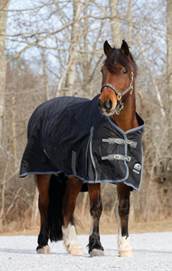
By: Dr. Lydia Gray
Hot chocolate, mittens and roaring fires keep us warm on cold winter nights. But what about horses? What can you do to help them through the bitter cold, driving wind and icy snow? Below are tips to help you and your horse not only survive but thrive during yet another frosty season.
Nutrition
Your number one responsibility to your horse during winter is to make sure he receives enough quality feedstuffs to maintain his weight and enough drinkable water to maintain his hydration. Forage, or hay, should make up the largest portion of his diet, 1 – 2 % of his body weight per day. Because horses burn calories to stay warm, fortified grain can be added to the diet to keep him at a body condition score of 5 on a scale of 1 (emaciated) to 9 (obese). If your horse is an easy keeper, will not be worked hard, or should not have grain for medical reasons, then a ration balancer or complete multi-vitamin/mineral supplement is a better choice than grain. Increasing the amount of hay fed is the best way to keep weight on horses during the winter, as the fermentation process generates internal heat.
Research performed at the University of Pennsylvania School of Veterinary Medicine showed that if during cold weather horses have only warm water available, they will drink a greater volume per day than if they have only icy cold water available. But if they have a choice between warm and icy water simultaneously, they drink almost exclusively from the icy and drink less volume than if they have only warm water available. The take home message is this: you can increase your horse’s water consumption by only providing warm water. This can be accomplished either by using any number of bucket or tank heaters or by adding hot water twice daily with feeding. Another method to encourage your horse to drink more in winter (or any time of the year) is to topdress his feed with electrolytes.
Exercise
It may be tempting to give your horse some “down-time” during winter, but studies have found that muscular strength, cardiovascular fitness and overall flexibility significantly decrease even if daily turnout is provided. And as horses grow older, it takes longer and becomes more difficult each spring to return them to their previous level of work. Unfortunately, exercising your horse when it’s cold and slippery or frozen can be challenging.
First, work with your farrier to determine if your horse has the best traction with no shoes, regular shoes, shoes with borium added, shoes with “snowball” pads, or some other arrangement. Do your best to lunge, ride or drive in outside areas that are not slippery. Indoor arenas can become quite dusty in winter so ask if a binding agent can be added to hold water and try to water (and drag) as frequently as the temperature will permit. Warm up and cool down with care. A good rule of thumb is to spend twice as much time at these aspects of the workout than you do when the weather is warm. And make sure your horse is cool and dry before turning him back outside or blanketing.
Blanketing
A frequently asked question is: does my horse need a blanket? In general, horses with an adequate hair coat, in good flesh and with access to shelter probably do not need blanketed. However, horses that have been clipped, recently transported to a cold climate, or are thin or sick may need the additional warmth and protection of outerwear.
Horses begin to grow their longer, thicker winter coats in July, shedding the shorter, thinner summer coats in October. The summer coat begins growing in January with March being prime shedding season. This cycle is based on day length—the winter coat is stimulated by decreasing daylight, the summer coat is stimulated by increasing daylight. Owners can inhibit a horse’s coat primarily through providing artificial daylight in the fall but also by clothing their horse as the temperature begins to fall. If the horse’s exercise routine in the winter causes him to sweat and the long hair hampers the drying and cooling down process, body clipping may be necessary. Blanketing is then a must.
Health
There are a number of health conditions that seem to be made worse by the winter environment. The risk of impaction colic may be decreased by stimulating your horse to drink more water either by providing warm water as the only source or feeding electrolytes. More time spent inside barns and stalls can exacerbate respiratory conditions like “heaves” (now called recurrent airway obstruction), GI conditions like ulcers, and musculoskeletal conditions like degenerative joint disease. Control these problems with appropriate management—such as increasing ventilation in the barn and increasing turnout time—and veterinary intervention in the form of medications and supplements.
Freeze/thaw cycles and muddy or wet conditions can lead to thrush in the hooves and “scratches,” or, pastern dermatitis, on the legs. Your best protection against these diseases is keeping the horse in as clean and dry surroundings as possible, picking his feet frequently, and keeping the lower limbs trimmed of hair. Another common winter skin condition is “rain rot,” caused by the organism Dermatophilus congolensis. Regular grooming and daily observation can usually prevent this problem, but consult your veterinarian if your horse’s back and rump develop painful, crusty lumps that turn into scabs.
Winter Resources
Preparing your horse and barn for winter
Winter Nutrition Tips for Horses
Penn State: Winter Care for Your Horses
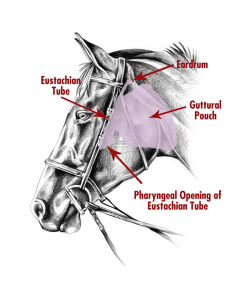
Guttural pouches: The hidden dangers in horses
An interesting article I came across about Guttural pouches in horses. Must read for those who work with or around horses.

Eyes Wide Shut
I had the opportunity to work with a “horse communicator” today. She was recommended to me by an equine vet who, after reading my blog, felt that I would be open to the idea, and introduced me to her via email. According to the vet, she often works with this particular equine communicator due to her ability to point out exactly where the horse’s issues are, allowing the vet to adjust/manipulate/treat the main issue.
I chatted with her at length a few days ago as she explained the process and we scheduled an appointment.
Today I gave her a call, as she explained, connecting remotely allows for the horse to be in his natural setting without the influence of an unknown person. That way the horse could be relaxed and the owner can observe, ask questions, and engage. So, that is what I did. She went onto explain that sometimes the horse needs energy work in order to open up to the process and that the horse must trust the process, her, and obviously, the owner.
I was asked to have questions ready to ask my horse, along with something I would like to tell him at the end of the session. (If you have been following this blog then you will know I had some difficulty narrowing down a couple of questions- I have a lot! 😉 ) She began connecting with Chance.
I will not be able to convey all the details of what was said, Chance’s reactions, or even mine…It is almost a blur… I wish I could.
I was asked to feel around Chance’s right forehead/eye area for a lump or bump. I did as I was asked and didn’t feel anything abnormal…but remembered he had a gash that was healing right above his right eye. She informed me that he had a “headache”. She continued to move over him and explained that his “energy” was “blocked” on his right side. This makes sense…Chance has a “swagger” at the walk- he pokes his butt to the side and has a twist on the back right leg (Chance’s swagger has gone up and down- it was worse when he had the tendon issues, resolved after stem cell injections, came back when he got EPM, went away ish, and came back with his Lyme). While she was working on his energy, I massaged Chance’s back, neck, hip, and shoulders. She went on to explain that Chance had some right shoulder pain. Thankfully, Chance allowed her to work on his jaw (he pretty much has TMJ), his head, his back, etc. The energy was “pouring out” even on the hind end which, if I recall correctly, is commonly seen on horses with head injuries.
This is where my one question came in…I wanted to know what happened to Chance when he came to my college. I didn’t give many details…I didn’t know many details but I always wondered what may have happened on Chance’s trip down to my college.
I had gone off to college in January and decided to have someone trailer Chance down (about 3 and a 1/2 hours) once I got settled and found a barn, etc. Two months later Chance was arrived at her new barn. Despite the cool March weather, he was covered in sweat and was visibly scared. I didn’t inquire too much since he was in one piece and I chalked up the sweating and fear to exactly that- fear and anxiety. However, as the months progressed, Chance began bucking and rearing while under saddle….this was really strange..When he had left home we were doing dressage and jumping and he was sound and calm. Once again, I chalked it up to being in a new place- a barn that hosted Friday night Bullbucking no less. I decided to switch to a different farm, one preferably without bulls, even though the show was awesome to go and see, and work with a trainer. Still the behaviors persisted and the episodes of lameness increased. The vet finally diagnosed Chance with arthritic changes in his back and suggested I no longer jump him. I decided that summer instead of bringing Chance home and have him endure another long trailer ride, to board him at my new vet’s farm. Chance had the summer to recuperate while under the care of an equine vet.
Anyways, after that summer, I decided to retire Chance for good. I would occasionally get home him to walk around, I still can and do today. But, that was the beginning of a chronic condition that was never given a diagnosis. Instead, Chance’s symptoms were treated as they came.
Back to my session with my very own horse whisperer..
Chance “showed” her what happened on his trip to college- a trailer wheel falling off the side of the road. His head hitting one side of the trailer and slamming the other side. The pain. The concussion. His neck and back becoming misaligned. His jaw coming out of position. His body compensating. He showed the decline of his once functioning body- starting with the hit on his head, to his jaw, and his neck. Down his neck and through his back towards his hips and down his legs. The wear and tear of his body. Chance stated that he is still angry with the person driving the trailer; he wasn’t ready to forgive. I have forgiven them. I have no doubt it was a mistake and that there was no ill intent. But, I am not the one feeling the pain that he is. I am not the one who went from a racehorse to a jumper to practicing dressage to retirement long before I should have. And like the “horse whisperer” said, she will “hold the forgiveness for him until he is ready.” I will do the same.
She spoke of his time on the racetrack. Chance was happy to hear that he was being remembered for who he once was, and will always be to me- a strong, beautiful and crazy talented 17.1 hand red-headed thoroughbred and not a “weak old man” as he put it. When asked what his name was during his time on the track, he said, “Hot Stuff”, which could be a nickname and not his actual race name.
At one point during Chance’s session he fell asleep; standing in an odd way- hind legs spread out. Suddenly, his body gave out and he caught himself from falling. This entire time his eyes were still closed! They remained closed for another minute after this. His body reacting to something, perhaps a shift in his energies, and all the while he was a a state of peace; trusting that nothing bad would happen to him.
The session lasted an hour and a half. Honestly, we could have continued because of all the “blockages” but decided to stop for the day and pick up again another day. I was told that the effects of the energy work or Reiki, would continued throughout the week and that he would be emotionally vulnerable. As the session wrapped up Chance apparently said that he was the lucky one because I found him all those years ago.
Energy Work and Reiki Resources
Reiki for Horses: Workshops, Training, Courses, and Resources
Reiki Related Research and Resources for Two and Four Legged Friends
Amorosa Equestrian Center in Ohio
Reiki Forum on Horse and Hound
Reiki Handout: Full history, explanation, and how to pictures
Equine Communication
Horse Forum: Horse Communicators
Head Trauma and Headaches in Horses
Symptoms of Equine Concussions
Trauma, Concussions or Other Brain injuries in Horses
How to Handle Horse Head Injuries
Helping Horses with Traumatic Brain Injuries

GRIT
Leave a reply
A while ago, one of my good girlfriends, sent me an article about perseverance; why some are able to withstand tremendous adversity while others can’t? The article referred to this concept of an individual’s strength to endure life’s obstacles, to succeed in the face of adversity, to remain positive and continue to move forward despite what is thrown ones way, as Grit. Those who are able to endure the obstacles-have it- and those who are unable to endure- don’t.
“In a recent article published by People in Aid, Scott Breslin argues that grit, and not just resilience, is a key component for aid workers. Grit is defined ‘as perseverance and passion for long-term goals. Grit entails working strenuously toward challenges, maintaining effort and interest over years despite failure, adversity, and plateaus in progress’ (Duckworth, et al. 2007: 1087-1088). Resilience instead is the human capacity to bounce back from difficult experiences.” (See more at: http://mindfulnext.org/aid-work-is-not-a-survival-contest/#sthash.OsqxZNnG.dpuf)
I can’t help but wonder if the concept of Grit may also apply to our four-legged friends? Because I am pretty sure that Chance has it. What makes living things able to remain positive and enthusiastic and continue to persevere despite being in tremendous pain?
I am truly humbled every time I look at Chance and I see a 25+ year old horse who has lived for years with painful flare-ups without a known cause…yet even at his absolute worse, he was still engaged in life…eating, whinnying, trying to run and play, giving kisses for treats…and now, after a year of ups and downs, triumphs and tribulations, stumbles and falls, medications and supplements, pokings and probings, needles and adjustments, samples and tests, and changes in just about every aspect of his life, he is finally in a healthy place! (He is no longer on pain medications daily. He maybe gets a dose a month or so. And does not have bouts of lameness or swelling).
What enables him to remain his calm and happy self despite all of the above? How was he not biting and kicking with every prick of a needle? How is his soul still gentle? How was he determined to walk up a small hill a year ago and now is able to run up that very same hill? He loves every second of his life. This may sound odd, but my old guy revels in every single second of his day.
He whinnies the moment I pull up into the driveway and greets me. He devours every ounce of grass he can. He often follows his friend and co-caretaker, John, to feed the chickens in the morning. He yells for his buddy, Lucky, when he can’t find him. He runs every where he is able to including back and forth from the house to the barn- racing with Lucky. He rolls around in the grass, the snow, or mud. He will lay in the green grass basking in the sunshine. He investigates everything around him. And each and every time he stumbles, or even falls, he gets right back up and tries again.
To me, that is the essence of Grit…to keep on trucking through life with a soft heart and grateful and determined soul.
Duckworth, A. Peterson, C. Matthews, M., Kelly, D. (2007) “Grit: Perseverance and Passion for Long-Term Goals”, Journal of Personality and Social Psychology, Vol. 92(6), 1087-1101.
 The Chances We Take