Tag Archives: Virginia

EQUINE BOTULISM: An unknown threat

Equine Botulism

Written by Dr. Tom Lenz on behalf of AQHA 

Few horse owners are aware of this disease which is a progressive, paralyzing disease that is 80-100% fatal in affected horses.  Botulism is sometimes referred to as “forage poisoning” in adult horses or “shaker foal syndrome” in foals. The disease is caused by a potent toxin that is produced by the bacterium Clostridium botulinum. This bacterium lives in the soil as well as the intestinal tract of many normal birds and mammals, including the horse. It produces dormant spores that can be found in 18.5% of soil samples tested in the United States. The disease is most prevalent in Kentucky, Ohio, Maryland, Pennsylvania, California, and Tennessee although it can occur in any state in the U.S. Clostridium botulinum produces several different toxins. Type A toxins are often implicated in human infant botulism and are most often found west of the Rocky Mountains. Types B, C, and D toxins are usually involved in cases of equine botulism, with Type B responsible for 85% of horse cases in the U.S.

Horses of any age are susceptible to botulism which may be initiated by one of three ways. In the case of “forage poisoning” the horse ingests toxins that are contaminating feedstuffs such as grain or hay. Feed contamination is most often due to putrefied carcasses of birds or rodents. A Type C botulism outbreak that killed a number of horses in California several years ago was traced back to hay that contained the infected carcass of a rabbit. The bacteria can also enter a horse’s body via contamination of a wound, especially a deep puncture wound. A good example is “Shaker foal syndrome” which is most frequently caused by the bacteria entering the newborn foal’s body through the foal’s moist navel. Something that can be minimized by dipping the foal’s navel in mild iodine solution soon after birth. The third method in which the disease can be initiated is by ingestion of the spores in the soil. The ingested spores activate in the horse’s intestinal tract where they produce potent toxins that are then absorbed. Regardless of the route, once the bacteria have entered the horse’s body they produce toxins that block transmission of nerve impulses to the horse’s muscles. This results in a progressive paralysis of all the major muscle groups and is concluded with paralysis of the diaphragm, which results in death. Once symptoms develop, death may ensue in several hours or take up to a week.

The disease is difficult to diagnose because it resembles several other medical conditions and diseases such as choke, colic, rabies, EPM, and sleeping sickness. Blood samples very rarely contain toxin and necropsy following the death of the horse usually does not provide a conclusive diagnosis. Because the bacteria often occur naturally in the horse’s intestinal tract, isolation of the organism from the sick horse’s intestine is not diagnostic.

Clinical signs of the disease in adult horses suffering from “forage poisoning” initially include loss of facial expression, a sleepy appearance, saliva drooling from the corner of the mouth, loss of tongue control and loss of tail tone. The horse’s appetite is good, but it has a great deal of difficulty in chewing food and appears to be “playing” in their feed and water buckets. As muscular weakness becomes more profound, the horse will experience muscle trembling, generalized sweating and labored breathing. A weakened, shuffling gait may develop and the horse may take stiff, short steps as if walking on eggs. Eventually, the horse goes down and death results due to paralysis of the respiratory muscles. “Shaker foal syndrome” is usually seen in foals one to two months of age but can develop as early as two weeks or as late as 8 months of age. Early signs in foals are similar to those seen in adults in that the foal shows generalized weakness, poor tail tone, and loss of tongue control. The foal will often dribble milk from the mouth and nostrils because of an inability to swallow. Because of muscle weakness, the foal will lie down frequently. When it does rise, it soon develops muscle tremors and collapses. Affected foals may die within 12 hours of exhibiting symptoms or may linger for as long as a week.

Botulism is usually fatal if left untreated. Prior to the advent of antitoxin, the death rate among affected foals was greater than 90%. With the use of antitoxins in conjunction with antibiotics and supportive therapy, the mortality rate can be reduced to less than 25%. Animals unable to swallow should be fed through a nasogastric tube and placed on IV fluids. Once the toxin produced by the bacteria is attached to the nerve ending it cannot be neutralized by the antitoxin. Therefore, early treatment is critical. Even with aggressive therapy, recovery is slow and may require up to two weeks before the affected horse recovers.

Because of the high death rate and the difficulty in diagnosing this disease, prevention through vaccination is critical. A Type-B Toxoid vaccine is available and is quite effective in preventing the disease. In areas where the disease is prevalent, pregnant mares should be initially vaccinated at the 8th, 9th and 10th month of gestation and thereafter at the 10th month of each pregnancy. Yearly vaccination of adults in areas where the disease frequently occurs is also recommended. If unable to vaccinate the mare prior to foaling, limited information suggests that foals vaccinated with the toxoid at 2 weeks, 4 weeks and at 8 weeks of age developed adequate protection, even in the presence of passive maternal antibodies. Currently, no licensed vaccines are available for preventing botulism due to Cl. botulinum types A or C or other subtypes of toxins. Cross-protection between subtypes does not occur.

As in all horse health issues, your local veterinarian is your best source of information.

ABOUT THE AUTHOR: Thomas R. Lenz, DVM, M.S., Diplomate of the American College of Theriogenologists, is a trustee of the American Horse Council, past chairman of AQHA’s research committee and past president of the American Association of Equine Practitioners. This article is provided courtesy of AAEP Alliance Partner, AQHA.

 
Reviewed and updated by original author in 2016.

When it rains…

ker.com/equinews/white-line-disease-requires-early-diagnosis-and-aggressive-treatment/

You’re Always with Me

Tonight I lost my best friend, Chance. The one who whinnied the moment my car pulled up, would run away and wait for me to catch him only to turn around and run away again. He made me laugh, knew all my secrets and nuzzled me when I was sad. He taught me about unconditional love and having a positive attitude despite circumstances. He nodded when I asked if he loved me and gave kisses to get treats. He’s the 17.1 hand horse who would stand behind me and fall asleep as I did my school work and would get upset if any horse got near me but would never hurt a fly. He let children hug him and dogs run into his stall and let me dress him up with flowers. He loved rolling in the snow, laying in the sunshine, and would light up the moment he saw me. I’ll miss playing in the barn on cold nights and curling up reading in his stall when he wasn’t feeling well. I’m thankful that he waited for me to get there tonight to say goodbye so I could hold his head in my lap and talk to him while he passed. There will never be a sweeter horse with a more gentle and pure soul. Thank you, Bubba, for being with me through it all- high school, college, the break ups, the losses, the good and bad days. You gave one hell of a fight for 30+ years. Lucky and I will miss you- there will never be another you❤️ #myfavoriteredhead #chancewetake #20yearstogether #thebesthorseintheworld #myheart

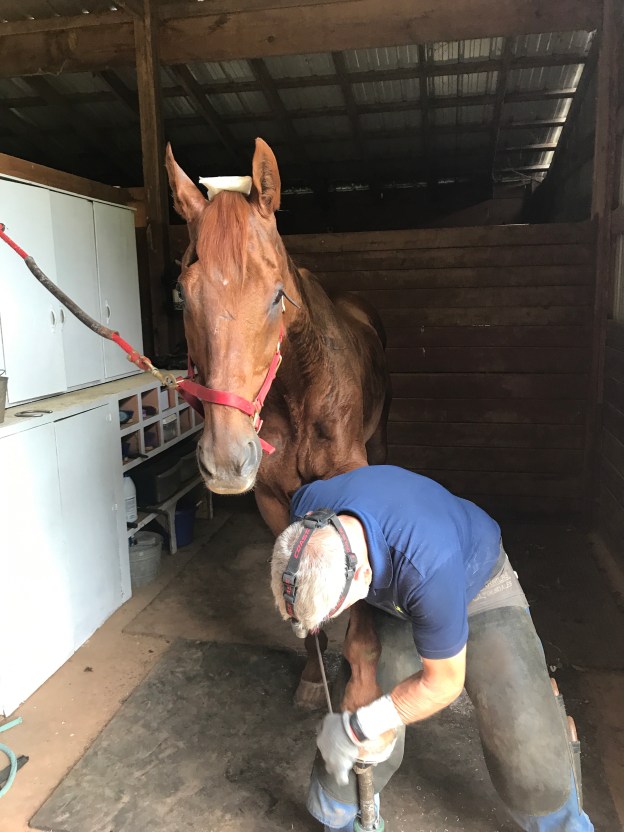
Ice Packs & Horseshoes

When it’s hot outside and you are getting your feet done, it’s imperative to have an ice pack on your head. 

Keeping Your Horse Safe on the 4th of July

When I think of the Fourth of July, I think of a fun time with my family and friends.   Typically, I am not thinking of the potentially hazardous effects the fireworks may have on my animals…. Why would you?  However, the truth is, the boom of the fireworks and the bright and sudden flashes can not only cause our horses severe anxiety but may also lead to injury.

Have you ever been in the dark and someone shines a flashlight in your eyes? What happens? You see spots.  You are momentarily unable to see.  Your balance gets thrown off and you can’t tell what is right in front of you.  Well, imagine a horse.  He is in a dark paddock and suddenly flashes of light momentarily blind him and add in the boom…recipe for disaster.  Not only can he barely see but he spooks from the noise.  The results could be anxiety to tripping and breaking a leg.   That being said, I have included some useful information below for ways to safeguard your horse this July 4th.

Fireworks and Horses: Preparing for the Big Boom | TheHorse.com

Horses and Fireworks

Immune Booster Leads to Infection?

For the past 6 weeks, my horse has been receiving Ozonetherapy to aid in his chronic back leg related issues- dermatitis (“scratches”), previous DDFT tendon laceration, a history of Lymphingitis, and the residual scar tissue from his DDFT injury.  Due to his age (27), he lacks proper circulation in his hind end which does not help him fight his pastern dermatitis.  


According to the American Academy of Ozonetherapy, Ozonetherapy is described as;

“Ozonotherapy is the use of medical grade ozone, a highly reactive form of pure oxygen, to create a curative response in the body. The body has the potential to renew and regenerate itself. When it becomes sick it is because this potential has been blocked. The reactive properties of ozone stimulate the body to remove many of these impediments thus allowing the body to do what it does best – heal itself.”

“Ozonotherapy has been and continues to be used in European clinics and hospitals for over fifty years. It was even used here in the United States in a limited capacity in the early part of the 20th century. There are professional medical ozonotherapy societies in over ten countries worldwide. Recently, the International Scientific Committee on Ozonotherapy (ISCO3) was formed to help establish standardized scientific principles for ozonotherapy. The president of the AAO, Frank Shallenberger, MD is a founding member of the ISCO3.”

“Ozonotherapy was introduced into the United States in the early 80’s, and has been increasingly used in recent decades. It has been found useful in various diseases;

  • It activates the immune system in infectious diseases.
  • It improves the cellular utilization of oxygen that reduces ischemia in cardiovascular diseases, and in many of the infirmities of aging.
  • It causes the release of growth factors that stimulate damaged joints and degenerative discs to regenerate.
  • It can dramatically reduce or even eliminate many cases of chronic pain through its action on pain receptors.
  • Published papers have demonstrated its healing effects on interstitial cystitis, chronic hepatitis, herpes infections, dental infections, diabetes, and macular degeneration.”


After doing research and speaking to one of my good friends, we determined that Chance’s flare up of Lymphingitis, after almost 3 years of not a single issue, could possibly be caused by his immune system’s response to Ozonetherapy.  Let me explain.

Chance suffers from persistent Pastern dermatitis (“scratches”) since I purchased him in 2000.  I have tried everything- antibiotics, every cream and ointment and spray for scratches, diaper rash ointment, iodine and vaseline mix, Swat, laser treatments, scrubs and shampoos, shaving the area, wrapping the area, light therapy…you name it, I have tried it.  So, when we began Ozonetherapy to help break down the left over scar tissue from his old DDFT injury, I noticed that his scratches were drying up and falling off.  We continued administering the Ozonetherapy once a week for about 6 weeks.  The improvement was dramatic!  

However, one day Chance woke up with severe swelling in his left hind leg and obviously, he had difficulty walking.  He received Prevacox and was stall bound for 24 hours.  The vet was called and she arranged to come out the following day.  The next morning, Chance’s left leg was still huge and he was having trouble putting weight on it.  I did the typical leg treatments- icing, wrapping.  The swelling remained.  I tried to get him out of his stall to cold hose his leg and give him a bath but he would not budge.  He was sweaty and breathing heavily and intermittently shivering.  So, I gave him an alcohol and water sponge bath and continued to ice his back legs.   I sat with him for 4 hours waiting for the vet to arrive.  He had a fever and wasn’t interested in eating and his gut sounds were not as audible.  He was drinking, going to the bathroom, and engaging with me.  I debated giving him Banamine but did not want it to mask anything when the vet did arrive.  

The vet arrived, gave him a shot of Banamine and an antihistamine and confirmed that Chance had a fever of 102 degrees and had Lymphingitis.  There was no visible abrasion, puncture, or lump… I asked the vet to do x-rays to ensure that he did not have a break in his leg.  The x-rays confirmed that there was no break.  The vet suggested a regiment of antibiotics, steroids (I really am against using steroids due to the short-term and long-term side effects but in this case, I would try anything to make sure he was comfortable) , prevacox, and a antacid to protect Chance from stomach related issues from the medications.  It was also advised to continue to cold hose or ice and keep his legs wrapped and Chance stall bound.  

The following day, Chance’s legs were still swollen but his fever had broken.  The vet called to say that the CBC had come back and that his WBC was about 14,00o. She suggested that we stop the steroids and do the antibiotic 2x a day and add in Banamine. I asked her if she could order Baytril (a strong antibiotic that Chance has responded well to in the past) just in case.  And that is what we did.  

Being as Chance had such a strong reaction to whatever it was, I did some thinking, discussing, and researching…first and foremost, why did Chance have such an extreme flare up of Lymphingitis when he was the healthiest he has ever been?  And especially since he had not had a flare up in 3+ years…plus, his scratches were getting better not worse.  The Ozonetherapy boosted his immune system and should provide him with a stronger defense against bacteria, virus’, etc.  So why exactly was he having a flare up?  And that is when it hit me!

In the past when Chance began his regiment of Transfer Factor (an all natural immune booster), he broke out in hives.  The vet had come out and she felt it was due to the Transfer Factor causing his immune system to become “too strong” and so it began fighting without there being anything to fight, thus the hives.  My theory- Chance started the Ozonetherapy and his body began to fight off the scratches by boosting his immune system.  As the treatments continued, his immune system began to attack the scratches tenfold.  This resulted in his Lymphatic system to respond, his WBC to increase, and his body temperature to spike.  Makes sense…but what can I do to ensure this is not going to happen again?  

My friend suggested attacking the antibiotic resistant bacteria by out smarting them…okay, that seems simple enough…we researched the optimal enviroments for the 3 types of bacteria present where Chance’s scratches are (shown in the results of a past skin scape test).  The bacteria – E. Coli, pseudomonas aeruginosa and providencia Rettgeri. The literature stated that PA was commonly found in individuals with diabetes…diabetes…SUGAR!  How much sugar was in Chance’s feed?  I looked and Nutrina Safe Choice Senior feed is low in sugar…so that is not it.  What else can we find out?  The optimal temperature for all three bacteria is around 37 degrees celsius (or 98.6 degrees fahrenheit), with a pH of 7.0, and a wet environment. Okay, so, a pH of 7.0 is a neutral.  Which means if the external enviroment (the hind legs)pH is thrown off, either to an acidic or alkaline pH, the bacteria will not have the optimal enviroment to continue growing and multiplying.  How can I change the pH?  

Vinegar!  An antimicrobial and a 5% acetic acid! And…vinegar is shown to help kill mycobacteria such as drug-resistant tuberculosis and an effective way to clean produce; it is considered the fastest, safest, and more effective than the use of antibacterial soap.  Legend even says that in France during the Black Plague, four thieves were able to rob the homes of those sick with the plague and not become infected.  They were said to have purchased a potion made of garlic soaked in vinegar which protected them.  Variants of the recipe, now called “Four Thieves Vinegar” has continued to be passed down and used for hundreds of years (Hunter, R., 1894).

I went to the store, purchased distilled vinegar and a spray bottle and headed to the farm.  I cleaned his scratches and sprayed the infected areas with vinegar.  I am excited to see whether our hypothesis is correct or not…I will keep you posted!


References & Information


Effect of pH on Drug Resistent Bacteriaijs-43-1-174

NIH: Drug Resistant Bacteria

Vinegar

Lymphatic Conditions

Horses Side Vet Guide

What does my horse’s CBC mean?

th

Nutrena SC Senior feed ingredience
The American Academy of Ozonetherapy

Hunter, Robert (1894). The Encyclopaedic Dictionary. Toronto: T.J. Ford. ISBN 0-665-85186-3.


Fall Fever

Today Chance had swelling of his back right fetlock.  He had a fever around 104 and didn’t eat his feed.  His eyes were dull and he was lethargic.  He wasn’t limping but was walking slower than normal (he usually runs to the paddock or back to the barn).  I decided, due to the Lymphingitis flare up on his back right leg, I would give him a shot of 5 mls (or 5 cc) of Banamine and wrap his leg.  Once the medication set in, I would bring him in to give him a bath (it was 80 degrees today).  So, that is what I did.  By the time he was back at the barn he was covered in sweat.  I cold hosed him and drenched the wrap in cool water and let him roam around the barn.

Thankfully, the vet was able to meet me at her veterinary practice so that I could pick up Baytril and more Banamine.  Since Chance just had Lyme Disease (and had finished his medication less than a week ago), we are not 100% if this is a Lyme reaction or something else.  The plan is to administer 25 cc of Baytril either orally, in his feed, or via IV for 6 days and Banamine 10 mls (or a 1000 lbs) twice a day for 3 days. The vet suggested that I do 5 cc of Banamine if his fever remains between 101-103 degrees and 10 cc if his fever is 103 degrees or above.   During this time I will begin Prevacox- one 1/4 of a tablet once a day.  After 3 days, I will discontinue the Banamine and continue the Prevacox.  If his fevers are not down in two days, I will continue the Baytril but start the doxycycline as it maybe a Lyme disease symptom.

While researching Lyme Disease, I found that many people do two+ months of doxycycline instead of 30 days to ensure the disease has been erraticated completely.  However, since Chance had shown such improvement after 30 days, I decided to not do another month.  Maybe I should have…

However, Chance had similar symptoms when we found a small laceration in the DDFT tendon of his back left hind- swelling, Lymphingitis, fever, lethargy, no appetite, etc.  If he does have an issue with his tendon I will most likely do another round of Stem Cell treatments which proved to be helpful last time.  Thankfully I stored his stem cells in a Stem Cell Bank (via Vet-Stem) and can easily have them shipped.